
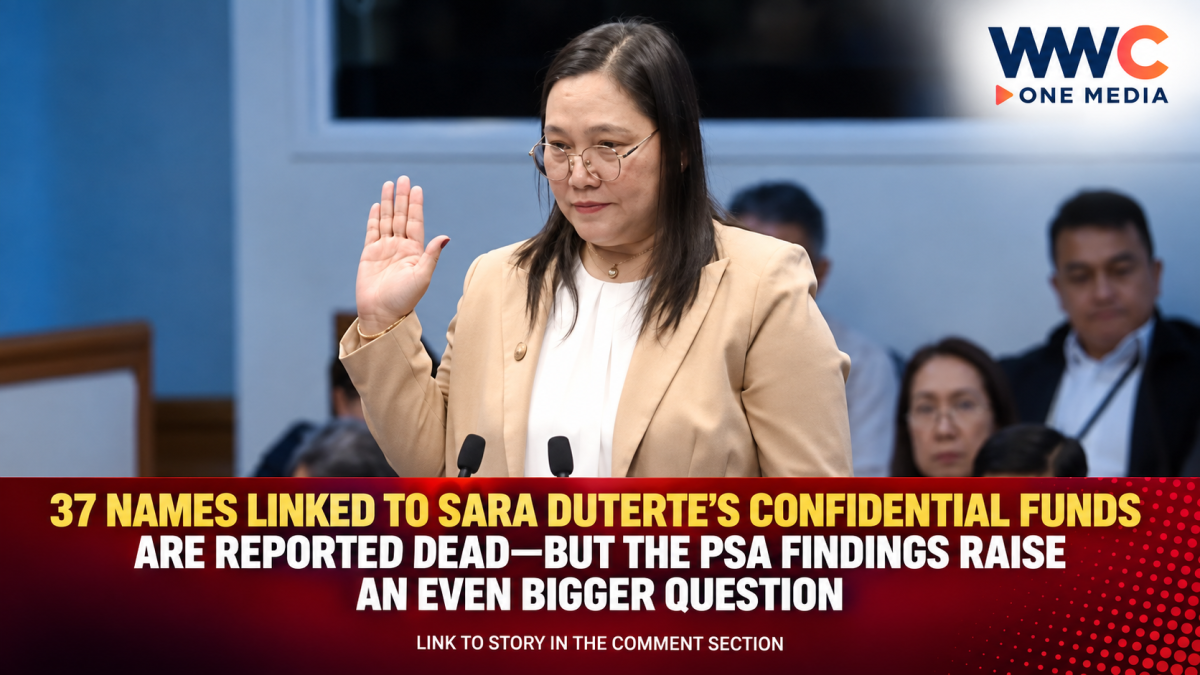
MANILA, Philippines — The scrutiny surrounding Vice President Sara Duterte’s controversial confidential funds intensified after a Philippine Statistics Authority (PSA) official testified that government records show 37 people listed as alleged recipients of confidential funds were already deceased.
PSA Assistant National Statistician Marizza Grande told the Senate impeachment court on Monday that the agency’s re-verification found death records corresponding to names appearing in documents submitted by the Office of the Vice President (OVP) and the Department of Education (DepEd).
Of the 37 names, 32 were matched with official death certificates from the PSA’s Civil Registry System, while another five names from the DepEd list also had official death certificates, Grande said.
The revelation came as prosecutors intensified their examination of the identities of people supposedly paid from confidential funds during Duterte’s tenure as vice president and education secretary.
A much bigger identity problem
The death records are only one part of the prosecution’s broader effort to establish whether the people named in acknowledgment receipts actually existed and received the money attributed to them.
The prosecution has identified 1,992 alleged recipients connected to the OVP’s ₱500 million confidential fund, while another 677 names were submitted in connection with the DepEd’s ₱112.5 million confidential fund, according to the proceedings reported by Inquirer.
Earlier PSA verification had already raised questions about hundreds of those names.
The Philippine News Agency reported that, among the 1,922 names submitted for verification, 1,322 had no birth record, while 1,593 had no death record and 1,456 had no marriage record in PSA databases. For the 677-name DepEd list, 405 had no birth record, 507 had no death record and 443 had no marriage record.
These findings do not by themselves prove that all such names were fictitious or that funds were stolen. They indicate that the names could not be matched to particular civil-registry records or, in the latest testimony, that some corresponded to people who had already died.
That distinction is crucial as the impeachment court weighs the prosecution’s evidence.
The “Mary Grace Piattos” question
The PSA testimony follows months of controversy over unusual names appearing on acknowledgment receipts used to document confidential-fund expenditures.
One of the most widely discussed names is “Mary Grace Piattos,” which prosecutors have cited as an example of a supposedly questionable recipient.
Other names that surfaced during the proceedings include Antonio Pagong, Timon Andrew Pusa, Shane Ngitngit, Xuniso P. Belat and May Pamana, among others.
Former OVP special disbursing officer Gina Acosta previously testified that she did not personally witness the alleged recipients receive the money. She said she relied on the OVP security official tasked with implementing the confidential activities and on the documents submitted to account for the expenditures.
The issue became even more complicated after National Bureau of Investigation forensic examiners reported that handwriting on 36 acknowledgment receipts could have been produced by as few as seven people.
The NBI said its examination raised questions about who actually prepared the receipts, although the bureau examined only the 36 documents specifically requested by the House panel.
₱612.5 million at the center of the impeachment case
The controversy forms part of the first impeachment article against Duterte.
The prosecution alleges the misuse, misappropriation and irregular liquidation of a combined ₱612.5 million in confidential funds — ₱500 million from the OVP and ₱112.5 million from DepEd during Duterte’s tenure as education secretary.
The House prosecution has said it will use PSA records, NBI findings and Commission on Audit documents to support its allegations concerning the funds.
The Commission on Audit has also become a major part of the case.
According to PNA reporting, the COA Commission Proper affirmed the disallowance of ₱73.287 million in OVP confidential-fund spending for December 2022 after Duterte and other officials appealed the earlier notice of disallowance.
The amount formed part of ₱125 million released and liquidated by the OVP in only 11 days in December 2022, according to testimony and documents presented in the proceedings.
Why the latest PSA testimony matters
The latest testimony could give prosecutors another way to challenge the authenticity and reliability of the liquidation documents.
If a person listed as receiving confidential funds was already dead at the time of the supposed transaction, the circumstances surrounding that payment would require further explanation.
However, the PSA testimony alone does not establish who created the acknowledgment receipts, who actually received the money or whether the names were aliases.
Those questions remain central to the impeachment proceedings.
GMA News previously reported that prosecutors intended to use PSA officials to establish that numerous names appearing on the receipts could not be verified through Philippine civil-registry records. Duterte’s defense, meanwhile, has indicated that it is prepared to explain the use of names and aliases appearing in the documents.
The trial moves closer to a key showdown
The PSA testimony comes as prosecutors approach the end of their presentation on the confidential-funds allegations.
Inquirer reported that only five prosecution witnesses remained scheduled for the confidential-funds portion of the case as of September 6. These included PSA Assistant National Statistician Marizza Grande, along with witnesses from DepEd, the police and COA.
The Senate impeachment court must ultimately determine what weight to give the PSA, NBI, COA and other evidence presented by the prosecution and how the defense responds to those allegations.
For now, the central question remains unresolved:
If dozens of names listed as confidential-fund recipients were either untraceable in civil records or corresponded to people already dead, who actually received the money — and where did the funds go?
That question is likely to remain one of the most closely watched issues as Duterte’s impeachment trial continues.
WWC ONE MEDIA J.M.S



Leave a Reply