
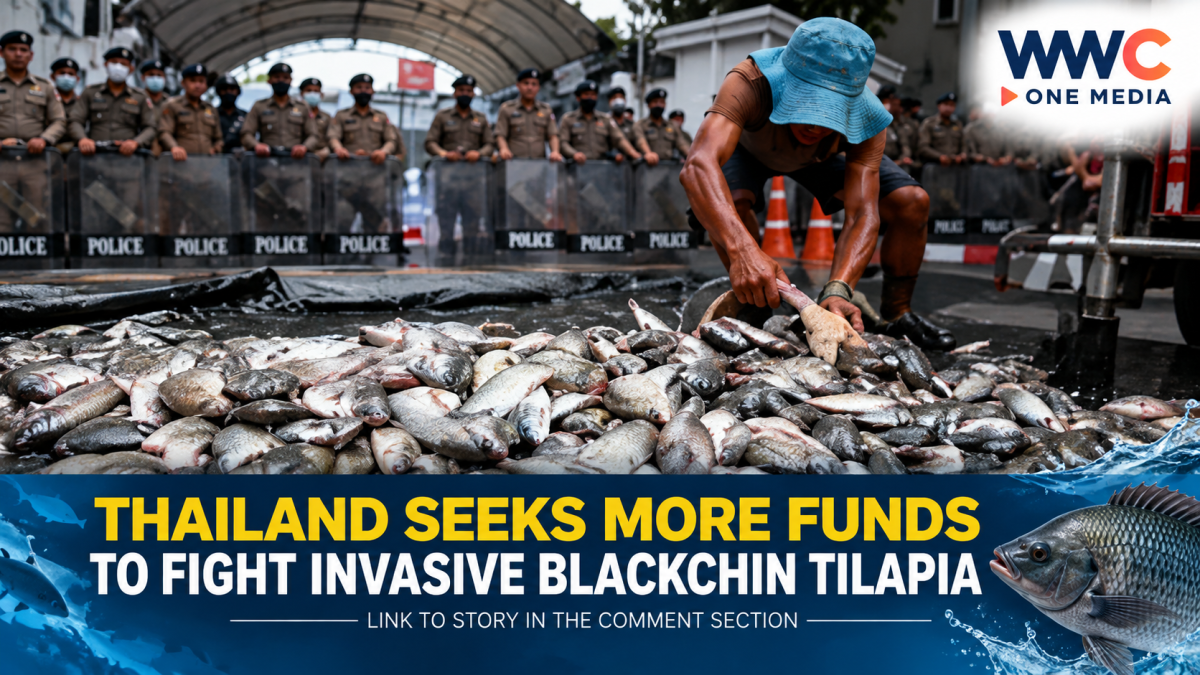
Thailand’s Ministry of Agriculture and Cooperatives is considering seeking an additional 350 million baht to strengthen efforts to control the spread of invasive blackchin tilapia, as authorities continue to struggle with the fish’s growing presence in the country’s waterways.
The proposed funding would support measures aimed at reducing the population of blackchin tilapia, an invasive species that has become a major concern for Thailand’s fisheries and aquatic ecosystems. The government has already spent significant amounts on efforts to catch and remove the fish, but officials say more resources are needed to keep the infestation under control.
Blackchin tilapia, scientifically known as Sarotherodon melanotheron, is native to coastal West Africa. The species can tolerate both freshwater and brackish environments, allowing it to survive and spread through rivers, canals, ponds and coastal areas. Its ability to reproduce rapidly has made it particularly difficult to eradicate once established.
Thailand has been battling the invasive fish for several years, with outbreaks reported across multiple provinces. The species has been particularly disruptive to fish and shrimp farmers because it can compete with native aquatic species for food and habitat.
The government has previously introduced incentives encouraging people to catch the invasive fish and has promoted the use of the species as food in an effort to reduce its numbers. Authorities have also explored biological control methods, including releasing predatory fish such as barramundi in affected areas.
The scale of the problem has made the response increasingly expensive. Earlier estimates put the potential economic damage from the infestation at billions of baht, reflecting losses faced by fish farmers as well as the broader impact on aquatic ecosystems.
Officials are now assessing how additional funding could be used to make the control programme more effective. The focus is expected to remain on removing fish from affected waterways, preventing further spread and supporting communities whose livelihoods have been affected by the infestation.
The challenge is that simply removing existing fish may not be enough. Blackchin tilapia can survive in different water conditions and reproduce quickly, meaning populations can recover if control efforts are not maintained. Its presence in both freshwater and coastal environments also makes containment more complicated.
Thailand’s continuing battle with the species highlights the wider difficulties countries face when invasive aquatic animals become established. Once an invasive fish spreads across interconnected waterways, controlling it can require sustained spending, coordinated action and cooperation from local communities and farmers.
With the Agriculture Ministry considering another 350 million baht, the government is preparing to increase its response as it tries to prevent blackchin tilapia from causing further damage to Thailand’s fisheries and aquatic biodiversity.




Leave a Reply