
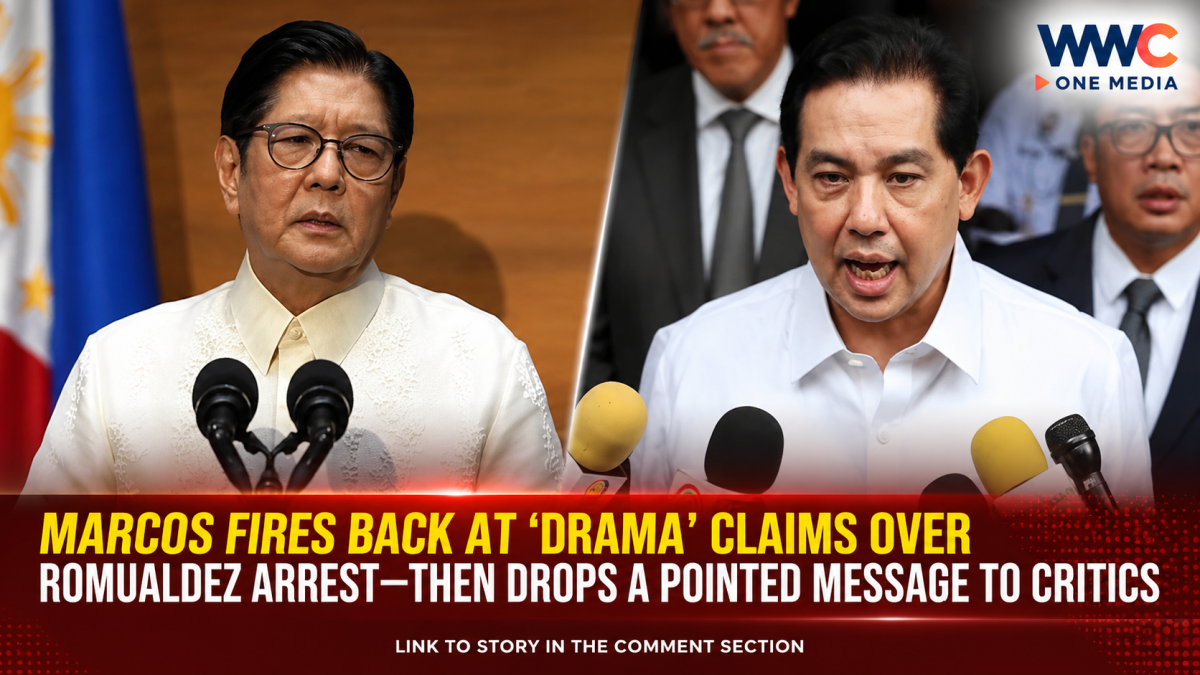
MANILA, Philippines — President Ferdinand Marcos Jr. has rejected claims that the arrest of his cousin and former House Speaker Martin Romualdez was merely political theater, saying accusations that the government staged the episode amount to another attack against his administration.
Marcos addressed the controversy while speaking to reporters on the sidelines of the BRICS Summit in India, after Vice President Sara Duterte and other critics questioned the circumstances surrounding Romualdez’s arrest.
Asked about the characterization of the case as “drama,” Marcos pushed back.
“Of course, this is political, right?” the President said, according to GMA News, adding that the criticism was not really about the court proceedings but was intended to attack or discredit him and his administration.
Marcos also pointed to Romualdez himself when asked about the seriousness of the former House speaker’s situation.
The President’s response comes days after Romualdez was arrested on September 7 while confined at Cardinal Santos Medical Center in San Juan City.
Romualdez faces P7.4-billion plunder case
Romualdez, who is also the representative of Leyte’s 1st District, is facing a plunder case involving more than P7 billion in alleged kickbacks connected to government flood-control projects.
The Office of the Ombudsman filed the case before the Sandiganbayan against Romualdez and three other individuals. Authorities have alleged that billions of pesos connected to flood-control projects were diverted through various transactions.
The case forms part of a much wider investigation into alleged corruption in the government’s flood-control program.
The Associated Press reported that nearly 10,000 flood-control projects worth more than P545 billion have come under scrutiny since Marcos assumed office, with investigators finding projects that were allegedly overpriced, substandard or never constructed.
Romualdez has denied wrongdoing.
‘No special treatment,’ Palace insists
The arrest immediately generated questions because of Romualdez’s close relationship with Marcos.
Romualdez is the President’s maternal first cousin and was previously one of Marcos’ most powerful political allies.
But Malacañang has repeatedly insisted that the President did not intervene in the case.
Interior Secretary Jonvic Remulla said there were no instructions from Marcos regarding how Romualdez should be treated following the issuance of the arrest warrant.
“Wala talagang instruction,” Remulla said, stressing that the President did not direct authorities on Romualdez’s treatment.
Remulla also acknowledged the personal relationship between Marcos and Romualdez, saying the former speaker is among the President’s closest relatives.
Despite those ties, he maintained that law enforcement had to follow the court’s order.
Palace: Evidence—not politics—should decide the case
Malacañang had already taken the position that Romualdez should not receive special treatment when the plunder case was filed.
Palace Press Officer Claire Castro said the administration would allow the evidence and the courts to determine the outcome, regardless of whether the accused is a relative, friend, political ally or political opponent.
The President had also addressed the possibility of cases against Romualdez during his 2026 State of the Nation Address.
At the time, Marcos acknowledged that the situation was personally painful but emphasized that his responsibility was to the Filipino people rather than to his family or political allies.
That position has become a central argument of the administration as it attempts to demonstrate that the flood-control corruption investigation is not being selectively enforced.
Sara Duterte calls the arrest ‘drama’
The controversy intensified after Vice President Sara Duterte described Romualdez’s arrest as “drama.”
Her remarks came amid her own political and legal confrontation with government officials, including Interior Secretary Jonvic Remulla.
Duterte later accused Remulla of being the one seeking political drama and referred to what she called the “supposed” arrest of Romualdez.
Marcos has now directly rejected that characterization.
He argued that such statements do not challenge the legal procedures themselves but instead serve as political attacks against the administration.
The hospital detention issue adds another layer
Romualdez’s medical condition has also become part of the controversy.
He was arrested while receiving treatment at Cardinal Santos Medical Center. Authorities have been weighing the appropriate arrangements for his custody based on medical assessments and court procedures.
The Palace has maintained that decisions concerning his health and possible continued hospital confinement should be made by doctors and the courts—not by the President.
The PNP had prepared a room for Romualdez in case he could remain under hospital detention, while the Office of the Ombudsman indicated that it would oppose his request for continued hospital confinement.
A political storm bigger than one arrest
The Romualdez case has now become one of the most politically explosive developments of the Marcos administration.
What began as a corruption investigation involving alleged irregularities in flood-control projects has evolved into a wider political confrontation involving Marcos, Duterte, senior government officials and some of the country’s most powerful political figures.
For Marcos, the challenge is increasingly twofold: allow the legal process to proceed against a close relative while convincing the public that the case is genuinely about accountability rather than political retaliation.
For Romualdez, the immediate battle is in court, where prosecutors will have to prove their allegations and the defense will have an opportunity to contest the charges.
And for the administration, the stakes may extend well beyond one defendant.
As investigations into the massive flood-control scandal continue, the next cases—and the evidence behind them—could determine whether the government’s anti-corruption campaign gains credibility or becomes another front in the country’s escalating political war.



Leave a Reply