
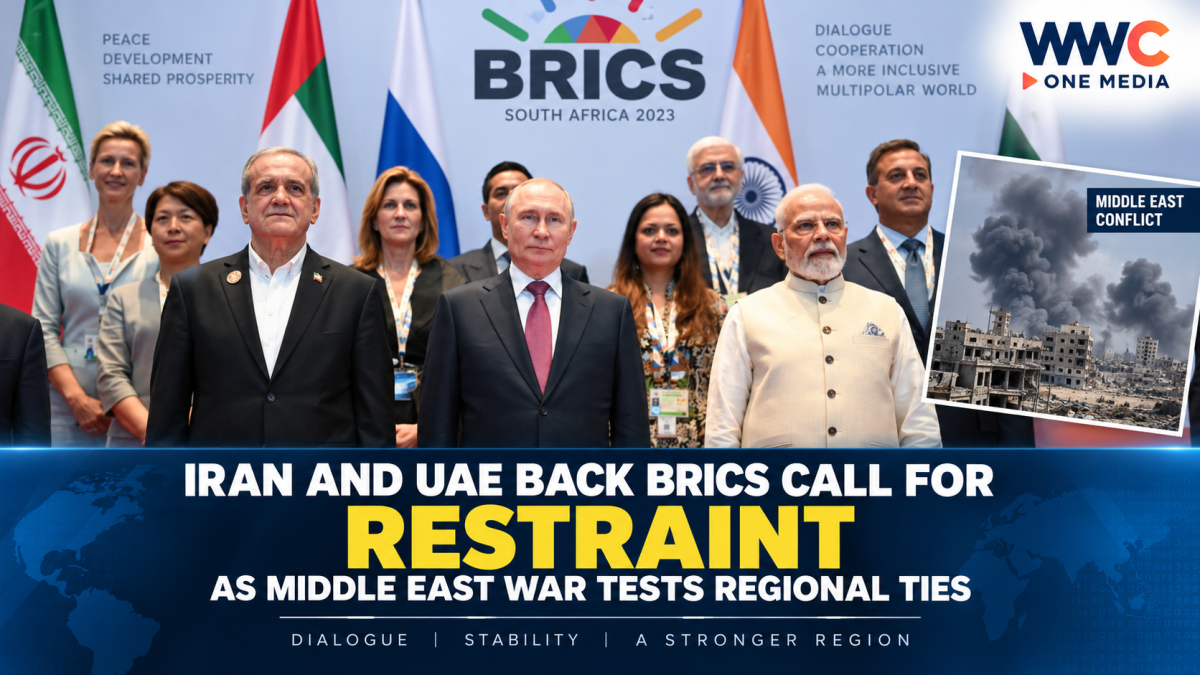
Iran and the United Arab Emirates have backed a joint BRICS declaration calling for maximum restraint in the Middle East, in a notable diplomatic moment between two countries whose relations have been strained by the ongoing war.
The declaration was adopted at the BRICS summit in New Delhi on Sept. 12, as leaders sought to present a united position despite deep divisions over the conflict. It expressed concern over the worsening situation and called on all sides to avoid actions that could further escalate hostilities.
The statement called for the protection of civilians, respect for the sovereignty and territorial integrity of states, and the safeguarding of trade and maritime security. It stopped short of directly assigning blame to any party, reflecting the difficult balance within the expanded 11-member bloc.
The agreement was particularly significant because Iran and the UAE have found themselves on opposite sides of the regional confrontation. Iran has recently carried out attacks targeting US forces and facilities in the UAE, while Abu Dhabi has condemned Iranian attacks and asserted its right to defend its territory.
Against that backdrop, Iranian President Masoud Pezeshkian held a meeting with Abu Dhabi Crown Prince Sheikh Khaled bin Mohamed bin Zayed Al Nahyan on the sidelines of the BRICS summit. It was their highest-level engagement since the conflict began and provided an opportunity for the two countries to discuss regional stability and relations.
The meeting also offered a rare sign of diplomatic movement at a time when efforts to contain the conflict have faced serious setbacks. A separate meeting involving Iran and Gulf Arab states on a proposal concerning shipping through the Strait of Hormuz was postponed, while attacks around key energy routes continued to threaten global oil supplies.
The BRICS statement itself was the result of difficult negotiations, with the bloc seeking consensus among members that have sharply different strategic interests. Iran has pushed for stronger condemnation of US and Israeli military action, while Gulf members such as the UAE have focused heavily on territorial security and the protection of their infrastructure and citizens.
Indian Prime Minister Narendra Modi, who hosted the summit, presented the agreement as evidence that BRICS could still find common ground despite major geopolitical differences. The bloc also addressed conflicts beyond the Middle East, alongside issues including trade, energy, artificial intelligence and reform of global institutions.
China and Russia also supported calls for de-escalation. Chinese President Xi Jinping used the summit to advocate a greater role for BRICS in international affairs, while stressing the importance of political solutions to global conflicts.
The declaration is unlikely by itself to end the war, but the willingness of Iran and the UAE to endorse the same diplomatic language marks an important moment. With tensions still threatening the Gulf, energy markets and one of the world’s most important shipping routes, the search for a broader regional de-escalation remains urgent.



Leave a Reply