
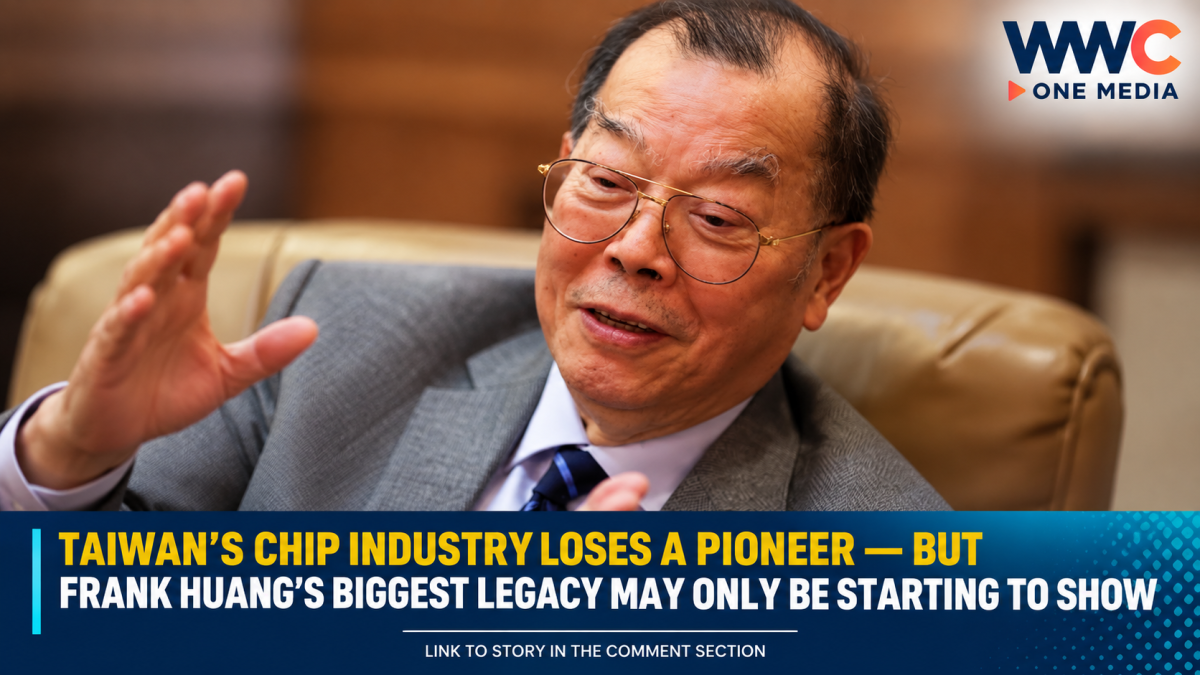
TAIPEI — Taiwan President Lai Ching-te has honored the late semiconductor pioneer Frank Huang, founder and longtime chairman of Powerchip Semiconductor Manufacturing Corp. (PSMC), recognizing the businessman whose career became closely intertwined with the rise and transformation of Taiwan’s chip industry.
Lai attended Huang’s memorial service on Saturday and presented a posthumous presidential commendation to Huang’s elder brother, Huang Chung-heng, on behalf of the family. Huang died on July 31 at the age of 77 after suffering cardiopulmonary failure at his home.
But Huang’s legacy is about far more than founding a semiconductor company.
His career included spectacular setbacks, billions of dollars in debt, a corporate delisting and an eventual transformation that brought his company back to Taiwan’s stock market.
From medicine to Taiwan’s technology industry
Huang’s path into the semiconductor business was anything but conventional.
He studied physics at National Taiwan University before traveling to the United States, where he earned a medical degree from Mount Sinai School of Medicine in New York.
After returning to Taiwan, he taught before making a dramatic career change.
At 38, Huang left academia and entered business, eventually founding Umax Computer in 1987. Seven years later, he established Powerchip Semiconductor in partnership with Japan’s Mitsubishi Electric, entering the highly competitive DRAM industry.
That decision would eventually make him one of the better-known figures in Taiwan’s semiconductor sector.
The crisis that nearly destroyed Powerchip
Huang’s biggest test came during the prolonged downturn in the global memory-chip industry.
Powerchip accumulated enormous debt as DRAM prices weakened. The company was eventually delisted from Taiwan’s over-the-counter market in 2012.
For many companies, that would have been the end.
For Huang, it became the beginning of one of the most dramatic turnarounds in Taiwan’s semiconductor industry.
He led a major financial and organizational restructuring that ultimately allowed the company to repay approximately NT$120 billion (about US$3.7 billion) in debt.
Powerchip then shifted away from its traditional DRAM manufacturing business and moved toward wafer foundry services.
The company eventually returned to Taiwan’s main stock market in 2021 under the name Powerchip Semiconductor Manufacturing Corp.
That turnaround became a defining part of Huang’s business legacy.
Lai praises Huang’s refusal to give up
At the memorial service, President Lai praised Huang for confronting repeated setbacks instead of abandoning the company.
Lai described Huang as a pioneer who helped build Taiwan’s semiconductor industry and highlighted his role in promoting technology cooperation, semiconductor education and talent development.
The president also recalled Huang’s efforts to encourage the establishment of semiconductor research and educational institutions.
Huang had approached then-President Tsai Ing-wen in 2021 to advocate stronger semiconductor research and talent development, according to Taiwan’s Presidential Office.
For Lai, Huang’s career demonstrated a lesson that extended beyond business: setbacks did not have to determine the final outcome.
His influence went beyond Powerchip
Huang was also active in Taiwan’s technology organizations.
He served as chairman of the Taipei Computer Association, the Taiwan Semiconductor Industry Association and the World Semiconductor Council, giving him a role in shaping discussions about Taiwan’s technology industry both domestically and internationally.
His influence also extended into international semiconductor cooperation.
Following his death, Taiwan’s Foreign Minister Lin Chia-lung described Huang as an important figure in Taiwan’s technology, economic and international-development efforts.
Representatives of India and France in Taiwan also paid tribute to him, with India’s representative highlighting Huang’s role in semiconductor cooperation between Taiwan and India.
A semiconductor legacy that reaches India
One of Huang’s later projects involved expanding Taiwan’s semiconductor expertise internationally.
PSMC worked with Tata Electronics on plans for semiconductor manufacturing in India’s Gujarat state.
India’s representative office in Taiwan described Huang as an important contributor to Taiwan-India economic and technology cooperation, particularly through the semiconductor partnership.
That cooperation reflects how Taiwan’s chip industry has increasingly become part of a much larger global effort to diversify semiconductor manufacturing.
Taiwan’s role has become especially important as governments seek more resilient supply chains for advanced technology and critical components.
He was still working shortly before his death
Huang’s death came unexpectedly to much of the business community.
As recently as July, he was still chairing an investor conference and answering questions about PSMC’s business outlook.
The company said he died peacefully in his sleep at home on July 31.
PSMC’s vice chairman Brian Shieh took over Huang’s duties, while the company said its production and sales operations would continue according to existing plans.
That continuity is particularly important because PSMC remains part of Taiwan’s strategically important semiconductor sector.
More than a businessman
Huang also became known for his interest in the arts.
Taiwan’s CNA reported that he was a major art collector whose collection included works associated with internationally renowned artists such as Picasso, Monet and Van Gogh, as well as major Chinese artists.
His interests therefore extended well beyond semiconductors and corporate strategy.
He was involved in technology, education, international cooperation and cultural activities — areas that President Lai also highlighted in the presidential commendation.
The bigger story behind his legacy
Frank Huang’s career mirrors some of the defining characteristics of Taiwan’s technology economy.
He entered an industry vulnerable to brutal global cycles, experienced a corporate collapse that threatened the company’s survival, accumulated enormous debt and then helped rebuild the business around a different semiconductor model.
The transformation from a troubled DRAM manufacturer into a foundry operator ultimately allowed the company to return to the public market.
That makes Huang’s story particularly relevant today, when Taiwan’s semiconductor industry has become one of the most strategically important technology ecosystems in the world.
The global semiconductor race is no longer simply about selling chips.
It is about national security, artificial intelligence, supply-chain resilience, economic competitiveness and international alliances.
And many of the foundations of Taiwan’s semiconductor strength were built by entrepreneurs and engineers who took enormous risks decades ago.
Frank Huang was one of them.
His death closes a remarkable chapter in Taiwan’s semiconductor history.
But the companies, talent networks and international partnerships he helped build remain part of the industry he spent decades shaping.
The man is gone. The chip legacy he helped build is still powering Taiwan’s future.



Leave a Reply