
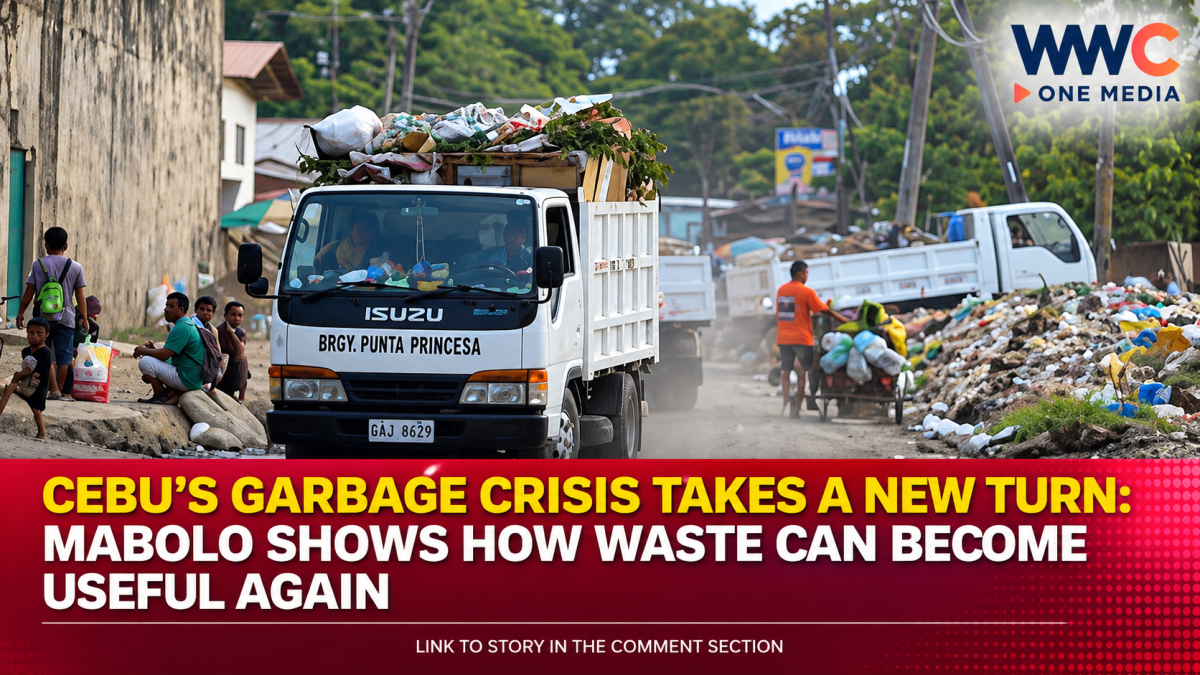
CEBU CITY — As Cebu City continues to grapple with mounting waste-management challenges, Barangay Mabolo is pushing a different approach: segregate garbage at the source, recycle what can still be used, and keep as much waste as possible out of landfills.
Barangay Mabolo Captain Atty. Daniel Frances Arguedo said the community is promoting stricter and more sustainable waste management instead of relying heavily on landfill disposal, according to a September 13 report by Bombo Radyo Cebu.
The initiative comes as Cebu City faces an ongoing solid-waste crisis and intensified efforts to enforce its “No Segregation, No Collection” policy.
Mabolo processes tons of plastic waste
Under Mabolo’s program, residents are encouraged to segregate their garbage directly at home before collection.
Bombo Radyo Cebu reported that the barangay collects an average of five truckloads of plastic waste daily, including PET bottles, sacks and sachets.
Instead of sending these materials directly to a landfill, the plastics are processed and converted into substitutes for sand and gravel, which can then be used in sidewalk and gutter rehabilitation projects within the barangay.
Biodegradable materials, meanwhile, are processed into compost.
Leaves and other organic waste are allowed to decompose for roughly a month before being converted into natural fertilizer, according to Arguedo.
The barangay reported that its system has allowed it to recycle or recover approximately 60% of its plastic waste and 40% of its biodegradable waste, turning materials that would otherwise require disposal into resources that can be used by the community.
Why the strategy matters for Cebu
The Mabolo initiative comes at a critical time for Cebu City.
In May, Mayor Nestor Archival declared a State of Solid Waste Management Emergency, directing the city to intensify waste reduction, segregation, recycling and composting efforts. The emergency measures were introduced amid continuing pressure on the city’s waste-disposal system following the closure of the Binaliw landfill after a deadly trash-slide incident in January.
The city’s emergency program initially identified 10 pilot barangays, including Mabolo, for intensified implementation of waste segregation and diversion measures. Barangay officials were also directed to strengthen information campaigns, reactivate Materials Recovery Facilities and monitor compliance.
The policy is rooted in Republic Act No. 9003, or the Ecological Solid Waste Management Act of 2000, which requires segregation at source and promotes recycling, composting and waste diversion.
Cebu City has also long had Ordinance No. 2031, which provides the legal basis for its “No Segregation, No Collection” policy.
Mabolo has already tightened enforcement
Mabolo’s approach is not limited to recycling.
In June, SunStar Cebu reported that the barangay had intensified enforcement of the segregation policy and even moved to hold garbage collectors accountable for collecting improperly segregated waste. A garbage truck driver was cited after allegedly picking up mixed garbage, underscoring the barangay’s position that enforcement must apply not only to residents but also to those responsible for collection.
The crackdown reflects a broader problem that Cebu City has been trying to address for years: laws requiring waste segregation exist, but compliance and enforcement have historically been inconsistent.
The bigger challenge: reducing dependence on landfills
Arguedo said a major advantage of segregation is that the city can reduce the amount of garbage that has to be hauled to disposal facilities.
That could translate into lower hauling and landfill-related expenses while also reducing the environmental pressure created by continually sending large volumes of waste to disposal sites. Bombo Radyo Cebu reported that Arguedo questioned the sustainability of relying primarily on landfill disposal because of the expense involved.
The urgency is particularly clear following the January 8 collapse at the Binaliw landfill, which killed dozens of people and led to the facility’s closure and subsequent changes in Cebu City’s waste-disposal arrangements. Multiple reports have linked the tragedy to the city’s intensified push for waste diversion and stricter segregation.
Cebu is moving toward a waste-diversion model
The citywide response is already expanding beyond traditional garbage collection.
In August, The Freeman reported that Cebu City had increased the number of barangays participating in its segregated-waste program from the initial 10 pilot areas to 18, with participating barangays delivering segregated waste to the city’s Eco Station at the South Road Properties. The reported processing capacity had also increased from about 20 tons to 25 tons daily.
In July, 11 barangays, including Mabolo, were also selected for the Balik-Bote Program, a waste-recovery initiative involving Cebu City and San Miguel Brewery aimed at collecting and reusing returnable glass bottles rather than sending them to landfills.
Mabolo’s message is simple: garbage does not always have to become landfill waste
Mabolo’s experience demonstrates one possible path for communities facing the same problem: separate waste before it becomes mixed, recover materials that still have value, compost organic waste and send only residual garbage for final disposal.
The challenge, however, is making the system work consistently across households, businesses, collectors and barangay authorities.
For Cebu City, that shift is becoming increasingly important as officials search for a more sustainable solution to a waste problem that has already placed enormous pressure on the city’s finances, environment and communities.
What was once viewed simply as garbage could become a resource — if segregation starts at the source.




Leave a Reply