
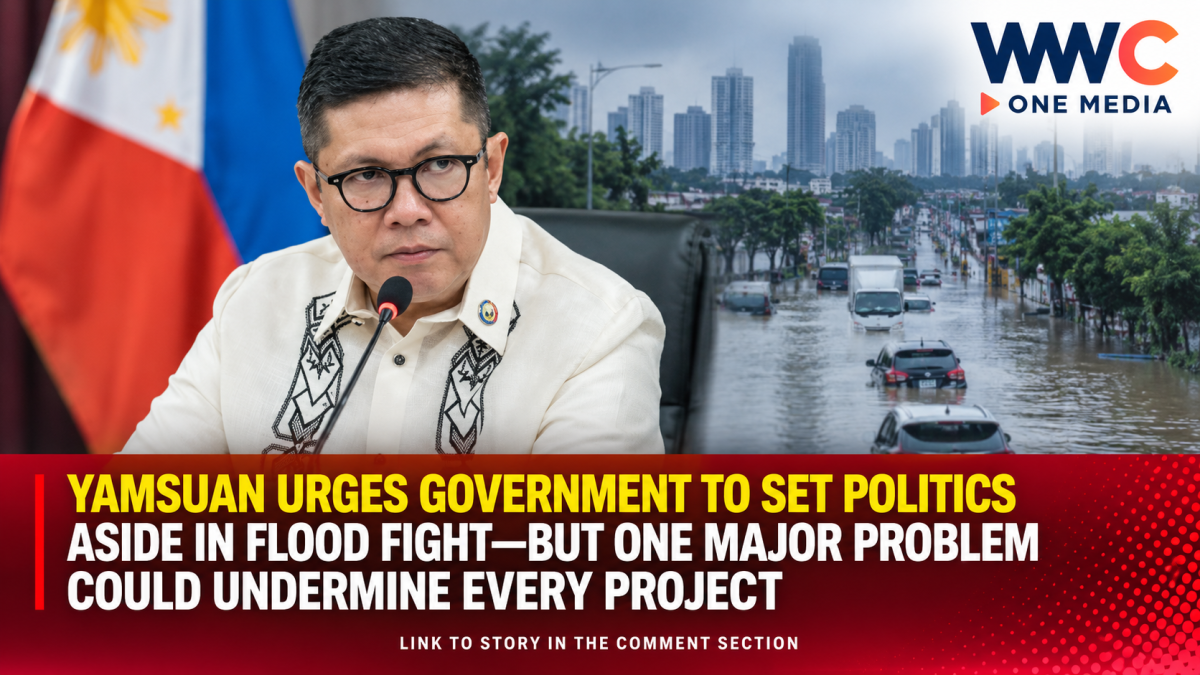
MANILA, Philippines — Parañaque 2nd District Representative Brian Yamsuan is calling on national and local government officials to set political differences aside and work together on a science-based, long-term strategy to address the Philippines’ worsening flooding problem.
Yamsuan backed the Department of the Interior and Local Government’s (DILG) appeal for “zero politicking” in the implementation of flood-mitigation projects, stressing that government programs should be guided by data, engineering studies and a unified national strategy—not political considerations.
The lawmaker said local flood-control projects must complement the government’s broader flood-management plans so that an intervention in one area does not simply transfer the flooding problem to another community.
His remarks came as the government steps up its response to recurring floods following heavy southwest monsoon rains and as authorities reassess how billions of pesos in public funds should be used for flood-control infrastructure.
DILG Secretary Jonvic Remulla earlier made a similar call for unity across all levels of government, saying a whole-of-government approach is needed to address the country’s persistent flooding problem. The DILG has emphasized that local and national officials need to coordinate rather than pursue disconnected projects.
Yamsuan pushes science and technology
Yamsuan said flood-control planning should be based on scientific data and long-term assessments of how water moves across cities and provinces.
He is also set to meet with representatives of the Philippine Space Agency (PhilSA) to determine whether additional funding could strengthen the government’s use of satellite technology and artificial intelligence to identify and monitor flood-prone areas.
PhilSA already uses satellite-derived information to assess flood impacts and produce flood-extent maps that can help authorities prioritize response and disaster-risk-reduction measures.
Yamsuan stressed that the problem extends far beyond Parañaque.
With climate change increasing the threat of extreme rainfall and stronger weather disturbances, he said flood-control planning needs to cover entire watersheds and interconnected communities rather than stopping at political or administrative boundaries.
The Manggahan–Laguna de Bay concern
One of the issues raised by Yamsuan is the potential interaction between major flood-control projects.
He has warned that the planned Manggahan Control Gate Structure in Marikina, which is designed to help divert floodwaters from the Marikina River toward Laguna de Bay, must be considered alongside other projects that will manage water levels in the lake.
The concern is that solving flooding in one location could potentially create additional pressure elsewhere if projects are not designed as part of one interconnected system.
That is one reason Yamsuan has strongly supported the long-delayed Parañaque Spillway Project, which is designed to provide a route for excess water from Laguna de Bay toward Manila Bay.
The spillway has gained renewed attention in recent months. GMA News reported that the Department of Agriculture and Laguna Lake Development Authority were looking at reviving the roughly P90-billion project, which was first proposed decades ago. The proposed 10.5-kilometer system would connect Laguna de Bay with Manila Bay and is also being considered for its potential benefits to water management, fisheries and climate resilience.
Public Works Secretary Vince Dizon has also said President Ferdinand Marcos Jr. directed the DPWH to prioritize the implementation of the spillway. Yamsuan previously raised concerns that other flood-control interventions could increase water flowing toward Laguna de Bay, making the spillway more important as a long-term solution.
Government explores detention basins and other solutions
Yamsuan has also supported the development of water-detention facilities in flood-prone communities.
The DPWH has been studying the possibility of placing underground detention basins beneath available open spaces, parks, basketball courts and even privately owned properties. The idea is to temporarily hold large volumes of rainwater and release them gradually rather than allowing huge amounts of water to overwhelm drainage systems simultaneously.
The approach is consistent with the government’s broader push for flood-catchment facilities in Metro Manila.
GMA News reported that authorities identified 39 potential flood-mitigation sites across the National Capital Region, including areas that could accommodate bioretention facilities, detention ponds, wetlands and other flood-management interventions.
The MMDA has also identified five priority flood-catchment projects that officials hope to complete by June 2027, including proposed sites at Miriam College, Camp Aguinaldo and the University of the Philippines Diliman in Quezon City, as well as Rajah Sulayman Park and Remedios Circle in Manila.
Bigger budget, bigger scrutiny
The push for a coordinated flood-control strategy comes amid intense scrutiny of government spending on flood projects.
Under the proposed P7.2-trillion 2027 National Expenditure Program, about P107 billion was initially earmarked for flood-control projects, according to reporting by Inquirer.net. Yamsuan has said Congress remains open to adjusting the proposed allocation based on actual needs and deliberations during the budget process.
Yamsuan has repeatedly argued that flood-control spending should be based on comprehensive master plans, scientific studies and actual community needs rather than short-term or isolated projects.
The debate is particularly significant after severe flooding across Metro Manila and other parts of Luzon exposed weaknesses in existing drainage and flood-control systems.
GMA News reported that Metro Manila received 201.8 millimeters of rainfall in just five hours during the August 2026 rains—nearly half of the rainfall recorded during Typhoon Ondoy in 2009, although Ondoy’s rainfall total was measured over a 24-hour period.
The bigger question: Can projects finally work together?
The government’s challenge is no longer simply building more flood-control structures.
The bigger test is whether national agencies, local governments and lawmakers can ensure that projects are connected to a single, science-based strategy.
Recent government discussions have increasingly focused on this approach. President Marcos has said the country already had flood-control master plans dating back decades but that implementation had lagged.
Meanwhile, the Private Sector Advisory Council has also urged the government to pursue measures including clearing the Manggahan Floodway and advancing the Parañaque Spillway, while improving coordination over flood control, drainage and water resources.
For Yamsuan, the message is straightforward: flooding should not become another political battleground.
Instead, he is pushing for government agencies and local officials to work from the same data, follow long-term plans and ensure that public funds produce projects capable of protecting communities for years to come.
The pressure is now on government to turn those plans into projects that actually work—and to make sure that solving flooding in one community does not simply push the water problem somewhere else.




Leave a Reply