
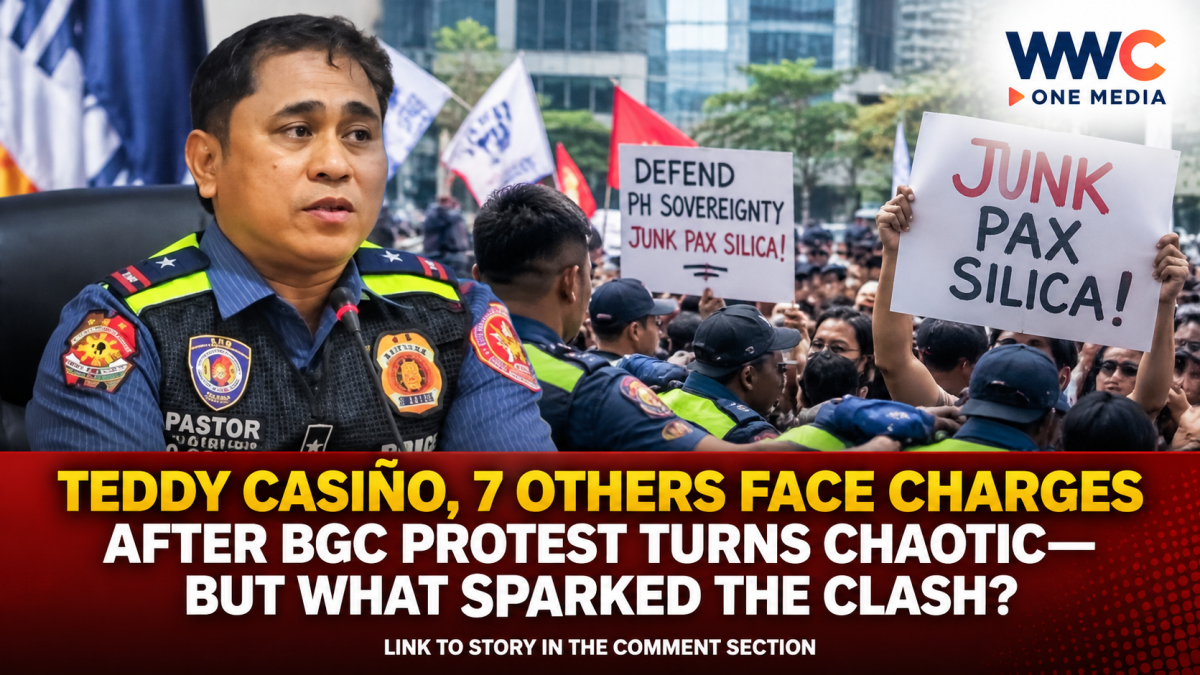
MANILA, Philippines — What began as a protest against a controversial US-led economic initiative escalated into a confrontation between police and demonstrators outside a hotel in Bonifacio Global City (BGC), Taguig, with Bayan Muna chairperson Teddy Casiño and seven others now facing possible criminal charges.
The Southern Police District (SPD) said charges would be filed against Casiño, rally organizers and several protesters following the Sept. 10 lightning rally outside the Grand Hyatt Manila, where the Luzon Economic Corridor Investment Forum was being held.
Among the possible complaints cited by police are direct assault, physical injuries and violation of Batas Pambansa Blg. 880, or the Public Assembly Act, along with other possible offenses. Several arrested protesters were undergoing inquest proceedings in Taguig, according to the SPD.
How the BGC confrontation unfolded
According to the SPD, the demonstration began at around 9:09 a.m. as groups opposed to the proposed Pax Silica initiative gathered near the hotel.
Police said some protesters entered the hotel premises after allegedly presenting themselves as customers. The situation later became tense as the demonstration affected traffic and hotel operations.
Authorities said officers repeatedly instructed the protesters to maintain order and disperse peacefully. Police alleged that some demonstrators resisted and physically assaulted responding personnel.
The SPD reported that 16 police officers and five activists were injured during the confrontation. The injuries sustained by police personnel reportedly included bruises, blunt-force wounds and lacerations.
The Philippine Star, however, reported a broader injury count, saying 43 police officers and activists were injured, with 16 police officers hurt and protest organizers reporting that 27 activists sustained injuries.
The difference in the reported totals underscores the importance of distinguishing between the police’s official account and figures supplied by protest organizers.
Protesters were opposing Pax Silica
The demonstration was linked to opposition to Pax Silica, a US-led initiative connected to critical minerals, technology and advanced manufacturing, as well as the broader Luzon Economic Corridor.
GMA News reported that Casiño and other protesters objected to what they described as foreign-led development and argued that Philippine economic development should be pursued on the country’s own terms.
The proposed Pax Silica-related development in New Clark City, Tarlac, has become a flashpoint among progressive and environmental groups, which have raised concerns involving land, the environment, communities and the country’s economic sovereignty.
A separate proposal from the Bases Conversion and Development Authority shows that the Philippines has been exploring a Pax Silica coordination facility in the Clark area to support critical-mineral supply-chain security, strategic industrial planning, investment coordination and workforce and technology development.
The protest happened as Marcos courted investors
The timing of the demonstration was significant.
Inside the hotel, President Ferdinand Marcos Jr. was participating in the 2026 Luzon Economic Corridor Investment Forum, which brought together hundreds of investors, government officials and industry leaders.
The United States, Philippines and Japan co-hosted the forum, with the US Trade and Development Agency saying the event brought together approximately 600 international investors, industry leaders and senior government officials to explore commercial partnerships and investment opportunities along the corridor.
Marcos used the forum to encourage foreign investors to bring capital, technology and expertise to the Philippines while developing Filipino workers and local suppliers.
The Luzon Economic Corridor itself is being positioned as a major platform for infrastructure, connectivity, supply-chain development and investment.
The partnership has also expanded. The European Union and Spain formally joined the LEC during the investment forum, bringing the partnership to 13 members, according to the Philippine News Agency.
Protesters dispute the police narrative
The police account is not the only version of what happened.
Rights and activist groups accused authorities of using excessive force during the dispersal. The Kalikasan People’s Network for the Environment claimed that dozens of protesters were injured and alleged that police used riot shields and batons during the confrontation.
The Philippine Star likewise reported that protest organizers said 27 activists were injured, while police maintained that their personnel had also been hurt during the confrontation.
Several protesters were also arrested. Reports identified paralegals and members of cause-oriented groups among those taken into custody.
Police said the arrested individuals could face complaints involving alarm and scandal, resistance and disobedience to a person in authority, direct assault, disturbances of public order and violations of the Public Assembly Act.
PNP insists officers exercised restraint
PNP chief Gen. Jose Melencio C. Nartatez Jr. said the police response was intended to maintain order and protect people attending the investment forum.
The PNP has maintained that officers exercised maximum tolerance and that the confrontation could have been avoided had the protest remained peaceful and within legal boundaries.
At the same time, the competing accounts of injuries and the conduct of both police and protesters have placed renewed attention on the balance between the constitutional right to peaceful assembly and the government’s responsibility to maintain public order.
Palace calls for dialogue
The confrontation has also drawn attention from Malacañang.
The Palace has emphasized that the government recognizes the public’s right to express opposition but said protests should not result in violence or endanger public safety. It urged groups with concerns about Pax Silica to raise their objections through dialogue with the agencies involved.
The incident therefore goes beyond a single clash outside a BGC hotel.
It has become part of a much larger debate over Pax Silica, foreign investment, Philippine economic sovereignty, critical minerals, the Luzon Economic Corridor and the government’s approach to dissent.
For Casiño and the other individuals named by police, however, the immediate issue is more concrete: possible criminal cases arising from a protest that authorities say crossed the line from lawful assembly into conduct requiring police intervention.
The eventual complaints, prosecutorial proceedings and any subsequent court action will determine whether those allegations result in formal charges and, ultimately, liability.



Leave a Reply