
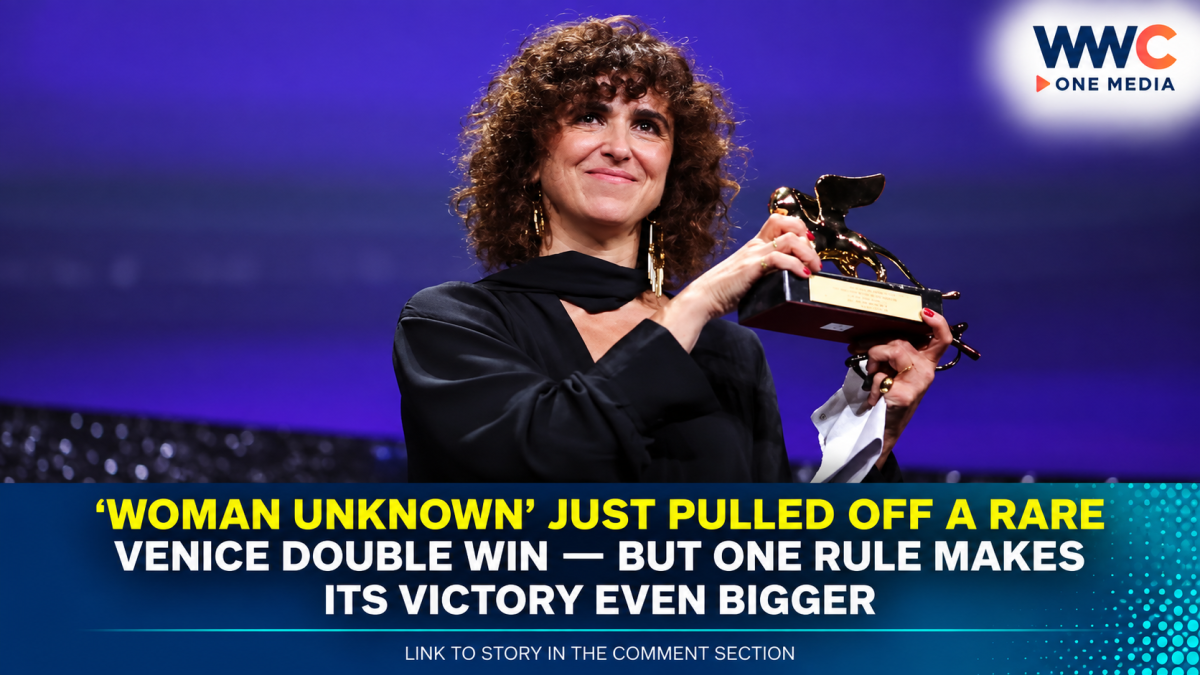
VENICE — A film about a woman whose wartime past threatens to destroy the future she is trying to build emerged as the biggest winner of the 83rd Venice International Film Festival — and its triumph was more unusual than the headline alone suggests.
Danish-Egyptian filmmaker May el-Toukhy’s Woman Unknown won the coveted Golden Lion for Best Film on Saturday, September 12, while its lead, Mathilde Arcel, took home the Coppa Volpi for Best Actress. Meanwhile, veteran American actor John Malkovich won Best Actor for Martin McDonagh’s dark CIA comedy Wild Horse Nine. The results were confirmed by the Venice Film Festival’s official awards announcement.
The double victory for Woman Unknown was particularly striking because Venice’s competition rules generally prevent a single film from collecting more than one major award.
There is an exception for acting prizes — but when the acting award goes to a performer in the film that also wins the Golden Lion, festival regulations state that the decision must be approved unanimously by the entire jury.
That means Arcel’s win was not simply another trophy added to Woman Unknown’s haul. Under Venice’s own rules, the unusual pairing represents an exceptionally strong level of jury support.
A little-known film became Venice’s biggest winner
Before the festival, Woman Unknown was hardly the most star-heavy title competing on the Lido.
Its director, May el-Toukhy, entered a 21-film competition that included projects involving internationally recognised filmmakers and performers. Yet by closing night, her 124-minute Danish-language drama had beaten the field for cinema’s oldest major film festival’s highest prize. The official festival lists the movie as a Denmark-Sweden-Latvia production.
The story follows Marie, a young nanny and housemaid who is preparing to marry Christian, the wealthy older widower who employs her.
But Marie carries a secret from Denmark’s German occupation: she previously had an intimate relationship with a German soldier.
In the newly liberated country after World War II, that history threatens both her reputation and the new life she hopes to enter.
The historical context gives the film a much larger canvas than a conventional romantic drama.
Women accused of relationships with German occupiers were sometimes publicly humiliated or subjected to vigilante punishment after liberation — allowing the movie to explore shame, power, class, sexuality and the way women’s bodies can become symbols onto which societies project political anger.
El-Toukhy described the film at the ceremony as being concerned with women who are rendered invisible and voiceless, and with the female body becoming a site of conflict.
The gender story surrounding the victory was impossible to ignore
El-Toukhy was the only woman who solely directed a feature in Venice’s main 21-film competition, a disparity that had already become a talking point before the prizes were announced. NAZA, which was added later to the lineup, was co-directed by Rachel Szor and Yuval Abraham.
The imbalance drew criticism during the festival and prompted jury president Maggie Gyllenhaal to speak publicly about structural obstacles facing female filmmakers, particularly difficulties obtaining financing.
But after Woman Unknown won, Gyllenhaal pushed back against the suggestion that the jury had selected it simply to make a statement about gender.
Variety reported that she said the decision came from the jury’s response to the film itself, rather than from a desire to symbolically reward the only solo female director in competition.
The distinction matters.
El-Toukhy is now the eighth woman to win Venice’s Golden Lion, according to AP and AsiaOne — but the jury’s decision also gave her film the festival’s most tightly controlled award combination.
Mathilde Arcel arrived at Venice with almost everything to prove
For Mathilde Arcel, the result was even more extraordinary.
The Danish actress said at the ceremony that Woman Unknown was her first leading role in a film and her first film festival.
She ended that first festival holding one of world cinema’s most prestigious acting prizes.
The official jury awarded her the Coppa Volpi over performers from all 21 competition films, while simultaneously giving her movie the Golden Lion.
For a relatively unfamiliar international performer, that kind of Venice breakthrough can transform career prospects almost overnight.
And she was not the only actor whose night may have significantly changed the awards-season conversation.
John Malkovich wins — from Montreal
John Malkovich, now 72, was not in Venice when his name was announced.
He was working in Montreal and instead sent a video message in which he said he was humbled to receive an honour previously given to so many major actors.
Malkovich won for Wild Horse Nine, written and directed by Martin McDonagh, the filmmaker behind In Bruges, Three Billboards Outside Ebbing, Missouri and The Banshees of Inisherin.
Set against the political turmoil surrounding Chile in 1973, the dark comedy follows CIA operatives played by Malkovich and Sam Rockwell. Malkovich portrays an ageing agent wrestling with secrets, regret and the moral consequences of American intervention.
The movie had already generated intense attention before the awards ceremony, receiving roughly 13 minutes of applause at its Venice premiere and triggering immediate speculation that Malkovich could return to the Academy Awards race.
That speculation now has considerably more fuel.
Malkovich has been nominated for an Oscar twice — for Places in the Heart and In the Line of Fire — but has never won. Academy records confirm his supporting-actor nominations in 1985 and 1994.
AP had already identified him as a potential contender in the developing 2027 Oscar race before his Venice victory. Winning the Volpi Cup does not guarantee an Academy Award nomination, but it gives an already acclaimed performance another significant piece of awards-season momentum.
Venice’s runner-up brought Lee Chang-dong back after eight years
South Korean filmmaker Lee Chang-dong won the Silver Lion Grand Jury Prize, the competition’s runner-up honour, for Possible Love.
The film marked Lee’s first feature since his acclaimed 2018 drama Burning.
Possible Love examines class, labour and human relationships through intersecting lives, with Lee saying at the ceremony that he wanted to ask what cinema can do at a time when traditional ideas about labour and social connection are being weakened.
One small accuracy point is worth noting because some early wire listings circulated the title incorrectly as Promised Love. Reuters subsequently corrected its winners list to Possible Love, which matches the official Venice result.
A secretive Gaza documentary also emerged as one of Venice’s biggest stories
Another major winner was NAZA, directed by Israeli filmmakers Yuval Abraham and Rachel Szor, which received the Special Jury Prize.
The documentary examines Israeli military operations in Gaza using testimony from Israeli military insiders, including soldiers and intelligence personnel.
The film was made under highly secretive conditions and became one of the festival’s most talked-about premieres, receiving an exceptionally long standing ovation reported at roughly 24 to 25 minutes.
Its inclusion also changed the gender arithmetic of the competition slightly: although el-Toukhy remained the only woman to solely direct a competition feature, Szor was a female co-director of NAZA. That distinction is important when describing Venice’s representation statistics accurately.
The rest of Venice’s major winners
Russian-born filmmaker Ilya Khrzhanovsky won the Silver Lion for Best Director for DAU, while Stéphane Brizé, Coralie Amédéo and Olivier Gorce won Best Screenplay for A Good Little Soldier. Malou Khebizi received the Marcello Mastroianni Award for Best Young Actor or Actress for A Place to Heal.
The jury was headed by Maggie Gyllenhaal and included Kaouther Ben Hania, Daniel Blumberg, Francesco Casetti, Xavier Giannoli, Shahrbanoo Sadat and Hong Kong filmmaker Johnnie To.
Venice may have changed two careers in one night
Awards ceremonies often produce familiar names holding familiar trophies.
This year’s Venice finale did something different.
It elevated a film without the biggest Hollywood stars to the top of the festival, gave a first-time lead actress one of cinema’s major acting prizes, and handed a 72-year-old veteran another potentially career-defining role decades after his first Oscar nomination.
For Woman Unknown, however, the most revealing detail may be hidden inside Venice’s rulebook.
Winning the Golden Lion was already extraordinary.
Winning Best Actress as well meant the jury had to clear a much higher procedural bar.
So while much of the immediate coverage focused on May el-Toukhy becoming only the eighth woman to take Venice’s top prize, the deeper story is arguably this:
The festival did not merely decide that Woman Unknown was its best film. Its jury made the exceptional decision to honour its lead actress too — a combination Venice permits for a Golden Lion winner only with unanimous approval.
For John Malkovich, meanwhile, Venice may have opened another chapter entirely.
He already had two Oscar nominations.
Now, more than three decades after the second, his first Volpi Cup has given Hollywood another reason to put his name back into the conversation.




Leave a Reply