
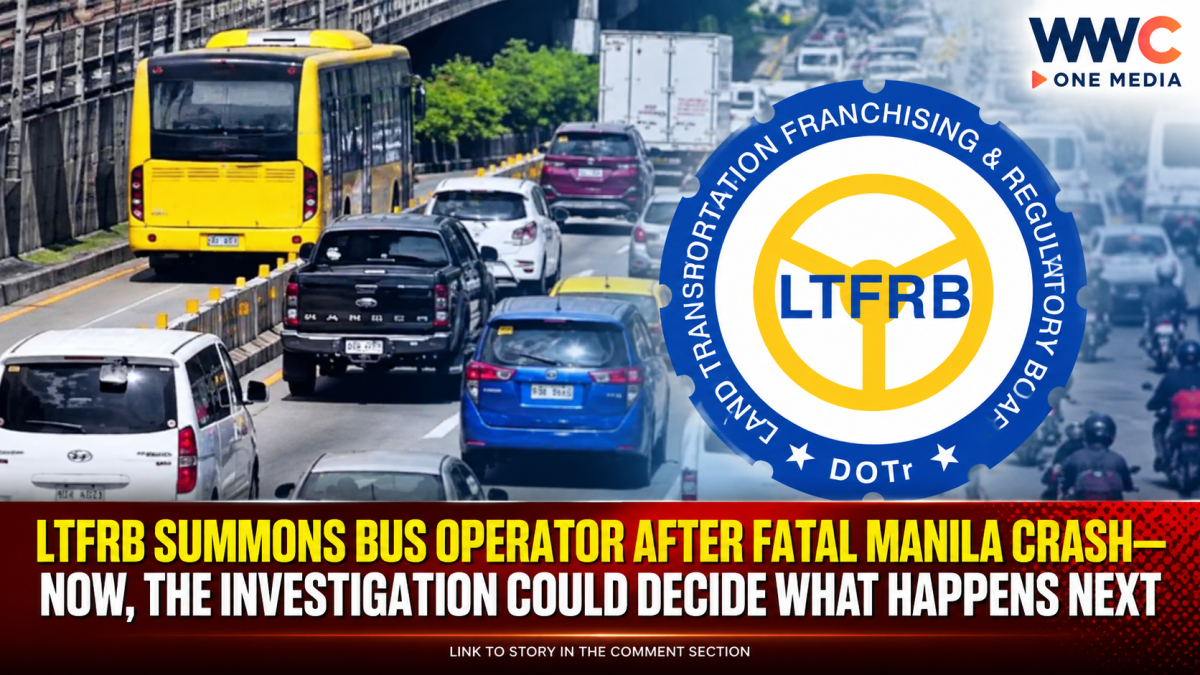
MANILA, Philippines — The Land Transportation Franchising and Regulatory Board (LTFRB) has summoned the operator of a passenger bus involved in a fatal road crash in Manila, placing renewed attention on the safety practices of public utility vehicle operators.
The summons is part of the regulatory agency’s investigation into the incident and seeks to determine whether violations of public transport rules or franchise conditions contributed to the deadly crash.
The case could have consequences beyond the individual driver. Depending on the findings of the investigation, the bus operator may be required to explain whether it exercised sufficient oversight over its vehicle, driver and safety procedures.
LTFRB moves to establish accountability
The LTFRB has increasingly used show-cause orders and preventive suspensions following serious road crashes involving public utility vehicles.
In a separate case in June, the agency issued show-cause orders to three transport companies after road crashes in Quezon and Nueva Ecija. The LTFRB also suspended 15 passenger buses operated by Victory Liner, one Philtranco bus and four trucks while investigations were conducted.
The agency has similarly taken action against operators following fatal crashes elsewhere in the country.
After a fatal crash in Baguio City in June, for example, the LTFRB suspended 24 buses operated by North Genesis Bus Line for 30 days while investigating possible violations of franchise conditions and safety regulations. The crash killed a bus conductor and injured six others.
The regulatory approach reflects the LTFRB’s position that responsibility for passenger safety does not rest solely on the person behind the wheel.
Operator could face franchise consequences
A show-cause order does not by itself establish that an operator is liable for the crash. Instead, it gives the company an opportunity to explain the circumstances and demonstrate compliance with transportation regulations.
However, LTFRB proceedings can result in significant administrative penalties if violations are established.
In another fatal crash in Quezon, the LTFRB suspended nine bus units for 30 days after issuing a show-cause order to Delmonte Motor Works Inc. The operator was directed to explain why its Certificate of Public Convenience should not be suspended or revoked.
The agency has also previously required operators involved in serious crashes to submit maintenance and roadworthiness records and ensure that drivers undergo appropriate testing and road-safety measures.
Road safety under renewed scrutiny
The Manila case comes as authorities continue to intensify scrutiny of public utility vehicles following a series of crashes and alleged reckless-driving incidents.
The LTFRB recently summoned 21 bus and UV Express operators over various violations, including alleged violations along the EDSA Busway and the operation of poorly maintained vehicles. The agency warned that franchises could face suspension or revocation depending on the findings.
The agency has also acted on reckless-driving incidents captured on video. In one recent case, a bus company was ordered to explain why its franchise should not be suspended or revoked after a bus was allegedly caught counterflowing while overtaking another vehicle.
These cases highlight the LTFRB’s broader push to hold both drivers and operators accountable when public transport safety rules are allegedly ignored.
Investigation now takes center stage
For the families affected by the fatal Manila crash, however, the most important issue is accountability.
The LTFRB investigation is expected to determine the circumstances surrounding the collision and whether the operator or driver violated regulations governing the safe operation of public utility vehicles.
The summons also gives the operator an opportunity to present its side before the agency makes any administrative determination.
For now, the case remains under investigation, and any finding of regulatory liability should await the completion of the LTFRB proceedings and the other authorities handling the crash.
What happens next could determine whether the case ends with a regulatory warning—or leads to much more serious sanctions against the bus operator.



Leave a Reply