
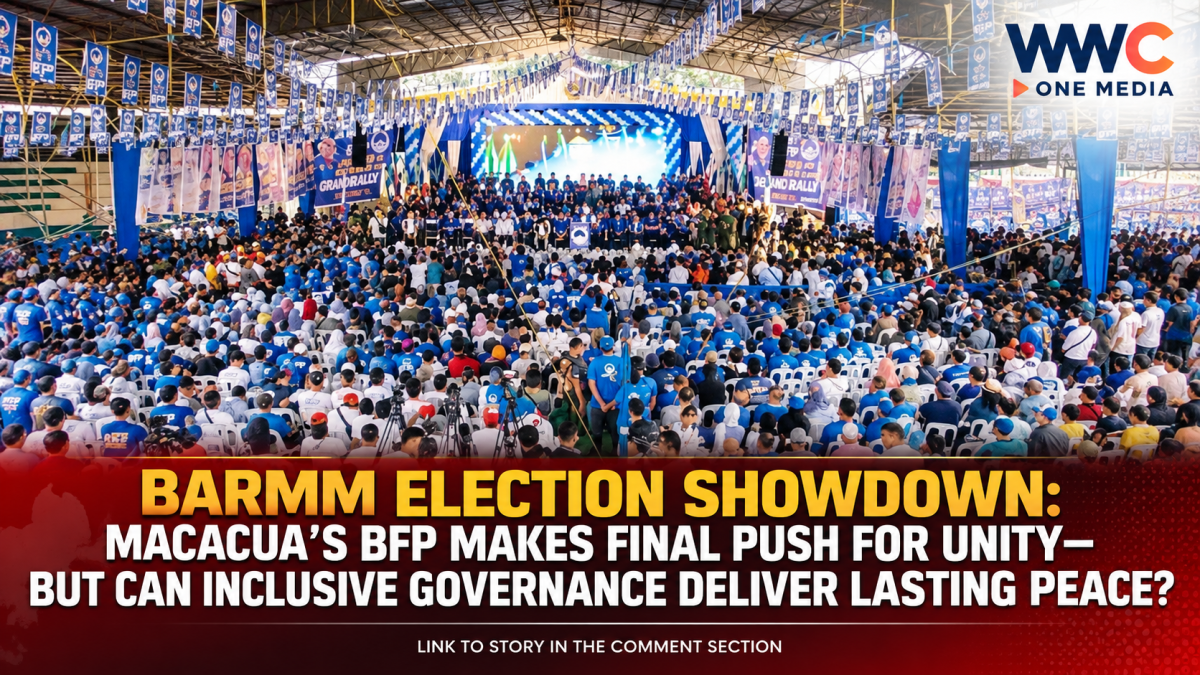
COTABATO CITY, Philippines — With the Bangsamoro Autonomous Region in Muslim Mindanao (BARMM) preparing for its first-ever parliamentary elections, Interim Chief Minister Abdulraof Macacua and the Bangsamoro Federalist Party (BFP) have made a final appeal to voters with a promise centered on unity, inclusive governance, peace and development.
At the BFP’s Miting de Avance and Grand Rally on September 12, Macacua said the party wants to bring together the Bangsamoro’s diverse Muslim, Lumad and Christian communities under a government that serves all sectors equally.
“Our goal is to unify the Bangsamoro and its people,” Macacua said, describing the BFP as a party that does not discriminate based on religion or background. He stressed that sustainable progress in the region can only be achieved if all communities move forward together.
Unity Becomes BFP’s Final Election Message
The BFP closed the 45-day campaign period by putting unity at the center of its political platform, arguing that inclusive leadership must extend beyond campaign promises and into the actual delivery of government services, development programs and economic opportunities.
Macacua said the Bangsamoro’s long-term progress depends on leadership that reaches every community and strengthens public trust in regional institutions.
The message comes at a historic moment for BARMM. On September 14, voters are set to elect members of the region’s parliament in its first regular parliamentary polls, a major milestone in the transition from decades of armed conflict toward democratic self-governance. Around 2.4 million registered voters are expected to participate in the election for the 80-seat Bangsamoro Parliament.
The Commission on Elections’ certified list includes the Bangsamoro Federalist Party among the political parties contesting regional parliamentary seats, highlighting the increasingly competitive and party-based nature of the Bangsamoro’s new political system.
Macacua Links Moral Leadership to Good Governance
Beyond political unity, Macacua also emphasized what he described as values-based governance.
The interim chief minister said the BFP would pursue programs aimed at strengthening Islamic consciousness, arguing that morality, accountability and compassion should remain central to public service.
According to Macacua, stronger ethical foundations could support the region’s broader campaign against corruption and help build more accountable institutions.
The message is closely aligned with the Bangsamoro government’s wider governance direction. Earlier this year, Macacua’s administration launched the “Mas Matatag na Bangsamoro” framework, built around stronger government institutions, sustainable livelihoods, resilient communities, peace and security, and faith-driven governance.
A Historic Election With Peace and Security at Stake
The September 14 elections are widely seen as one of the most important developments in the Bangsamoro peace process since the 2014 peace agreement between the Philippine government and the Moro Islamic Liberation Front.
The creation of BARMM was intended to provide greater autonomy and establish democratic institutions capable of addressing decades of conflict, underdevelopment and political instability.
But the transition has also faced serious challenges, including political rivalries, security concerns and isolated incidents of election-related violence. Philippine authorities have nevertheless maintained that the parliamentary elections will proceed, describing the polls as a critical step toward strengthening democratic governance in the region.
More than a campaign contest, the election represents a major test of whether the Bangsamoro can successfully transition toward a stable parliamentary democracy built around political parties rather than the traditional personalities and clan-based politics that have long shaped parts of Mindanao.
Can Inclusive Politics Protect BARMM’s Peace Gains?
For Macacua and the BFP, the answer lies in unity.
The party’s final campaign message focused on building a government that recognizes the Bangsamoro’s religious, cultural and ethnic diversity while ensuring that public services and development opportunities reach all communities.
That approach also echoes the broader principles promoted by the Bangsamoro Parliament, which has repeatedly emphasized moral governance, the fight against corruption and peaceful, issue-based political participation ahead of the elections.
As BARMM voters head to the polls, the stakes extend far beyond which political party wins the most seats.
The outcome could shape how the region governs itself, protects the gains of the peace process and addresses the demands of millions of Bangsamoro residents in the years ahead.
Macacua’s BFP has now made its position clear: unity, inclusion and accountable governance are at the heart of its promise.
But as the Bangsamoro enters a new chapter in its political history, the bigger question remains — can the region turn those promises into a stronger, more peaceful and truly inclusive government after the votes are counted?



Leave a Reply