
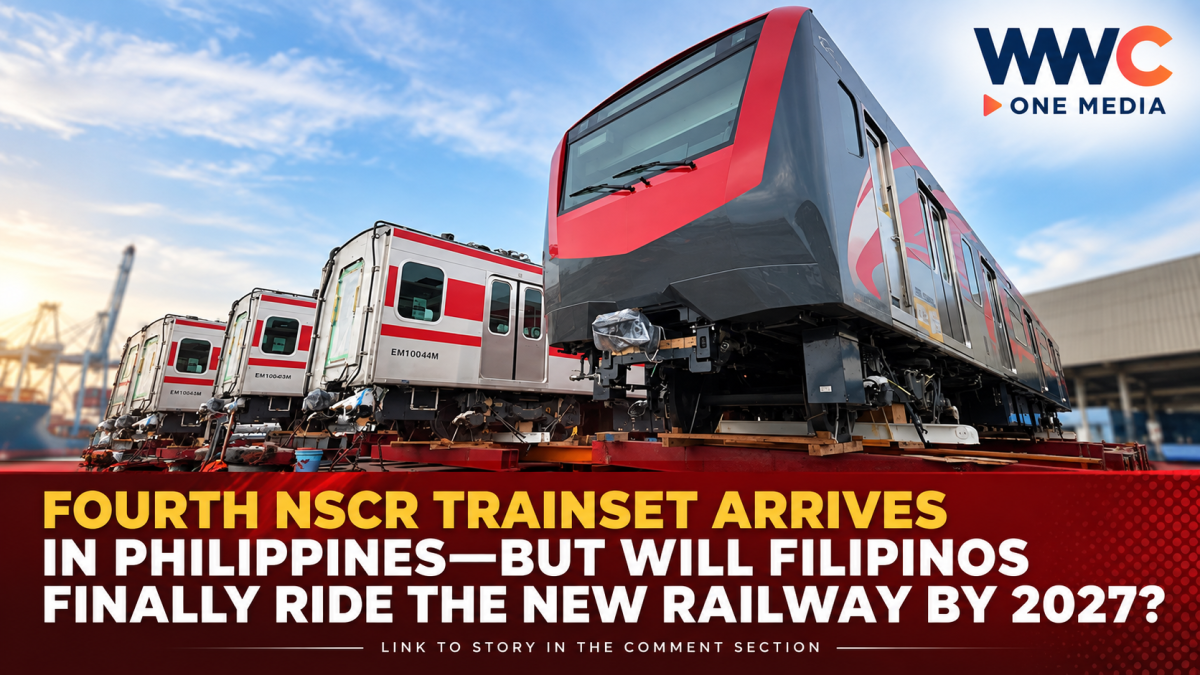
MANILA, Philippines — The Philippines has received another major piece of its ambitious railway transformation after the fourth eight-car trainset for the North-South Commuter Railway (NSCR) arrived in the country.
The Department of Transportation (DOTr) confirmed that the newest Electric Multiple Unit (EMU) trainset will eventually serve the NSCR Malolos-Tutuban segment, bringing the government one step closer to its target of opening the first portion of the massive railway system in 2027.
According to Transportation Secretary Giovanni Lopez, the newly arrived trainset is currently undergoing importation procedures with the Bureau of Customs before being transported to the Malanday Depot in Valenzuela.
The trainset was procured from Japan Transport Engineering Co. and Sumitomo Corp. as part of the NSCR’s rolling stock program.
Fourth Trainset Arrives as NSCR Construction Accelerates
The arrival of the fourth eight-car trainset marks another milestone for what is expected to become one of the Philippines’ most important transportation projects.
Just weeks earlier, the Philippine Information Agency reported the arrival of the third NSCR eight-car trainset. At the time, officials said additional trainsets were expected to arrive as the government accelerated preparations for testing and eventual operations.
The government is initially preparing seven trainsets for the partial operations between Valenzuela City and Malolos, Bulacan.
Earlier reports from PIA said two trainsets had already begun initial testing at the NSCR depot near the boundary of Meycauayan, Bulacan and Valenzuela City. The arrival of additional trains is expected to support the transition from depot testing to eventual testing on completed railway tracks.
Target: First NSCR Operations by December 2027
The DOTr is targeting the completion of the Bulacan phase of the NSCR, stretching from Valenzuela to Malolos, by December 2027.
President Ferdinand Marcos Jr. has also publicly identified the Valenzuela-Malolos section as the first segment expected to begin operations, with the government pushing to extend railway service toward Clark before the end of the current administration.
The planned opening would mark a major development for commuters in Bulacan and northern Metro Manila, particularly along a corridor that has long struggled with heavy traffic and limited transportation options.
But the biggest question now is whether construction, systems installation, track testing and operational preparations can all stay on schedule.
A 147-Kilometer Railway Connecting Three Major Regions
The full North-South Commuter Railway is planned as a 147-kilometer railway network with 35 stations connecting Central Luzon, Metro Manila and Calabarzon.
Once completed, the NSCR will eventually connect areas from Clark International Airport in Pampanga to Calamba, Laguna.
Government reports have described the NSCR as the country’s largest railway project and a key component of efforts to modernize public transportation.
The system is expected to eventually serve around 800,000 passengers daily and could significantly reduce travel time across the north-south corridor. Previous government reports estimated that travel between Clark and Calamba could be reduced to about two hours compared with roughly four hours by road.
More Than Just New Trains
The arrival of new trainsets is only one part of the massive project.
For trains to begin commercial operations, the government must also complete major civil works, install railway systems and electrical equipment, conduct extensive testing and ensure that stations and depots are ready.
PIA reported in July that track installation was continuing toward Malolos, while the project was also preparing for the installation of catenary systems that will supply electricity to the trains.
The NSCR trains are brand-new electric commuter trains built in Japan specifically for the Philippine railway system.
Government plans call for a total of 51 commuter trainsets for the broader NSCR system, with additional trainsets intended for express services that will stop at selected major stations.
Billions Released to Keep Major Rail Projects Moving
The Marcos administration has also moved to maintain funding for major railway projects.
In March, the Department of Budget and Management announced the release of P44.17 billion to help accelerate the Metro Manila Subway and NSCR projects.
The funding was intended to support critical loan requirements and keep the implementation of the major transportation projects moving forward.
Meanwhile, the government is also preparing for the long-term operation and maintenance of the NSCR. In July, The Philippine Star reported that at least 10 local and foreign companies were expected to participate in bidding related to the railway’s P229-billion operations and maintenance concession.
Could 2027 Finally Be the Year Filipinos Ride the New NSCR?
With four trainsets now in the Philippines, additional rolling stock expected, testing preparations underway and construction continuing, the NSCR is gradually moving from a massive infrastructure project on paper toward an operational railway.
For commuters, however, the real milestone will come when passengers finally board the trains.
The government is aiming to begin partial operations between Valenzuela and Malolos by December 2027 before eventually expanding service farther north toward Clark and south toward Calamba.
If the timetable holds, the NSCR could become a major turning point for Philippine transportation—offering a faster alternative to traffic-clogged roads and reconnecting communities across Luzon through a modern electric railway system.
But as the fourth trainset arrives, attention is now shifting to the next and most difficult phase: completing the tracks, stations and railway systems needed to finally put the trains into service.
The trains are arriving. The tracks are being built. But can the Philippines deliver its long-awaited railway to passengers by 2027?




Leave a Reply