
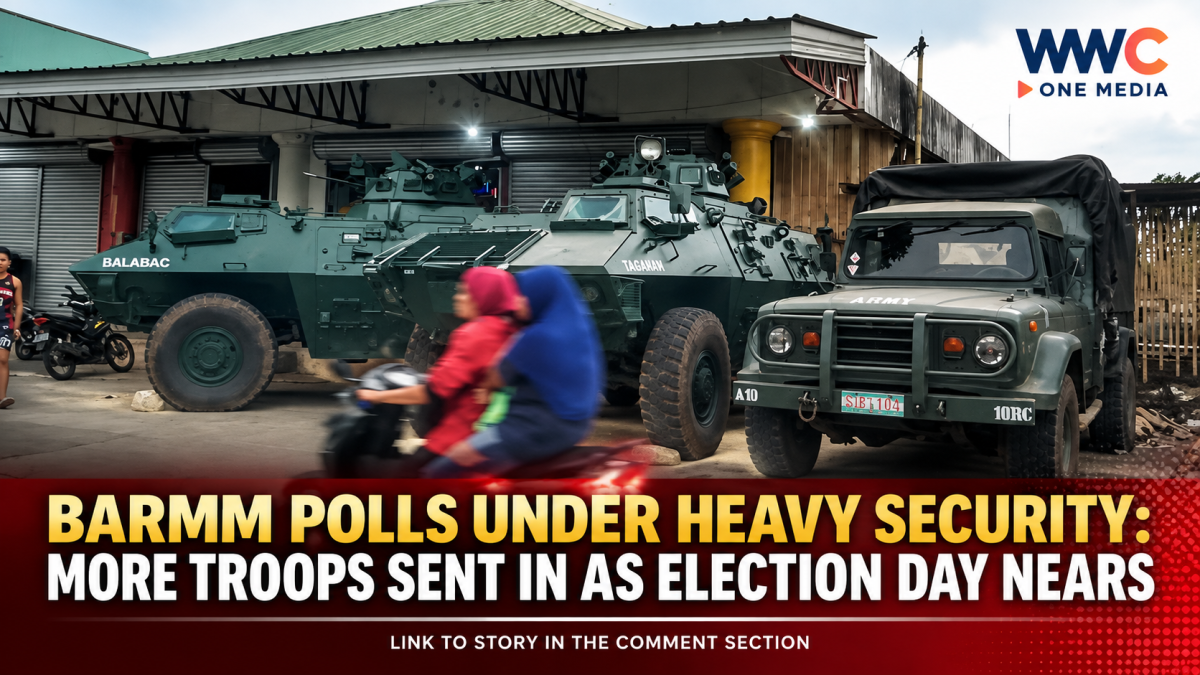
The Philippine military is tightening security across the Bangsamoro Autonomous Region in Muslim Mindanao (BARMM) as the region prepares for its first-ever parliamentary elections on September 14, with additional troops being deployed to areas considered vulnerable to election-related violence.
The latest reinforcement includes personnel from the Philippine Army’s 4th Infantry Division (4ID), whose units have been tapped to augment security operations in the Bangsamoro region.
The deployment comes as authorities move into the final stretch of preparations for a historic vote involving about 2.4 million registered voters who will choose the members of the 80-seat Bangsamoro Parliament.
4ID troops reinforce election security
The Army’s 4ID is among the units contributing personnel to the broader security operation in BARMM.
On Sept. 7, the 75th Infantry Battalion from the 4ID was among two Army support battalions deployed to help secure polling areas in Maguindanao del Sur and Maguindanao del Norte. The other unit came from the 10th Infantry Division.
The two battalions were tasked with supporting security operations covering 15 municipalities in Maguindanao del Sur and three towns in Maguindanao del Norte, according to the 601st Infantry “Unifier” Brigade.
The move forms part of a much larger military buildup.
The Philippine Army said it had already deployed 11,900 soldiers and CAFGU Active Auxiliary members from the 1st, 6th and 11th Infantry Divisions as of Sept. 6, with additional forces from the 10th Infantry Division also augmenting election security operations.
Why is security being intensified?
The heightened security comes amid concerns over political rivalries, clan conflicts and previous incidents of violence in parts of BARMM.
The Commission on Elections has classified 108 areas as election areas of concern: 15 green, 39 yellow, 27 orange and 27 red, the highest-risk classification.
Many of the red-category areas are concentrated in Maguindanao del Sur, Maguindanao del Norte and Lanao del Sur, prompting authorities to concentrate additional military and police personnel in those areas.
PNP chief Gen. Jose Melencio Nartatez Jr., however, has maintained that the overall security situation remains “under control.” He said police forces are focused on preventing election-related violence and protecting voters, candidates and election workers.
More than 20,000 security personnel involved
The military deployment is only part of the security operation.
The Philippine Army previously reported that nearly 12,000 soldiers and auxiliary personnel had been deployed, while the PNP said more than 9,000 police personnel were being positioned for election duties.
The combined deployment is part of an effort involving the AFP, PNP and other government agencies to ensure voters can cast their ballots safely.
President Ferdinand Marcos Jr. earlier authorized the deputation of the AFP, PNP and other government agencies to assist the Comelec in conducting the elections under Memorandum Order No. 48.
Military assets also being positioned
The security preparations go beyond additional troops.
The AFP has also deployed military assets to areas requiring reinforcement. In Lanao del Sur, the 1st Infantry Division has added Sabrah light tanks, ATMOS 155mm self-propelled artillery systems, additional ground troops and air assets to support election security operations.
Earlier, the AFP also announced the deployment of four additional battalions, two of which came from the 4ID and 10ID, with forces placed under the operational control of the 6th and 1st Infantry Divisions.
A historic vote with high stakes
The Sept. 14 election will determine the 80 members of the Bangsamoro Parliament, making it a major milestone in the region’s transition toward parliamentary self-government.
The 80 seats consist of 40 party representatives, 32 district representatives and eight sectoral representatives, according to the Associated Press.
The election is also being closely watched because BARMM was created through the peace process between the Philippine government and the Moro Islamic Liberation Front (MILF).
But analysts and observers continue to point to unresolved security and political challenges, including incomplete MILF combatant decommissioning, political rivalries and the region’s history of clan-based competition and election-related violence.
Authorities promise a peaceful election
Despite the heavy deployment, military and police officials have repeatedly emphasized that their mission is not to influence the vote but to protect the electoral process.
The Army has stressed that troops are expected to remain professional, impartial and nonpartisan, while police officials have said their priority is protecting every voter’s right to freely choose their leaders.
With election day now just hours away, the scale of the security operation underscores the importance—and the risks—surrounding BARMM’s first parliamentary election.
For millions of Bangsamoro voters, Monday’s vote is more than another election. It is a test of whether decades of conflict and peace-building can finally translate into a functioning democratic system—and whether the region can hold its historic vote peacefully.



Leave a Reply