
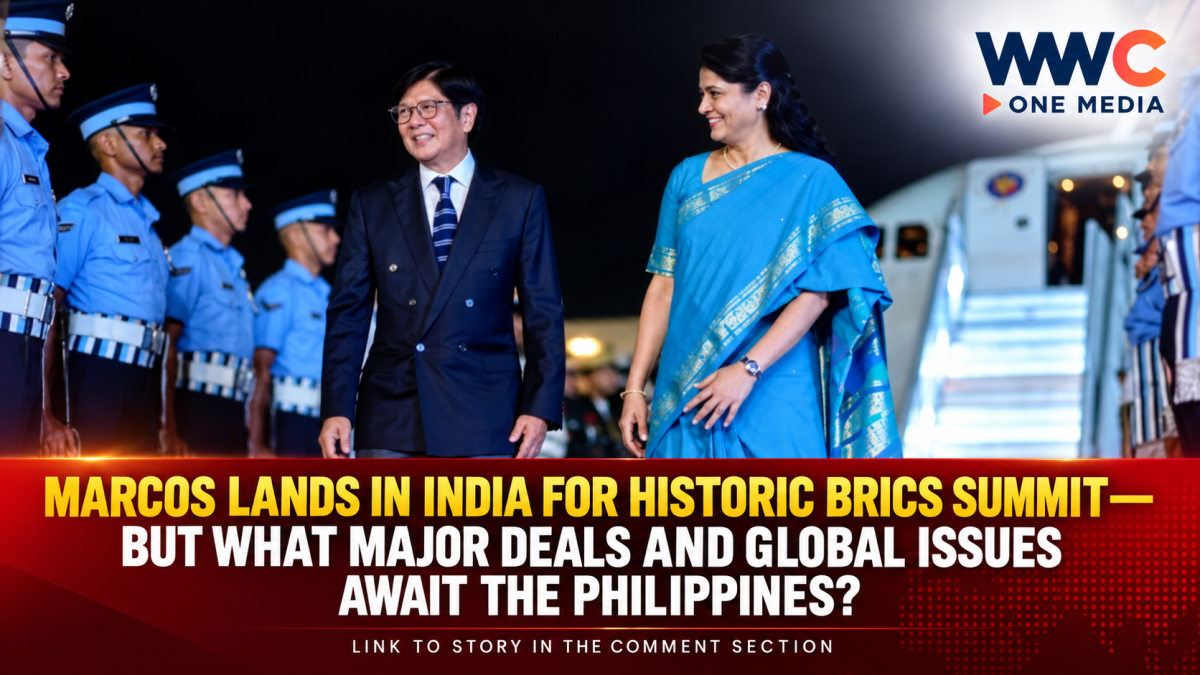
NEW DELHI, India — President Ferdinand R. Marcos Jr. has arrived in India for the 18th BRICS Summit, marking a historic first for the Philippines as he becomes the first Philippine president to personally attend the high-level gathering of emerging economies.
But Marcos’ trip to New Delhi is about more than making history.
The Philippine president is bringing the concerns of the Association of Southeast Asian Nations (ASEAN) to a summit taking place at a critical moment for the global economy, trade, energy security and international diplomacy.
According to reports from The Manila Times and the Presidential Communications Office, Marcos arrived in New Delhi to participate in the BRICS Summit and pursue stronger ties between the Philippines and India. His visit also includes discussions with Indian Prime Minister Narendra Modi as Manila seeks to expand cooperation with one of Asia’s fastest-growing major economies.
The trip comes as the Philippines looks to strengthen its diplomatic and economic partnerships while navigating an increasingly complicated global landscape.
A Historic First for the Philippines
Marcos’ participation is particularly significant because he is the first Philippine leader to attend a BRICS Summit.
The Philippines is not a BRICS member, but Marcos is attending in his capacity as ASEAN chair, giving him an opportunity to bring Southeast Asian concerns to a broader gathering of major emerging economies.
Reports by the Philippine Daily Inquirer and other Philippine media said Marcos’ attendance provides an opportunity for the Philippines to engage directly with leaders and representatives from some of the world’s largest and fastest-growing economies.
For Manila, the summit could also become a platform for promoting ASEAN priorities, including stronger economic cooperation, food and energy security, disaster resilience, sustainable development and reforms to global governance.
The Presidential Communications Office said Marcos is seeking to use the trip to strengthen Philippine-India relations while engaging other world leaders attending the summit.
Marcos Seeks Stronger Philippines-India Partnership
One of the major focuses of Marcos’ visit is the Philippines’ growing strategic relationship with India.
The president is expected to engage with Prime Minister Modi as both countries seek to deepen cooperation across multiple sectors.
The Philippines and India have increasingly expanded their relationship in recent years, particularly in areas involving trade, technology, defense, infrastructure and investment.
BusinessWorld earlier reported that Marcos was also expected to raise billions of dollars in Indian investment pledges during his India trip, highlighting Manila’s efforts to turn diplomatic engagement into concrete economic opportunities for the Philippines.
Other reports have pointed to possible cooperation in areas such as railway development, space technology and other major infrastructure and innovation projects.
This means Marcos’ India trip could potentially have implications that extend well beyond diplomacy.
The question now is whether discussions at the summit and on its sidelines will produce concrete investments, projects and partnerships.
Bringing ASEAN’s Voice to the Global Stage
Marcos is also expected to highlight ASEAN priorities during the summit.
According to reports, the Philippine president is bringing the concerns of Southeast Asia to a gathering dominated by some of the world’s most influential emerging economies.
That comes at a time when countries across Asia are confronting rising concerns over:
- global trade disruptions;
- energy and food security;
- supply chain vulnerabilities;
- regional conflicts;
- climate and disaster risks;
- technological competition; and
- reforms to international institutions.
The summit gives Marcos an opportunity to position ASEAN as a key voice in discussions about the future of the Global South.
A report by the Philippine Canadian Inquirer described Marcos as carrying both the Philippines’ voice and ASEAN priorities to the New Delhi gathering.
What Is at Stake at the BRICS Summit?
The BRICS Summit in New Delhi comes amid major geopolitical tensions.
BRICS, originally formed by Brazil, Russia, India, China and South Africa, has expanded significantly and now brings together a broader group of emerging economies.
The organization has increasingly positioned itself as an important forum for countries seeking a greater role in global economic and political decision-making.
But the group’s growth has also created new challenges.
Reuters reported that the 2026 summit is taking place against the backdrop of conflicts, energy disruptions and divisions among BRICS members, including tensions connected to the Middle East. The gathering also brings together major powers with competing interests and different approaches to relations with the United States and the wider Western alliance.
Associated Press reported that leaders at the summit have raised concerns about conflicts in the Middle East and Ukraine while discussing global governance and the role of emerging economies in international affairs.
For Marcos and the Philippines, participation in the discussions provides a rare opportunity to engage directly with a changing global order.
China, Russia and Other Major Powers Also in Focus
The New Delhi summit has attracted significant international attention because of the presence of leaders from some of the world’s biggest geopolitical powers.
One of the closely watched developments has been the engagement between Indian Prime Minister Narendra Modi and Chinese President Xi Jinping.
Reuters reported that the two leaders discussed efforts to improve business and transport links and reduce tensions in relations that have been heavily affected by their long-running border disputes.
The broader summit has also focused attention on Russia, Iran and other BRICS countries as the bloc confronts difficult questions involving wars, sanctions, trade and energy security.
These developments underscore the complicated environment in which Marcos is making his historic appearance.
The Philippines is entering the conversation at a time when emerging economies are increasingly demanding a stronger voice in global institutions, while major powers continue to compete for influence.
Can the Philippines Turn Diplomacy Into Economic Gains?
For Marcos, the biggest challenge may be turning high-level diplomacy into tangible results.
The Philippines has been actively seeking new investment sources, stronger trade relationships and partnerships in technology and infrastructure.
India represents an increasingly important potential partner.
Beyond government-to-government relations, Philippine officials are looking at opportunities involving investment, innovation, infrastructure, transportation and advanced technology.
Reports from Philippine media indicate that Marcos’ engagements in India could include discussions involving railway and space-related cooperation, while BusinessWorld previously reported that investment commitments worth billions of dollars were also expected to be part of the broader agenda.
For ordinary Filipinos, however, the ultimate question will be simple:
Will this historic trip result in new jobs, investments, infrastructure and economic opportunities?
A Historic Visit at a Crucial Moment
Marcos’ BRICS appearance comes as the Philippines attempts to balance its relationships with major powers while protecting its national interests and strengthening ties across Asia and beyond.
The president’s attendance does not make the Philippines a BRICS member.
Instead, it provides Manila with a diplomatic platform to engage a powerful group of emerging economies while representing ASEAN interests.
It also gives the Philippines an opportunity to demonstrate that its foreign policy is not limited to one region or one group of partners.
As Marcos meets world leaders in New Delhi, attention will now turn to the agreements, investment commitments and diplomatic outcomes that emerge from the visit.
The trip may be historic because Marcos is the first Philippine president to attend a BRICS Summit.
But whether it becomes truly consequential may depend on what the Philippines brings home.
Because in New Delhi, the Philippines is not just attending a summit—it is stepping into a much bigger conversation about who will shape the future of the global economy.




Leave a Reply