
After years of transition, delays and political uncertainty, the Bangsamoro Autonomous Region in Muslim Mindanao is finally approaching a defining moment: its first-ever parliamentary elections on September 14, 2026.
About 2.4 million registered voters are expected to cast their ballots to elect the region’s first regular Bangsamoro Parliament—a vote widely viewed as a major test of whether the region’s long-running peace process can translate into a stable, representative and functioning democratic government.
The expectations are enormous.
The election is not simply about choosing lawmakers. It will determine who holds political power in the Bangsamoro government and who will have a decisive role in selecting the region’s first elected chief minister.
Under the parliamentary system, voters will elect 80 members of the Bangsamoro Parliament. Forty seats will come through proportional representation, 32 through parliamentary districts, and eight will be reserved for sectoral representatives.
From armed struggle to the ballot box
The significance of the September 14 vote extends far beyond the campaign trail.
The BARMM was created through the peace process between the Philippine government and the Moro Islamic Liberation Front (MILF). The first parliamentary elections are therefore being closely watched as a crucial step in moving the region from an interim administration toward a fully elected government.
President Ferdinand Marcos Jr. has described the elections as an important product of the decades-long peace process and said the government remains committed to ensuring that the vote is safe, peaceful and credible.
For the MILF, which once pursued its objectives through armed struggle, participation in an electoral process represents another major stage in the transition toward political governance.
A battle for the future of Bangsamoro politics
The contest is also expected to reshape the political balance in the region.
The United Bangsamoro Justice Party (UBJP), the political arm associated with the MILF, is facing competition from the Bangsamoro Federalist Party and other political groups, including coalitions involving established political clans and regional leaders.
The outcome could determine whether the political forces that dominated the transition period retain influence—or whether traditional political families, new parties and other regional alliances emerge as powerful players in the new parliamentary government.
That makes the election much more than a routine regional contest.
It is effectively a test of who will define the next chapter of Bangsamoro self-governance.
Voters are choosing a different kind of government
One of the biggest challenges is that the parliamentary system is unfamiliar to many voters.
Unlike the presidential system used nationally, the BARMM chief minister will not be directly elected by voters.
Instead, the newly elected parliament will select the chief minister from among its members. The chief minister will then form a Cabinet that is accountable to the legislature.
Because of this, the composition of the 80-member parliament could be just as important as the individual candidates who win district seats.
The Commission on Elections has consequently intensified voter education efforts, particularly in geographically isolated communities. Officials have identified misconceptions about the parliamentary system, over-voting, vote buying, vote selling, fake news and disinformation as challenges that could affect the election.
Security remains a major concern
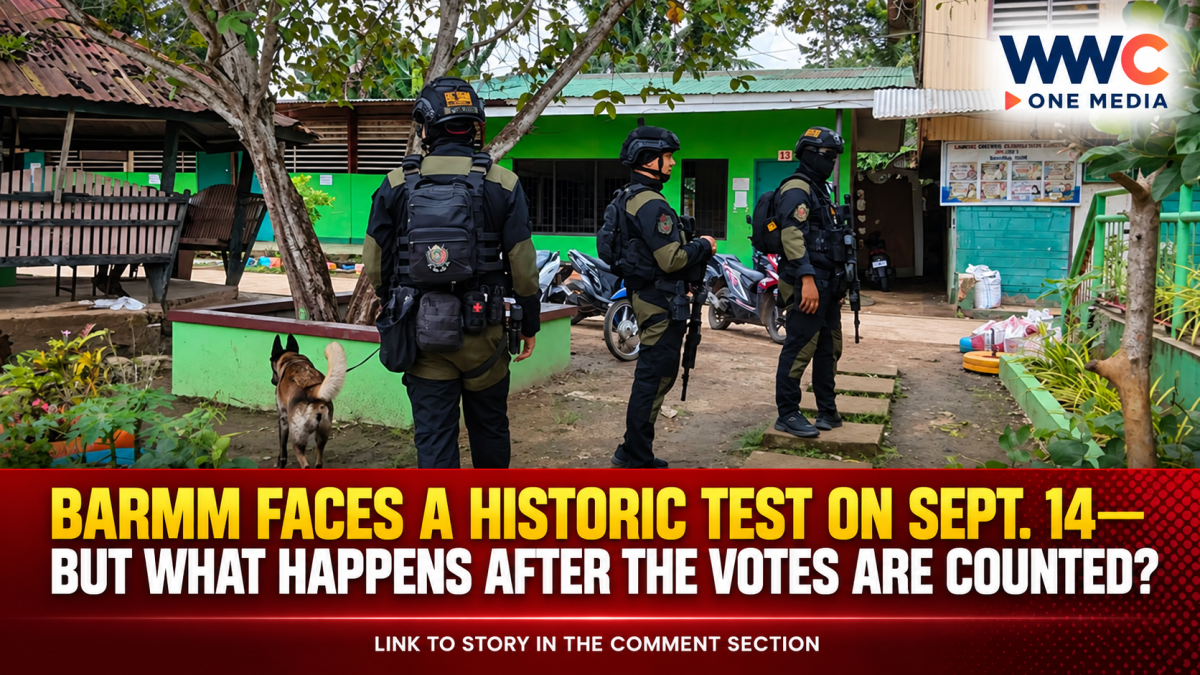
While expectations are high, the election is taking place against a backdrop of continuing security concerns.
The AFP has intensified preparations across the region, while Comelec has identified 27 areas under the highest “red” security classification because of serious threats and previous incidents of election-related violence.
The concern is not theoretical.
Just days before the election, two brothers were killed in a shooting in Paglat, Maguindanao del Sur, despite the continuing election gun ban, underscoring the security challenges surrounding the historic vote.
MILF chair Ahod Balawag “Al Haj Murad” Ebrahim has also called for international election observers, arguing that outside monitoring could help strengthen confidence in the credibility and integrity of the polls.
Comelec says preparations are on track
Despite the challenges, election officials say preparations are moving forward.
Comelec Chair George Erwin Garcia reported that election materials were being delivered throughout the region, with the poll body preparing for final testing and sealing of automated counting machines on September 12. The election will cover 5,212 precincts across BARMM.
Authorities have also been working on power and security preparations to prevent disruptions during voting and the transmission of results.
The election calendar places the campaign period from July 30 to September 12, followed by election day on September 14.
Why September 14 matters
The road to the first BARMM parliamentary elections has not been straightforward.
The elections were postponed multiple times, originally envisioned for 2022 before being moved to later dates. The government ultimately reset the polls to September 2026 through Republic Act No. 12317.
The delays gave authorities additional time to address institutional, legal and districting issues—but they also increased public expectations surrounding the eventual vote.
Now, the region is approaching the moment when the interim political structure will give way to elected representatives.
The elected officials are scheduled to assume office on October 30, 2026, and their initial term will run until June 30, 2031.
The bigger question comes after election day
For Bangsamoro voters, September 14 is therefore about more than simply filling 80 parliamentary seats.
The bigger question is whether the new government can deliver on the promises that have accompanied the peace process for years: better public services, economic opportunities, jobs, security, inclusive governance, transitional justice and lasting peace.
The first parliamentary election will provide the political foundation.
But the real test begins after the ballots are counted.
If the vote is peaceful, credible and broadly accepted, it could mark one of the most consequential steps yet in the transformation of Bangsamoro from a region shaped by armed conflict into a functioning parliamentary democracy.
If political rivalries, violence, disinformation or disputes over the results overshadow the process, however, the new government could face a difficult start.
On September 14, Bangsamoro voters will choose their parliament. But what they are ultimately deciding is who gets to shape the region’s future—and whether the promise of the peace process can finally be translated into effective government.


Leave a Reply