
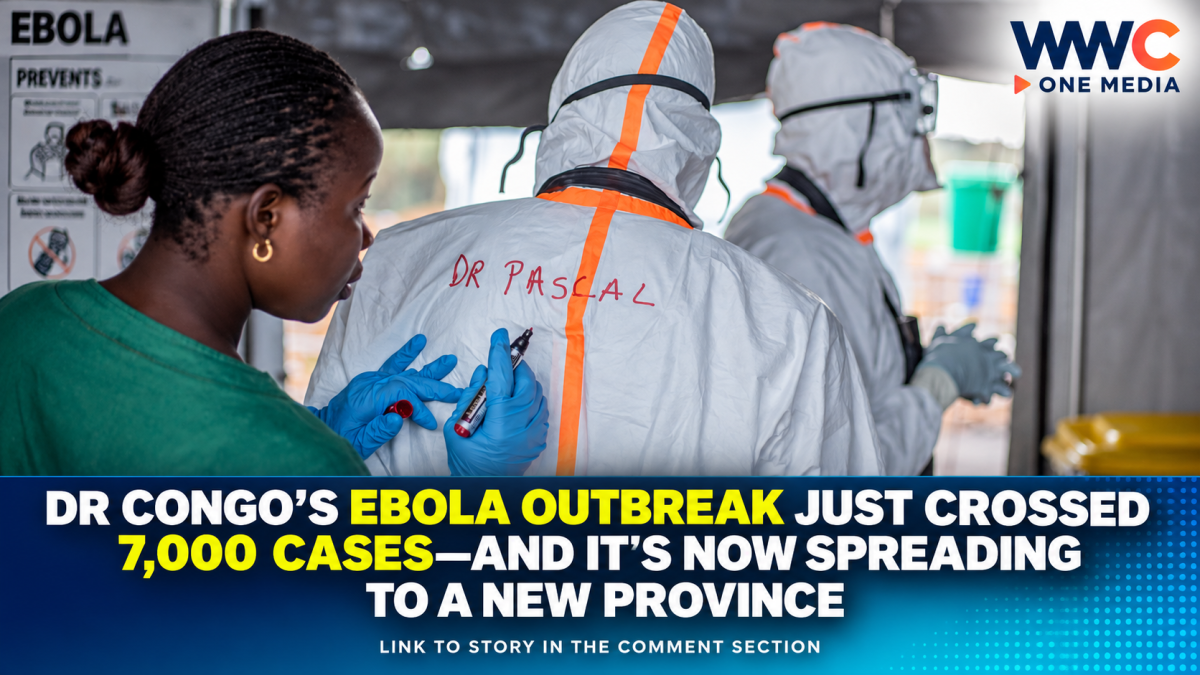
KINSHASA, Democratic Republic of Congo — The Democratic Republic of Congo’s Ebola outbreak has crossed a grim new milestone, with 7,022 confirmed cases and 3,398 deaths, as the virus continues spreading beyond its original epicenter and has now reached a seventh province.
The latest figures from Congolese authorities, reported by Reuters on September 11, show that the outbreak has become the largest and deadliest Ebola epidemic ever recorded in the Democratic Republic of Congo, surpassing the country’s 2018–2020 epidemic.
The outbreak is being caused by the Bundibugyo virus, a rare Ebola species. Authorities officially detected the epidemic in mid-May, although health experts believe the virus may have been circulating undetected for weeks before it was identified.
The virus has now reached a seventh province
The latest development has intensified concern among health authorities: Ebola has been detected in South Ubangi, in northwestern Congo, hundreds of kilometers from the outbreak’s main center in the northeast.
According to Reuters and AP, the confirmed case involved a 23-year-old man who died on September 8. He had reportedly left South Kivu in July, traveled abroad and subsequently returned to Congo before reaching South Ubangi. Health authorities have begun contact tracing around the case.
The geographic expansion is particularly worrying because South Ubangi borders both the Central African Republic and the Republic of Congo, increasing concerns about possible cross-border transmission.
Ituri remains the epicenter
The northeastern province of Ituri continues to bear the brunt of the epidemic.
WHO reported that, as of September 7, Ituri had recorded 5,406 confirmed cases, accounting for the overwhelming majority of infections in the country. The agency also reported that cases had been detected across 61 health zones in six provinces at that point.
The outbreak has also expanded through areas affected by armed conflict, displacement, limited health infrastructure and difficult access to medical facilities.
Those conditions are making conventional outbreak-control measures—including surveillance, testing, contact tracing and early treatment—far more difficult.
Why health officials are struggling to contain it
The World Health Organization has warned that the response is being hampered by a shortage of trained personnel, operational partners and funding.
WHO said the country needs additional treatment capacity and thousands more health workers as the outbreak continues expanding geographically. The agency has estimated that approximately 5,000 additional health workers could be needed to support planned treatment capacity.
The crisis is unfolding amid insecurity, population movement and displacement—factors that can make it harder for response teams to locate contacts and identify infections before transmission continues.
WHO has assessed the risk as very high inside the Democratic Republic of Congo and high for countries sharing land borders with the country, while the risk to the wider African region and globally remains low based on currently available information.
A different Ebola strain creates another challenge
The current epidemic is caused by Bundibugyo virus, rather than the Zaire species responsible for the major West African Ebola epidemic of 2014–2016.
That distinction matters because the vaccines and treatments developed for other Ebola species cannot simply be assumed to work against Bundibugyo virus.
WHO says there is currently no approved vaccine specifically for Bundibugyo virus disease. The licensed Ervebo vaccine is being used for healthcare and frontline workers only within a research context, while researchers are testing potential treatments and vaccine strategies.
A clinical trial known as the PARTNERS trial began enrolling patients in July to investigate potential treatments for Bundibugyo virus disease.
Bigger than Congo’s previous Ebola record
The scale of the current outbreak is unprecedented for the country.
The major Ebola epidemic that struck North Kivu and Ituri between 2018 and 2020 resulted in 3,470 total cases and 2,287 deaths, according to WHO. It was previously the Democratic Republic of Congo’s largest Ebola outbreak.
The current outbreak has already more than doubled that case total.
Globally, however, it still trails the enormous 2014–2016 West African Ebola epidemic, which infected more than 28,600 people and killed more than 11,000 in Guinea, Liberia and Sierra Leone. Reuters described the current Congo outbreak as the second-largest by confirmed infections.
The numbers may not tell the whole story
One of the most troubling aspects of the outbreak is the possibility that official figures could underestimate the true scale of transmission.
Earlier reporting by the Washington Post found that doctors and humanitarian workers in affected communities believed many infections and deaths could be going undetected because of limited surveillance, misinformation, fear and difficulty reaching patients.
WHO has also noted that increases in reported cases can reflect improved surveillance, expanded laboratory testing and the reconciliation of previously unreported data—but it has simultaneously documented sustained community transmission and geographic expansion.
What happens next?
For Congo and its neighbors, the immediate challenge is preventing the virus from establishing additional chains of transmission outside the current outbreak zones.
That means rapidly identifying suspected cases, isolating and caring for patients, tracing contacts, strengthening infection-control measures and working with communities to counter misinformation.
The arrival of Ebola in South Ubangi has added another layer of urgency because the province is far from the original epicenter and sits near international borders.
For now, WHO is not recommending general travel or trade restrictions related to the outbreak. Instead, the agency is calling for stronger surveillance, cross-border coordination and rapid detection of cases.
But with more than 7,000 confirmed infections, nearly 3,400 deaths and the virus spreading into another province, the question facing Congo and the international health community is becoming increasingly urgent:
How far can the outbreak spread before containment efforts catch up with it?


Leave a Reply