
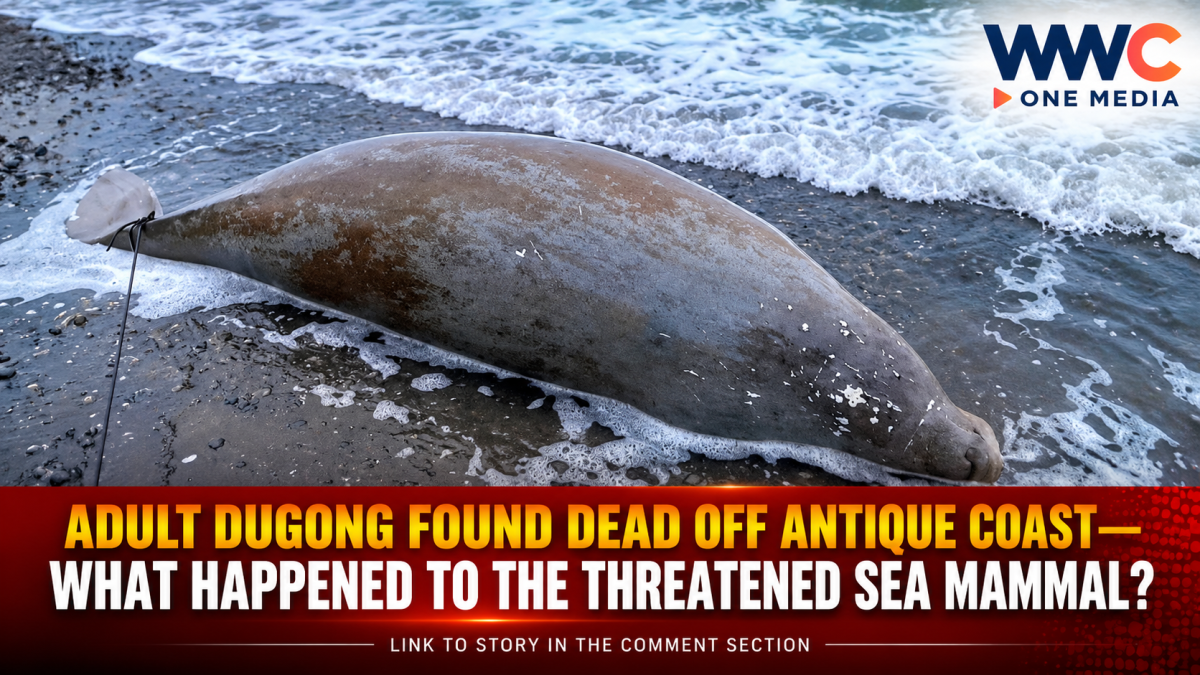
SEBASTE, ANTIQUE — Concern grew over the condition of marine wildlife in Antique after a large adult dugong was found dead along the coast of Barangay Aras-Asan in Sebaste town on Monday, September 7.
The discovery came just one day after residents in nearby Caluya town rescued a juvenile dugong that had become stranded during low tide, successfully helping the young sea mammal return to the water.
The adult dugong, scientifically known as Dugong dugon, was found along the shoreline and was examined by authorities and local personnel. Fisheries technologist and biodiversity researcher Flord Nicson Calawag said photographs indicated that the animal appeared to be a large adult.
Some superficial marks and abrasions were visible on its body, but Calawag cautioned that photographs alone cannot determine how the animal died.
Cause of death remains unknown
One possible explanation is that strong waves associated with the prevailing southwest monsoon, or habagat, may have pushed the carcass toward the shoreline.
However, being washed ashore does not necessarily explain what killed the dugong.
A proper examination or necropsy would be necessary to determine whether the animal may have died from fishing-related incidents, marine debris ingestion, a vessel collision, disease, natural causes, or other human-related factors. Authorities had not yet released a definitive cause of death at the time of the report.
This distinction is important because there is currently no confirmed evidence that fishing activity, marine debris or a boat strike caused the Antique dugong’s death.
Two dugong incidents in two days
The death has attracted particular attention because it followed the rescue of a juvenile dugong on Liwagao Island in Barangay Sibolo, Caluya, on September 6.
The juvenile was found in shallow water during low tide, prompting residents to intervene and help return it to the sea.
There is no indication that the two incidents are connected. Still, their occurrence on consecutive days highlights the presence of dugongs in Antique waters and raises renewed questions about the protection of their coastal habitat.
Dugongs depend heavily on seagrass meadows, which serve as an important source of food. The species is particularly vulnerable because it has a slow reproductive rate, making the loss of mature animals especially significant to local populations.
Why the death matters
Dugongs are already under pressure across their range from human activity and habitat degradation. The International Union for Conservation of Nature (IUCN) classifies the dugong globally as Vulnerable, citing threats including accidental capture in fishing gear, habitat loss, pollution and vessel traffic.
The species faces an even more serious conservation situation in the Philippines. The Department of Environment and Natural Resources has described the dugong as critically endangered in the country, with conservation efforts focused on protecting remaining populations and their habitats.
Historical incidents also show why determining the cause of death can be important. In 2022, a roughly 700-kilogram dugong stranded off Belison, Antique, underwent a necropsy by SEAFDEC/AQD and the National Museum Western Visayas. Investigators reported signs consistent with a possible boat strike, while a fishhook, fishing line and plastic material were also recovered from its gut. Those findings involved a different animal and should not be treated as evidence about the cause of death of the newly discovered Sebaste dugong.
Protected under Philippine wildlife law
The dugong is protected under the country’s wildlife conservation framework. Republic Act No. 9147, or the Wildlife Resources Conservation and Protection Act of 2001, prohibits unauthorized acts including the killing, injury, collection, possession and transport of protected wildlife, subject to the law’s specific exceptions and provisions. The law also places dugongs under the jurisdiction of the Department of Environment and Natural Resources.
For the Sebaste incident, however, authorities have yet to establish whether the animal’s death resulted from natural causes, environmental conditions or human activity.
That determination will depend on further examination of the carcass.
A warning for Antique’s coastal communities
The back-to-back incidents involving a juvenile dugong and a dead adult underscore the importance of protecting the province’s seagrass-rich coastal waters.
Residents and visitors who encounter stranded, injured or dead marine mammals are advised to avoid unnecessarily handling or disturbing the animals and to report them to the appropriate local and environmental authorities.
For now, the biggest unanswered question remains: What caused the adult dugong in Sebaste to die?
Until a necropsy or other scientific examination is completed, any claim identifying a specific cause would be premature.
WWC ONE MEDIA J.M.S



Leave a Reply