
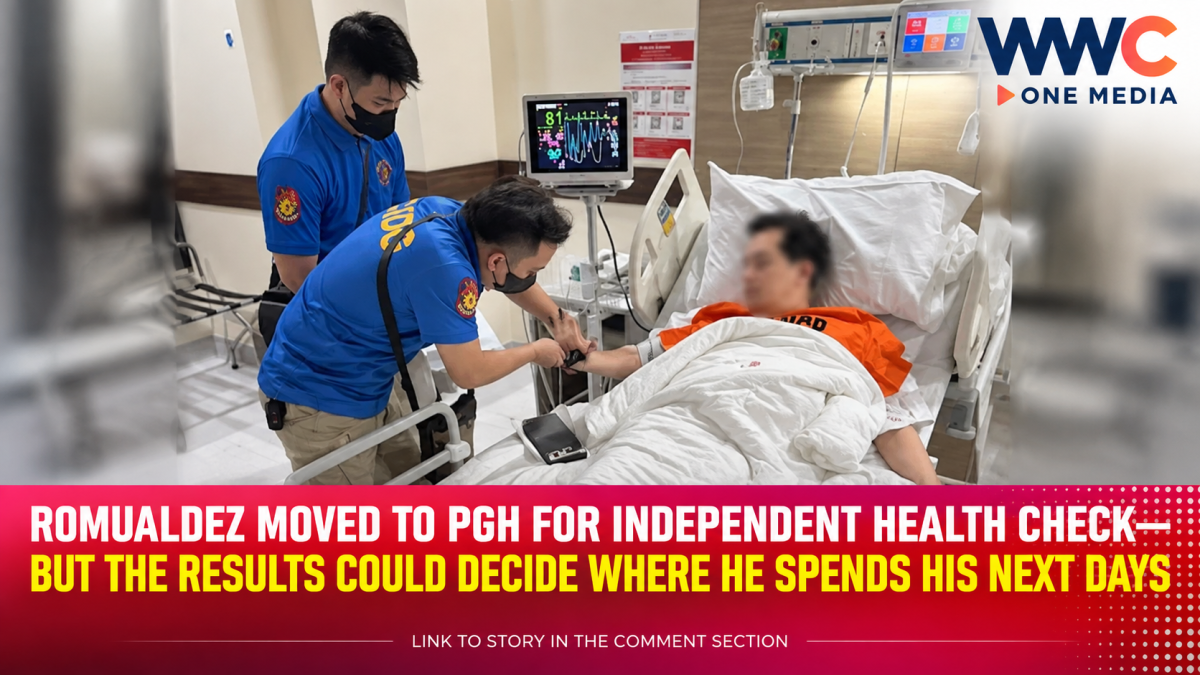
Manila, Philippines — September 12, 2026. The Philippine General Hospital (PGH) has pledged to conduct an objective and professional medical assessment of former House Speaker and Leyte 1st District Representative Martin Romualdez, whose health has become a central issue in determining where he should remain in custody.
Romualdez was transferred Saturday morning from Cardinal Santos Medical Center in San Juan City to PGH in Manila following an order from the Sandiganbayan Third Division for an independent medical examination.
The assessment could become a crucial turning point in the dispute over whether Romualdez should continue receiving treatment in a hospital or be transferred to the New Quezon City Jail, where the court had previously ordered his detention.
PGH: Review Will Be Independent
PGH said it has assembled a panel of specialists who will conduct their own examinations and diagnostic tests.
The government hospital stressed that its assessment will be conducted according to professional medical standards, without being influenced by Romualdez’s existing medical team.
The Sandiganbayan directed PGH officials to determine whether there is a genuine medical necessity for Romualdez to remain confined in a hospital. The hospital is expected to submit its findings and recommendations to the court by September 13, with a representative expected to testify about the assessment on September 14.
The Bureau of Jail Management and Penology (BJMP) confirmed that Romualdez arrived at PGH at approximately 8:45 a.m. Saturday, in compliance with the court order. BJMP said it will await further instructions from the Sandiganbayan regarding his eventual transfer to the Quezon City Jail.
Why Romualdez’s Health Became A Court Issue
Romualdez has been under hospital confinement since September 7, when authorities served an arrest warrant against him at Cardinal Santos Medical Center.
His doctors have cited several medical conditions, including cardiovascular and cerebrovascular problems, hypertension and other ailments. During the Sandiganbayan hearings, his cardiologist also testified that his blood pressure had reached 170/110 on September 10.
His psychiatrist testified that Romualdez had been diagnosed with depressive disorder with anxiety.
However, the medical testimony has also raised questions about the necessity of continued confinement in a private hospital.
Dr. Rosalio Torres, the coordinator of Romualdez’s medical team, told the court that no surgery or invasive medical procedure was scheduled at the time of his testimony. His cardiologist, Dr. Rody Sy, meanwhile, argued that Romualdez could require rapid access to specialized cardiac facilities if a serious event occurred.
Court Wants A Separate Medical Opinion
The Sandiganbayan’s decision to send Romualdez to PGH followed the hearings over his request to remain hospitalized rather than be transferred to a regular detention facility.
The court emphasized that hospital confinement should be based on medical necessity, rather than a person’s political position, wealth or influence. The independent assessment is therefore intended to give the court another medical basis for deciding what happens next.
The Ombudsman’s office has opposed continued hospital detention and previously said it would seek an assessment by government doctors to determine whether Romualdez’s conditions could be managed outside a hospital.
Ombudsman Jesus Crispin “Boying” Remulla has publicly argued that the same rules should apply regardless of a person’s status, while Romualdez’s camp has maintained that his medical conditions are genuine and documented by his doctors.
The Bigger Case Behind The Medical Dispute
The hospital controversy is unfolding against the backdrop of a ₱7.4-billion plunder case involving alleged irregularities in government flood-control projects.
The Ombudsman filed the case before the Sandiganbayan against Romualdez and three other individuals. Romualdez’s camp has denied wrongdoing and said he is prepared to face the allegations in court.
For now, Romualdez remains at PGH while the court awaits the independent medical findings.
The key question is no longer simply whether Romualdez has medical conditions. It is whether the independent government hospital’s assessment will establish that those conditions require continued hospital confinement—or whether he can safely be transferred to the detention facility ordered by the court.
That determination could directly shape the next chapter of the high-profile flood-control case.




Leave a Reply