
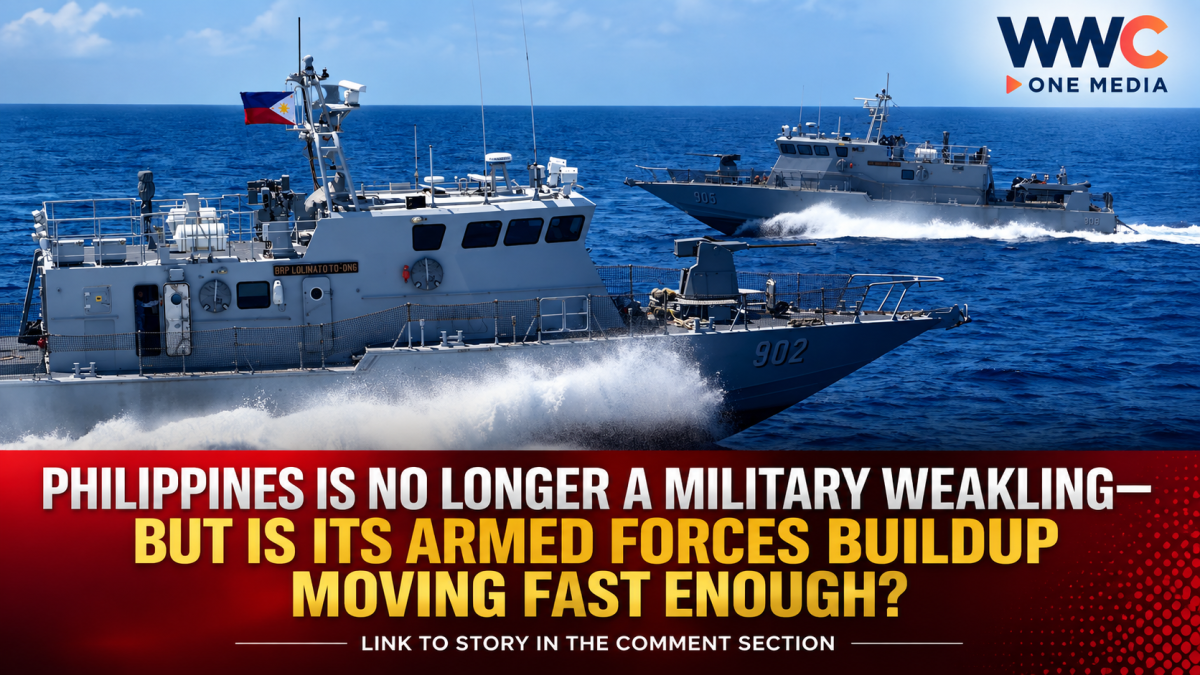
The Philippines is no longer the militarily under-equipped nation it was just a decade ago.
After years of modernization, Manila has acquired new warships, fighter aircraft, missile systems, radars and surveillance capabilities while dramatically expanding defense cooperation with the United States, Japan and other allies.
But as tensions continue to rise in the South China Sea and the wider Indo-Pacific, a critical question is becoming harder to ignore:
Can the Philippines modernize its military fast enough?
The country has made major progress in transforming the Armed Forces of the Philippines, which for decades focused largely on fighting insurgencies and internal security threats. Today, however, the country’s defense strategy is increasingly focused on external defense, maritime security and protecting Philippine territory and waters.
Yet defense officials and security analysts continue to warn that major capability gaps remain.
From Internal Security to External Defense
For much of its modern history, the Philippine military concentrated on domestic security challenges, including communist insurgents, separatist groups and extremist organizations.
That meant the country invested relatively little in advanced naval, air and missile capabilities needed to defend its vast maritime territory.
The situation has changed dramatically.
Growing confrontations between Philippine and Chinese forces in the South China Sea have pushed Manila to accelerate its shift toward territorial and external defense. Incidents involving Chinese coast guard and maritime forces have repeatedly raised concerns about the Philippines’ ability to protect its exclusive economic zone and resupply its forces in disputed areas.
The Philippine government has responded by investing in more advanced military equipment and strengthening alliances with security partners.
Reuters reported in August that the Philippines is now seeking to further expand its unmanned military capabilities, including drones, while also pursuing additional guided-missile corvettes and other major defense assets. Defense Secretary Gilberto Teodoro said the modernization effort is increasingly focused on surveillance, communications, networking and external defense capabilities.
More Missiles, Warships and Drones
The modernization of the Philippine military is no longer limited to replacing aging equipment.
Manila is attempting to build a force capable of detecting threats earlier, monitoring vast maritime areas and responding more effectively during a crisis.
The Armed Forces of the Philippines has already introduced significant new capabilities in recent years, including modern naval vessels, fighter aircraft, air-defense systems and coastal defense weapons.
The next stage could place even greater emphasis on drones.
According to Reuters, Philippine officials are looking to expand both the acquisition and development of unmanned systems. The country already uses UAVs for intelligence, surveillance and reconnaissance, but officials want to improve how drones are integrated into wider military operations and secure communications networks.
The proposed 2027 budget also signals that modernization remains a major government priority.
The Department of Budget and Management said the government is proposing P50 billion for the Revised Armed Forces of the Philippines Modernization Program in 2027, representing a P10-billion increase from the previous allocation.
That funding could support additional major platforms and emerging technologies as Manila attempts to close long-standing capability gaps.
But the Biggest Gaps Have Not Disappeared
Despite the progress, the Philippines still faces serious limitations.
A modern military requires far more than purchasing new weapons.
It also needs trained personnel, secure communications, logistics networks, maintenance facilities, intelligence systems, ammunition stockpiles and the ability to sustain operations during a prolonged crisis.
The Philippines also remains without some of the advanced capabilities possessed by larger regional militaries.
For example, Defense Secretary Teodoro recently indicated that the country’s submarine acquisition plans are still under review, with infrastructure and other requirements remaining major considerations.
Building an effective submarine force would require more than simply buying submarines. The Philippines would also need specialized crews, maintenance facilities, training programs and long-term operational support.
That illustrates the broader challenge facing Philippine modernization:
Buying advanced equipment may be the fastest part of the process. Building an integrated defense force capable of operating and sustaining that equipment takes much longer.
China’s Military Power Raises the Pressure
The urgency of the Philippines’ modernization effort is also being shaped by the enormous military imbalance in the region.
China continues to expand and modernize the People’s Liberation Army while increasing its military and maritime activities across the Indo-Pacific.
Beijing announced a 7% increase in defense spending for 2026 as part of its long-term military modernization strategy. China has continued developing advanced naval, missile, air and surveillance capabilities as it seeks to strengthen its ability to project power across the region.
China has also continued expanding infrastructure in disputed areas.
Reuters reported in August that satellite imagery showed China completing the first stage of major construction at Antelope Reef in the Paracel Islands, including infrastructure that analysts believe could significantly strengthen Beijing’s military position in the South China Sea.
For the Philippines, the comparison is stark.
Manila does not need to match China’s military capability ship for ship or aircraft for aircraft. Instead, Philippine defense planners are increasingly focused on developing credible deterrence, improving maritime awareness and ensuring the country can impose significant costs on any attempt to violate its sovereignty.
Alliances Are Becoming Part of the Defense Strategy
The Philippines’ military buildup is also being supported by an expanding network of security partnerships.
The country’s alliance with the United States remains central to its defense strategy.
In 2026, thousands of American and Filipino troops again participated in large-scale military exercises, with forces from other countries also joining parts of the expanded training activities. The exercises increasingly focus on territorial defense, maritime operations, missile defense and responding to modern threats such as drones.
Manila has also continued strengthening security cooperation with Japan.
The two countries signed an Acquisition and Cross-Servicing Agreement in January 2026 to facilitate logistical support, including supplies such as fuel and other resources, during joint training and operations. The agreement builds on their growing defense relationship and earlier arrangements allowing expanded military cooperation.
Defense cooperation is also expanding beyond traditional allies.
According to Reuters, the Philippines has been strengthening security relationships with countries including Canada, New Zealand, France and Britain as regional concerns over China’s actions continue to grow.
These partnerships give the Philippines something it cannot easily purchase:
interoperability, intelligence sharing, advanced training and the ability to operate alongside more capable military forces.
The US Alliance Remains Critical—But Manila Is Watching Closely
The Philippines continues to rely heavily on its alliance with the United States, particularly the Mutual Defense Treaty.
American officials have repeatedly reaffirmed their commitment to the Philippines despite growing questions across Asia about Washington’s long-term military posture.
Philippine officials have said that defense cooperation with the United States remains strong, even as American military resources are also needed in other regions.
But uncertainty surrounding the broader regional security environment has also reinforced one important lesson for Manila:
Alliances are essential, but the Philippines must still develop its own credible defense capabilities.
The country cannot rely entirely on foreign support during every potential crisis.
The Real Challenge: Turning New Weapons Into Real Deterrence
The Philippines has undoubtedly made significant progress.
The Armed Forces now possess capabilities that would have seemed difficult to imagine years ago. Modern ships, aircraft, missile systems, surveillance platforms and international military partnerships are reshaping the country’s defense posture.
But modernization remains a race against time.
The Philippines must continue upgrading its military while managing limited budgets, maintaining new equipment, training personnel and responding to immediate security challenges.
The country’s geography makes the challenge even more complicated.
The Philippines is an archipelago with thousands of islands and enormous maritime areas to monitor and defend.
That means a stronger military will require an integrated combination of naval forces, aircraft, drones, coastal missiles, radar systems, satellites, cyber defenses and secure communications.
Simply purchasing a few high-profile weapons will not be enough.
A Stronger Philippines—But the Hardest Work Is Still Ahead
The Philippines may no longer deserve to be described as a military weakling.
Its armed forces are becoming more modern, its alliances are expanding and its government is allocating greater resources toward external defense.
But the transformation is incomplete.
The country’s military still faces major capability gaps, particularly in its ability to sustain long-range operations, monitor vast maritime territory and build a fully integrated defense network.
And with South China Sea tensions showing no sign of disappearing, the pressure to modernize will only grow.
The Philippines has started building a stronger military.
The question now is whether it can complete the transformation before the next major crisis tests how far that modernization has really gone.



Leave a Reply