
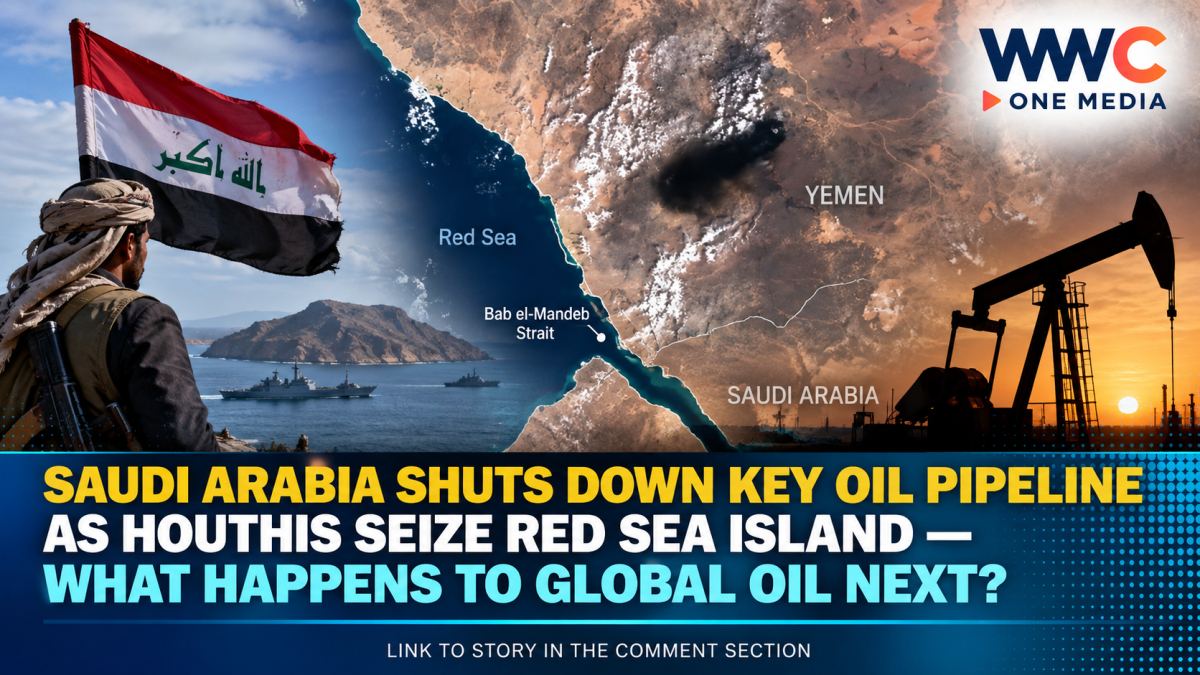
CAIRO — A major Saudi oil lifeline has been temporarily shut down just as Yemen’s Iran-aligned Houthi forces tightened their grip on one of the world’s most important maritime chokepoints, raising fresh fears that the widening Iran war could trigger another shock to global energy supplies.
Saudi Arabia said it shut down its East-West oil pipeline after drones attacked the vital conduit, calling the move a precautionary measure. The development came as Houthi forces seized Mayun, also known as Perim Island, in the Bab el-Mandeb Strait, according to Yemeni government and Houthi officials cited by AP and Reuters.
The timing is particularly significant because Saudi Arabia has increasingly depended on Red Sea export routes after disruption around the Strait of Hormuz during the wider conflict with Iran. The Bab el-Mandeb provides the maritime gateway between the Red Sea and the Gulf of Aden, making control of the passage strategically important for oil, container shipping and other global trade.
Houthis move closer to a critical global chokepoint
The latest Houthi advance follows the capture of Mocha, a strategically located Yemeni Red Sea port, and advances toward territory overlooking the Bab el-Mandeb.
Reuters reported that Houthi forces reached Perim Island and the nearby mainland town of Dhubab, potentially putting the group in a much stronger position around the strait.
The Bab el-Mandeb is only about 28 kilometers wide at its narrowest point and connects the Red Sea with the Gulf of Aden. Its importance extends far beyond Yemen because vessels using the Red Sea can ultimately connect with the Suez Canal, one of the major trade corridors between Asia and Europe.
The Houthis have said maritime navigation remains safe for companies other than those covered by their restrictions on Saudi-linked shipping. But analysts and shipping experts warn that the group’s growing military presence around the strait could increase uncertainty for commercial vessels.
Saudi oil exports face another route problem
The East-West pipeline, built in the 1980s, transports Saudi crude from the kingdom’s eastern oil-producing regions toward the Red Sea.
That infrastructure became especially important after the Strait of Hormuz was disrupted. Saudi Arabia had increased exports through its Red Sea terminal at Yanbu, providing an alternative route for getting oil to international markets.
But the strategy is now under renewed pressure.
AP reported that Houthi attacks and threats have already caused shipping through Bab el-Mandeb to fall by roughly 60% from pre-2023 levels, when the group began attacking selected vessels in the Red Sea.
Saudi shipments to Asian customers have consequently faced major logistical complications. Some cargoes are being redirected north through the Red Sea toward the Suez Canal and other routes, increasing sailing times and costs.
Reuters reported that oil prices were approaching or exceeding US$100 a barrel, adding to concerns over the potential economic consequences if more Middle Eastern supply routes are disrupted.
Drone attack adds another layer of pressure
The Saudi pipeline shutdown followed a drone attack that Riyadh said originated from Iraq.
Iraq subsequently announced an investigation and dismissed the commander of the Maysan province operations command after authorities determined that the attacks against Saudi Arabia had been launched from a site in the province.
This is separate from the Houthi seizure of Perim Island, although the developments are unfolding within the same broader regional conflict involving Iran, Saudi Arabia, Yemen and US forces.
AP reported that regional officials said the Houthis had helped Iranian-backed Iraqi militias plan and execute attacks, although such claims involve intelligence assessments and should not be treated as independently established fact.
Iran and Saudi Arabia still talking
Despite the escalating violence, Tehran and Riyadh have also maintained diplomatic contacts.
Iran’s Foreign Minister Abbas Araghchi and Saudi Foreign Minister Faisal bin Farhan spoke by phone about the deteriorating regional security situation. Iran has called for renewed negotiations between Saudi Arabia and the Houthis and an end to Saudi restrictions on Houthi-controlled areas.
That diplomatic channel could become increasingly important as the military situation worsens.
The Houthis’ advance also comes as the United States faces a difficult strategic calculation. Reuters reported that Saudi Crown Prince Mohammed bin Salman asked US President Donald Trump for greater military action against the Houthis, but Washington has so far resisted direct strikes, instead offering intelligence and other support.
Yemen risks sliding back into a wider war
The danger is not limited to oil and shipping.
The latest fighting threatens to unravel a fragile period of relative calm in Yemen that followed the 2022 truce. The country’s internationally recognized government has called for international support as Houthi forces expand along the Red Sea coast.
The humanitarian consequences are already mounting.
The International Organization for Migration said more than 46,000 people were displaced during the latest surge in fighting, with the number potentially rising further. Medical workers have also fled affected areas, putting additional pressure on hospitals and humanitarian organizations.
The UN’s special envoy for Yemen, Hans Grundberg, has warned that the escalation represents a more dangerous phase of the Yemen conflict, particularly because Houthi control around Mocha gives the group a direct presence near one of the world’s most important maritime routes.
Why this matters globally
This is no longer simply another chapter in Yemen’s long-running civil war.
The combination of Iran’s pressure around the Strait of Hormuz, Houthi advances around Bab el-Mandeb and attacks affecting Saudi energy infrastructure creates the possibility of simultaneous disruption across two critical Middle Eastern shipping corridors.
That could mean:
- Higher crude oil prices
- More expensive shipping and insurance
- Longer delivery times between Asia and Europe
- Greater pressure on Saudi oil exports
- Increased risks for commercial vessels
- More pressure on the United States to intervene
- A possible escalation of the Yemen conflict
But one important distinction remains: the Houthis’ capture of Perim does not automatically mean that every ship using Bab el-Mandeb has been blocked. The group has publicly said non-Saudi commercial navigation remains safe, while shipping analysts warn that the military situation could change rapidly.
The bigger question
For Saudi Arabia, the problem is becoming increasingly difficult.
The kingdom has spent months trying to use alternative oil routes to bypass threats around Hormuz. Now, the route through the Red Sea and Bab el-Mandeb is itself coming under growing pressure.
For Iran, meanwhile, the Houthi advance potentially provides another source of leverage over energy markets and the United States.
And for the global economy, the question is becoming increasingly urgent:
If both Hormuz and Bab el-Mandeb remain under severe pressure, how much more expensive will the world’s energy and shipping routes become?
That is the question markets, governments and shipping companies are now watching most closely.




Leave a Reply