
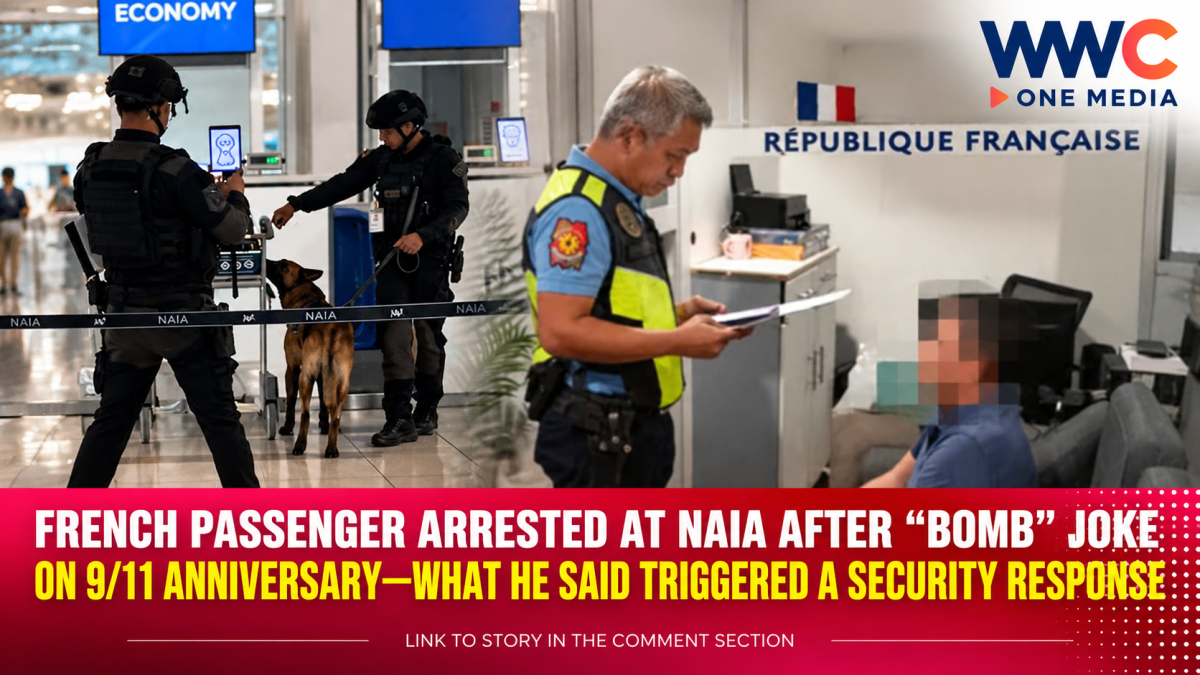
MANILA, Philippines — A 58-year-old French passenger bound for Cebu was detained at the Ninoy Aquino International Airport after allegedly making a bomb-related remark during check-in, prompting an immediate security response on September 11, the anniversary of the 9/11 terrorist attacks.
The incident occurred at NAIA, where personnel of the Philippine National Police Aviation Security Group (PNP-AVSEGROUP) took the foreign national into custody following the remark.
Although the passenger reportedly treated the statement as a joke, authorities did not dismiss it because any reference to explosives or bombs inside an airport is treated as a potential security threat.
The case comes on a particularly sensitive date for aviation security: September 11 marks 25 years since the 2001 terrorist attacks in the United States, when four commercial aircraft were hijacked and nearly 3,000 people were killed.
A joke that triggered a real security response
The passenger was reportedly preparing to travel to Cebu when the bomb-related remark was made during the airport check-in process.
Security personnel responded to the statement and detained the passenger for investigation. The incident underscores how quickly airport authorities must act when potentially threatening language is used, even when the person later claims that it was only a joke.
Authorities have repeatedly warned travelers that joking about bombs, explosives or terrorism can have serious consequences in Philippine airports.
The issue is not new.
In 2024, the Civil Aviation Authority of the Philippines (CAAP) reported that a foreign passenger at Dipolog Airport was taken into PNP Aviation Security Group custody after telling airline personnel that his luggage contained an “Atomic Bomb,” before later saying he was only joking.
In another 2024 incident, a passenger at Davao International Airport was arrested after allegedly making a bomb joke while checking in for a Singapore-bound flight. Authorities said the passenger was subsequently processed for a possible violation of Presidential Decree No. 1727.
Philippine law treats bomb jokes seriously
The Philippines has a specific law covering false bomb threats and bomb-related jokes.
Presidential Decree No. 1727, commonly referred to as the Anti-Bomb Joke Law, penalizes the malicious dissemination of false information concerning bombs and other explosive devices, as well as similar statements that can create fear or disruption.
CAAP has previously reminded travelers that violations can carry a penalty of up to five years in prison, a fine of up to ₱40,000, or both, depending on the circumstances and applicable legal proceedings.
That warning applies regardless of whether the person actually possesses an explosive device.
In practical terms, telling airport personnel that a bag contains a bomb can immediately trigger security procedures because officers cannot simply assume the statement is harmless.
Foreign travelers face additional consequences
Foreign nationals can also face immigration consequences in addition to possible criminal proceedings.
The Bureau of Immigration previously warned foreign travelers that bomb jokes or comments referring to explosives can result in serious consequences, including possible exclusion from the Philippines or deportation, depending on the circumstances and the outcome of the case.
The Bureau issued that warning after an earlier airport security incident and stressed that foreign nationals are expected to comply with Philippine laws while in the country.
NAIA has seen similar cases before
Bomb-related jokes at NAIA have repeatedly resulted in security interventions.
In August 2023, two travelers were arrested at NAIA in separate incidents involving an alleged bomb threat and a bomb joke. One passenger reportedly told an airline employee that his luggage contained “chicharon bomba,” adding that he was joking.
Airlines operating at NAIA have likewise warned passengers that comments or jokes involving bombs, explosives or violence are prohibited and can lead to legal action.
The message from airport authorities has remained consistent: what a passenger considers a joke can still be treated as a security threat.
Why September 11 made the incident especially sensitive
The latest NAIA incident occurred on September 11, a date permanently associated with the transformation of aviation security following the attacks in the United States in 2001.
The attacks involved four hijacked passenger aircraft, two of which were deliberately flown into New York’s World Trade Center towers, while another struck the Pentagon. A fourth aircraft crashed in Pennsylvania after passengers and crew fought the hijackers.
The attacks fundamentally changed airport security worldwide, bringing much stricter passenger screening, baggage controls, cockpit security and threat-response procedures.
That history helps explain why authorities are particularly unwilling to ignore statements involving explosives at airports.
The bigger warning for travelers
The NAIA arrest is another reminder that airport security personnel cannot afford to distinguish between a “serious” bomb statement and a supposedly harmless joke based solely on a passenger’s intention.
A statement can trigger a security response even when no explosive is ultimately found.
For travelers, the safest rule is simple: never joke about bombs, explosives, terrorism or hijacking inside an airport or aircraft.
A few seconds of humor can lead to questioning, detention, missed flights, criminal proceedings and potentially immigration consequences for foreign nationals.
For the French passenger detained at NAIA, authorities will determine the next steps based on the investigation and applicable law.
What began as an alleged joke ended with a passenger in police custody—on a date when the world was already remembering one of aviation history’s darkest days.

Leave a Reply