
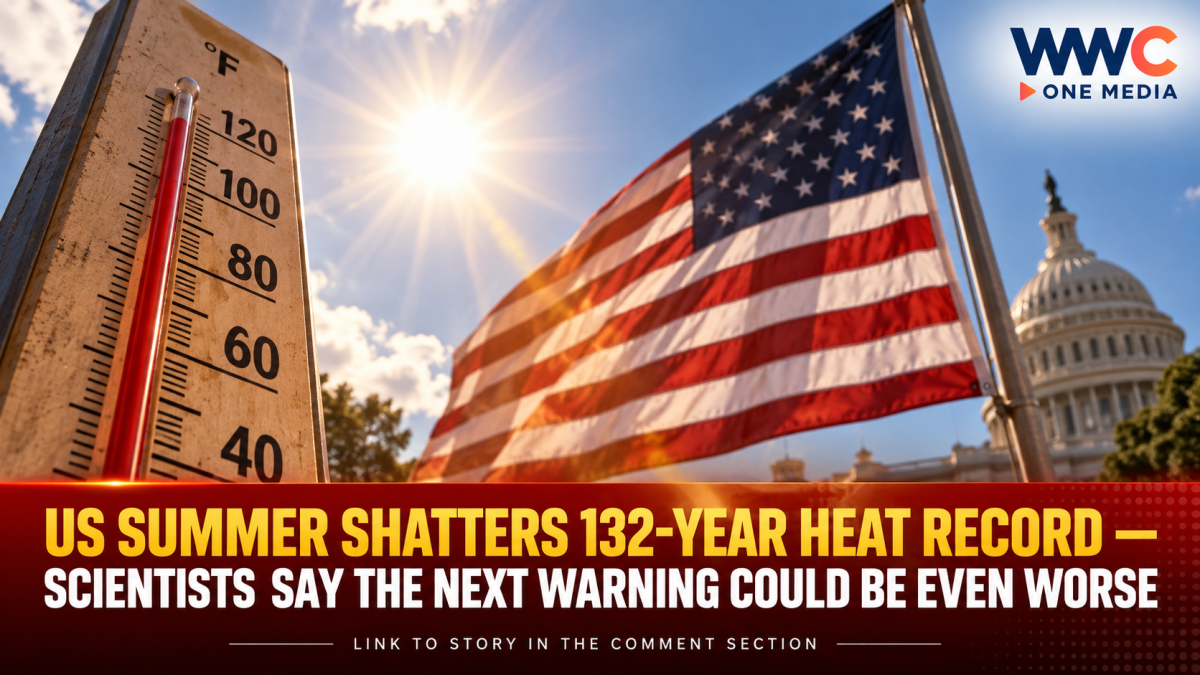
The United States has just endured its hottest summer on record, with scientists warning that the extraordinary temperatures are another major sign of a rapidly warming planet.
Data released by the US National Oceanic and Atmospheric Administration showed that the summer of 2026, covering June through August, was the hottest since national record-keeping began 132 years ago.
The alarming milestone was accompanied by another record: August also ranked as the hottest August ever recorded across the contiguous United States.
Scientists say the numbers are more than just another entry in the climate record books.
They are sounding the alarm over what could lie ahead.
Hottest Summer in US History
According to NOAA data cited in reports by international news organizations, average temperatures across the contiguous United States reached unprecedented levels during the three-month summer period.
The record surpassed the infamous summer of 1936, during the Dust Bowl era, when extreme heat devastated large parts of the country.
The scale of the 2026 heat was particularly striking because it followed an already extraordinary July. NOAA had previously announced that July 2026 was the hottest single month ever recorded in the United States.
Heatwaves swept across large areas of the country throughout the summer, with communities in the Southwest, central states and other regions enduring prolonged periods of dangerous temperatures.
In some areas, nighttime temperatures also remained unusually high, giving residents little relief after scorching daytime conditions.
“Alarm Bells Are Ringing”
Climate scientists and environmental experts say the record-breaking summer should serve as a warning.
The extreme temperatures have intensified concerns about the growing impact of human-driven climate change, which is increasing the likelihood and intensity of severe heat events.
Scientists have long warned that rising greenhouse gas emissions are loading the climate system toward more frequent and more intense heatwaves.
A developing El Niño pattern has also contributed additional warmth to the global climate system this year, according to climate reports. However, scientists emphasize that natural climate patterns alone cannot explain the long-term rise in global temperatures.
The underlying driver remains the warming caused by human activities, particularly the burning of fossil fuels.
August Sends Another Global Warning
The alarming US record came as the rest of the world also experienced extraordinary heat.
The European Union’s Copernicus Climate Change Service reported that August 2026 was the world’s joint-hottest month on record, tying with July 2023.
Global average surface air temperatures in August reached around 16.96 degrees Celsius, approximately 1.65 degrees above estimated pre-industrial levels.
The milestone marked the first monthly global temperature reading above 1.5 degrees Celsius over pre-industrial levels since late 2025, according to reports on the Copernicus findings.
Scientists caution that the 1.5-degree target under the Paris climate agreement refers to long-term average warming rather than a single month. Still, repeated monthly breaches underline how rapidly global temperatures are rising.
From America to Europe, Extreme Heat Is Spreading
The United States was not alone.
Western Europe also endured its hottest summer on record, according to recent climate reporting, while heatwaves, drought and wildfires affected several parts of Europe and Asia.
Record ocean temperatures have added to concerns among climate scientists, with unusually warm seas capable of affecting weather patterns and increasing risks to marine ecosystems and coastal communities.
Spain, for example, recorded unprecedented sea temperatures around its Mediterranean and Atlantic coasts during the summer, according to the country’s state port authority. Scientists have linked the extreme marine heat largely to human-induced climate change.
The consequences of rising temperatures are increasingly being felt beyond weather forecasts.
Extreme heat can put pressure on electricity systems, increase cooling costs, threaten agriculture, worsen drought conditions and pose serious health risks, particularly to elderly people, children, outdoor workers and communities without reliable access to air conditioning.
Colorado Among Areas Breaking Records
The record-breaking national summer was also reflected at the state level.
Colorado experienced its hottest summer on record, according to NOAA data cited in recent reporting, while other parts of the country recorded extraordinary temperatures and prolonged heat events.
Reports from across the United States showed residents coping with soaring temperatures, higher energy bills and disruptions to everyday life.
The Washington Post also reported that 2026 set a record for summer minimum temperatures in the United States, another worrying sign because hotter nights can prevent the human body and infrastructure from recovering after extreme daytime heat.
Could 2026 Become One of the Hottest Years Ever?
The record-breaking summer is raising another major question: could 2026 become one of the hottest years ever measured globally?
Climate monitoring groups have already warned that rapidly developing El Niño conditions could push global temperatures even higher through the coming months and into 2027.
Carbon Brief recently reported that the strengthening El Niño had increased expectations for further global temperature records.
Scientists warn that the combination of long-term climate change and natural warming patterns can create a dangerous double effect, pushing temperatures into previously unseen territory.
The Bigger Question: What Happens Next?
For climate scientists, the US summer record is not an isolated event.
It is part of a growing pattern.
From record-breaking heat in America and Europe to warming oceans, droughts, wildfires and destructive floods in other parts of the world, the signals are becoming increasingly difficult to ignore.
The latest figures suggest that extreme heat is no longer a rare anomaly.
It may increasingly become a defining feature of a warmer world.
And as the United States closes the books on its hottest summer in 132 years, scientists are warning that the real concern may not simply be how hot 2026 became.
The bigger question is whether the world is prepared for what comes next.



Leave a Reply