
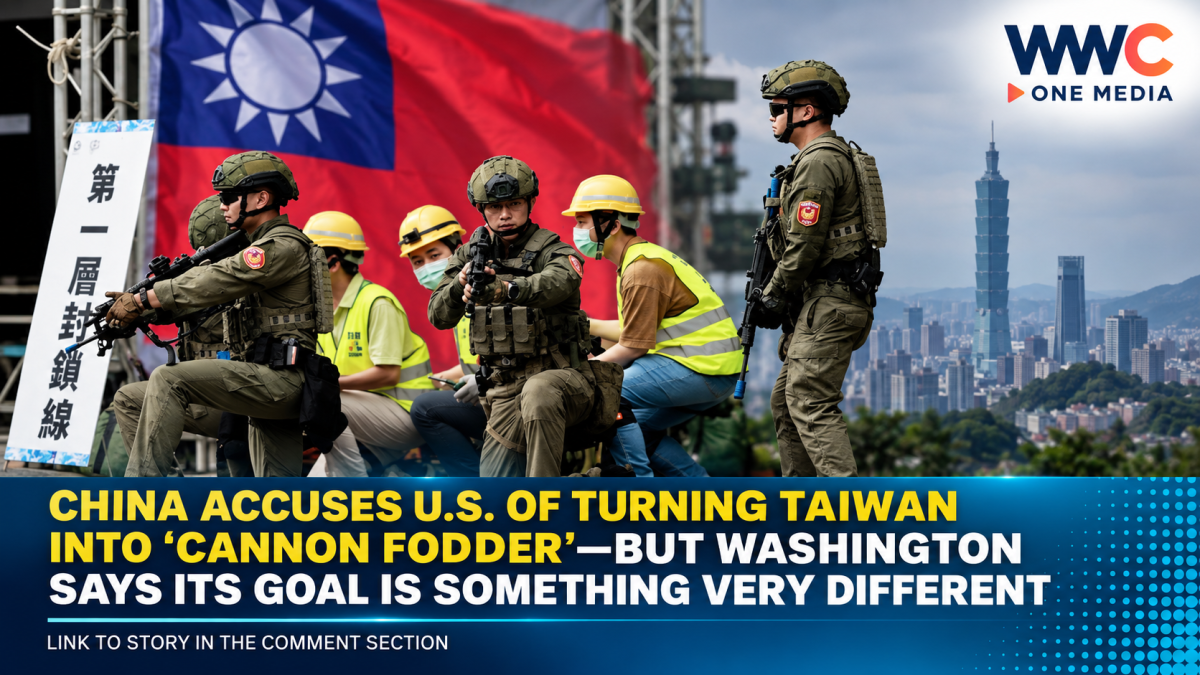
BEIJING/TAIPEI — China has sharply criticized the United States over its approach to Taiwan’s defense, with Chinese state broadcaster CCTV accusing Washington of effectively preparing the island to serve as “cannon fodder” in a potential conflict with mainland China.
The accusation followed remarks by Raymond Greene, director of the American Institute in Taiwan (AIT), who said Taiwan does not need to demonstrate that it could win a war outright. Instead, he argued, the island needs to convince a potential attacker that successfully invading and sustaining a large force there would be extraordinarily difficult.
The comments have become the latest flashpoint in the increasingly intense dispute between Beijing and Washington over Taiwan’s military preparedness.
What did the US actually say?
Speaking at the 2026 Taipei Security Dialogue on September 9, Greene said Taiwan’s geography gives it significant defensive advantages.
He pointed to Taiwan’s heavily urbanized and mountainous terrain and the roughly 145 kilometers of turbulent water separating the island from mainland China.
His argument was that Taiwan’s objective should be to make an invasion so difficult and costly that a potential adversary is deterred from launching one in the first place.
Greene also highlighted three areas he said could strengthen Taiwan’s deterrence:
- Uncrewed systems and drones
- More flexible military command structures
- Greater societal resilience
He said Taiwan has already been working with US companies on drones and autonomous military systems and has been incorporating lessons from the wars in Ukraine and the Middle East.
Greene also stressed that the United States views preserving peace in the Indo-Pacific as a priority.
He said Washington is pursuing that goal through diplomacy, stronger regional partnerships and support for Taiwan’s ability to defend itself.
Beijing sees something very different
China’s state broadcaster CCTV interpreted Greene’s remarks in a dramatically different way.
According to CCTV, saying Taiwan does not need to prove it can win a war suggests that Washington is more interested in using the island as a tool to confront and contain mainland China than in ensuring Taiwan can prevail in a conflict.
The broadcaster accused the United States and what it described as Taiwan “separatists” of placing the island in greater danger and characterized Taiwan as potentially becoming a battlefield for a prolonged conflict.
That “cannon fodder” characterization is Beijing’s framing of US policy—not a statement by Washington that it intends Taiwan to be sacrificed.
That distinction is critical when assessing the story.
Washington says deterrence is the objective
The official US position presented by Greene was the opposite of deliberately seeking a war.
In his address, Greene said Taiwan’s ability to deter conflict is intended to preserve its political, economic and social stability while creating space for cross-Strait dialogue without coercion or threats of force.
He also rejected arguments that strengthening Taiwan’s defenses necessarily constitutes a provocation or represents a fundamental change in long-standing US policy.
The United States has maintained an unofficial but extensive relationship with Taiwan for decades, including arms sales and other forms of defensive support, while maintaining formal diplomatic relations with Beijing rather than Taipei.
Taiwan is spending more on defense
Taiwan itself is dramatically increasing its defense preparations.
President Lai Ching-te’s administration has made military modernization a central priority as Beijing continues to claim Taiwan as part of China and refuses to rule out the use of force to achieve reunification.
Taiwan’s proposed defense spending for next year is expected to exceed NT$1 trillion, or roughly US$31.8 billion, for the first time.
Taipei has also proposed an additional NT$145.7 billion (about US$4.6 billion) in defense spending for this year, including major investments in drones, unmanned systems and anti-ballistic missile capabilities.
Vice President Hsiao Bi-khim has emphasized the need for layered defenses and greater domestic production of military technology.
She said proposed coastal drones and unmanned vessels would be produced domestically, while Taiwan is also seeking supply chains that exclude Chinese components for sensitive defense systems.
Why the “cannon fodder” claim is gaining attention
The dispute is unfolding at a particularly sensitive moment.
Taiwan is increasing military spending, China is continuing military activity around the island, and Washington is simultaneously attempting to deter Beijing while keeping diplomatic channels open.
Taiwan’s defense ministry reported that on September 9, 16 Chinese military aircraft and unmanned aerial vehicles were detected conducting activities around Taiwan, with 11 crossing the Taiwan Strait median line and entering areas of Taiwan’s air-defense identification zone. Chinese naval vessels also participated in what Beijing described as a joint combat-readiness patrol.
A separate Taiwan defense assessment has warned that recent Chinese military exercises increasingly focus on scenarios involving blockades, joint firepower strikes, control of surrounding air and sea routes, and potential amphibious operations.
US-China summit adds another layer
The timing is also significant because Washington and Beijing are preparing for another high-level meeting.
Greene said an upcoming September 24 US-China summit in Washington could provide an opportunity to advance what he described as strategic stability and reduce the risk of misunderstandings or miscalculations.
That creates an unusual diplomatic balancing act.
Washington is simultaneously supporting Taiwan’s defense preparations while seeking direct dialogue with Beijing to prevent those same tensions from spiraling into conflict.
The stakes go far beyond Taiwan
Greene warned that a conflict in the Taiwan Strait would have consequences extending far beyond the region.
He said the economic impact could exceed that of World War II, underscoring how deeply Taiwan is connected to global trade, technology and supply chains.
Taiwan is a critical center for advanced semiconductor manufacturing, while the Taiwan Strait is one of the world’s most important maritime corridors.
A major military confrontation could therefore disrupt global shipping, semiconductor supplies, financial markets and manufacturing networks.
A separate Reuters-cited strategic assessment has also warned that a US-China conflict over Taiwan could create risks of nuclear escalation, demonstrating how quickly a conventional confrontation could become a much broader international crisis.
A dangerous war of words
The latest dispute ultimately comes down to two radically different interpretations of deterrence.
Washington says Taiwan needs enough military strength to convince Beijing that an attack would be too difficult and costly to attempt.
Beijing argues that US military support is instead encouraging confrontation and turning Taiwan into a frontline against China.
Neither side appears willing to abandon its basic position.
For Taiwan, the challenge is how to strengthen its defenses without triggering the very conflict those defenses are designed to prevent.
For Washington, the challenge is supporting Taiwan while keeping a diplomatic channel open with Beijing.
And for Beijing, the central question remains whether increased US involvement around Taiwan is a defensive strategy—or part of a broader attempt to contain China’s rise.
That unresolved question could become even more consequential when Xi Jinping and Donald Trump meet later this month.

Leave a Reply