
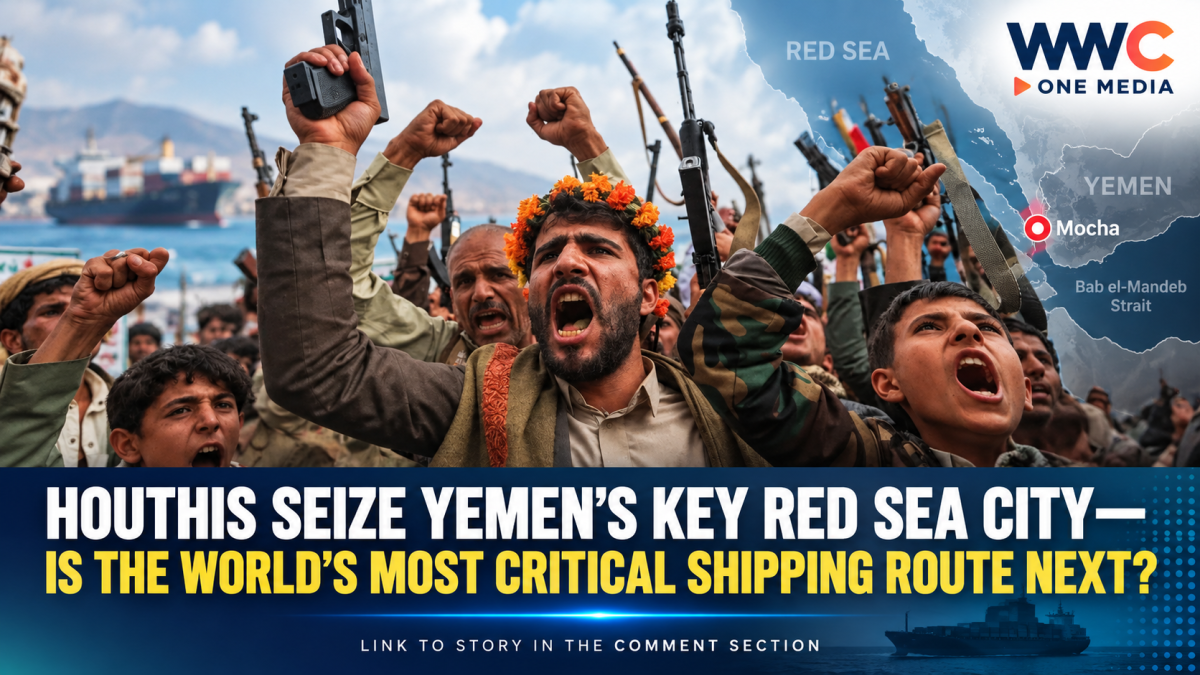
Yemen’s Iran-aligned Houthi rebels have seized the strategic Red Sea port city of Mocha in a dramatic advance that is raising fresh alarms over the security of one of the world’s most important maritime trade routes.
The takeover of Mocha, reported on September 11, marks a major territorial gain for the Houthis and brings them closer to consolidating control around the Bab el-Mandeb Strait—the narrow waterway connecting the Red Sea to the Gulf of Aden and a vital passage for global shipping and energy supplies.
Why Mocha Matters
Mocha is far more than a historic Yemeni port city.
Its location along Yemen’s southwestern coast gives whoever controls it greater strategic access to the Bab el-Mandeb Strait, often described as one of the world’s most important maritime chokepoints.
The strait links the Red Sea and the Suez Canal with the Gulf of Aden and the Indian Ocean. It is a crucial route for cargo vessels, oil tankers and other ships traveling between Asia, Europe and beyond. Reuters reported that disruption to the waterway can force vessels onto much longer routes around Africa, increasing shipping costs and delivery times.
According to AFP reporting carried by ABS-CBN News, Houthi fighters entered the strategic port city as government forces withdrew from the area. The development represents one of the group’s most significant recent advances along Yemen’s Red Sea coast.
Houthis Push Closer to Bab el-Mandeb
The capture of Mocha was quickly followed by further developments that dramatically increased the stakes.
Reuters reported that Houthi forces reached the Yemeni town of Dhubab, located near the Bab el-Mandeb Strait and close to the strategic island of Perim, also known as Mayun. Control of these locations could give the group greater influence over territory surrounding the vital shipping passage.
By September 12, reports from AP said the Houthis had also captured Mayun Island, intensifying concerns about their growing position around the southern entrance to the Red Sea.
The rapid sequence of territorial gains has transformed what initially appeared to be the seizure of a single strategic city into a much bigger geopolitical development.
A New Threat to Global Shipping?
The Bab el-Mandeb Strait has already faced major disruption in recent years.
Since late 2023, Houthi attacks on commercial shipping have forced numerous shipping companies to avoid the Red Sea route and sail around the Cape of Good Hope instead. That alternative journey is significantly longer and more expensive.
The latest Houthi advance is now raising fears that the group could gain even greater leverage over maritime traffic.
Reuters has described the Bab el-Mandeb as a critical global chokepoint, with the narrow waterway serving as an important route for oil, commodities and goods traveling between Asia and Europe through the Red Sea and Suez Canal.
AP reported that the new territorial gains have raised concerns about global energy flows and shipping security, particularly as the Red Sea becomes increasingly important to countries seeking alternative routes amid wider instability in the Middle East.
Oil Markets React as Regional Tensions Rise
The growing threat to shipping has also sent shockwaves through global energy markets.
Reports from multiple international outlets said oil prices surged above $100 per barrel as traders reacted to fears of possible disruptions affecting key Middle Eastern energy routes.
The situation is particularly significant because the Red Sea and Bab el-Mandeb have become increasingly important alternatives for oil shipments amid tensions affecting the Strait of Hormuz.
AP reported that Saudi Arabia recently shut down its critical East-West oil pipeline following a separate drone attack, adding further pressure to the region’s already strained energy infrastructure.
With major routes facing simultaneous security concerns, the Houthis’ expanding control along Yemen’s coast could have consequences far beyond the country’s borders.
Questions Over Iran’s Role
The Houthis are widely described as Iran-backed, although Tehran has repeatedly denied directly controlling the group’s military operations.
Reuters reported that Iranian support—including weapons, funding and tactical assistance—played an important role in the Houthi offensive that led to the capture of Mocha, citing Yemeni, Iranian and regional sources. The report said the advance was part of a broader escalation that could open another major front in the region.
The reported Iranian involvement is likely to increase international concern over whether Yemen’s conflict is becoming even more deeply connected to the wider confrontation involving Iran, Saudi Arabia and the United States.
Yemen Faces the Risk of Another Major War
The Houthi offensive also threatens to shatter Yemen’s fragile period of relative calm.
The country has experienced years of devastating conflict between the Houthis and forces aligned with Yemen’s internationally recognized government, with Saudi Arabia and other regional powers becoming deeply involved.
The current escalation has raised fears that Yemen could slide back into full-scale warfare.
Recent reports indicate that thousands of civilians have already fled areas affected by the fighting, while humanitarian concerns are mounting as front lines shift along Yemen’s western coast.
For ordinary Yemenis, another major conflict could deepen an already severe humanitarian crisis.
What Happens Next?
The biggest question now is whether the Houthis can consolidate their gains—or whether Yemen’s government and its allies will launch a major counteroffensive.
Their capture of Mocha was already considered strategically significant. But the subsequent advances toward Dhubab and the reported seizure of Mayun Island have raised the possibility of a much broader shift in the balance of power around the Bab el-Mandeb Strait.
For the international community, the stakes are enormous.
A prolonged threat to shipping through the Red Sea could increase transportation costs, disrupt supply chains and put additional pressure on global energy prices.
For Yemen, it could signal the beginning of another devastating chapter in a war that millions of people are still struggling to survive.
And for the rest of the world, the question is becoming increasingly urgent:
After taking Mocha, how much closer are the Houthis to gaining unprecedented control over one of the planet’s most important shipping gateways?

Leave a Reply