
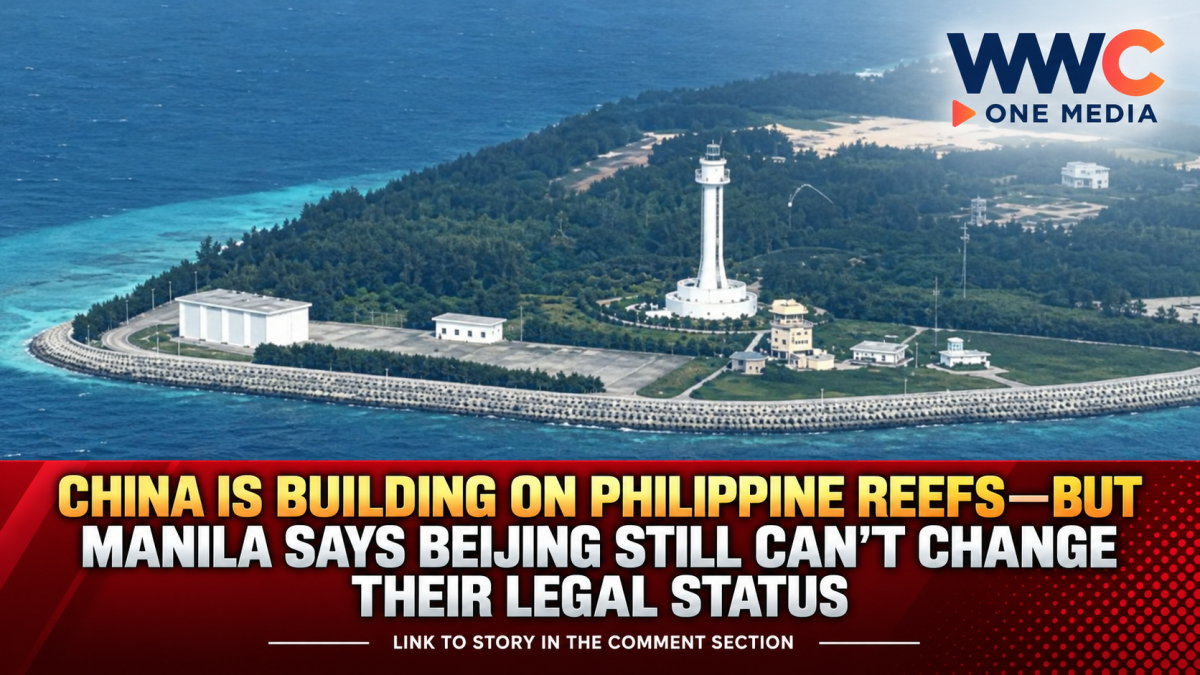
MANILA, Philippines — China’s growing presence and island-building activities in the West Philippine Sea may be changing the physical landscape, but they cannot rewrite the legal status of the reefs involved, the Philippine Department of Foreign Affairs (DFA) said.
The latest warning from Manila centers on Panganiban Reef (Mischief Reef) and Zamora Reef (Subi Reef), two features in the Spratly Islands where China has established large artificial structures and installations.
The DFA has called on Beijing to immediately stop what it described as illegal occupation and island-building activities in the two areas, arguing that the construction does not create new maritime rights for China under international law.
The dispute comes as tensions in the West Philippine Sea remain elevated, with the Philippines repeatedly invoking the 2016 South China Sea Arbitral Award and the United Nations Convention on the Law of the Sea (UNCLOS) in challenging China’s maritime claims.
Artificial islands cannot manufacture new rights
According to the DFA, Panganiban and Zamora reefs are low-tide elevations located within the Philippines’ exclusive economic zone (EEZ) and continental shelf.
Under the legal framework cited by Manila, the fact that China has reclaimed land and constructed artificial structures on the features does not transform their original legal character.
The DFA specifically said China’s island-building activities violate the Philippines’ Maritime Zones Act (Republic Act No. 12064) and UNCLOS, as interpreted by the 2016 arbitral ruling.
The Philippine position is rooted in a crucial distinction: building land does not automatically create sovereignty or an EEZ where none existed naturally.
The 2016 tribunal likewise examined the natural condition of disputed maritime features rather than allowing subsequent reclamation to determine their legal entitlements. The ruling found that Panganiban Reef is a low-tide elevation within the Philippines’ EEZ and continental shelf.
The 2016 ruling remains Manila’s strongest legal weapon
The Philippines has continued to emphasize that the arbitral award is final and legally binding.
The National Security Council’s summary of the ruling states that the tribunal rejected China’s claim to historic rights over resources within the so-called nine-dash line and determined that Panganiban Reef and Ayungin Shoal are low-tide elevations located within the Philippines’ EEZ and continental shelf.
The ruling also found that China’s construction of artificial islands in areas where the Philippines exercises sovereign rights violated those rights and caused severe environmental damage to coral reef ecosystems.
Ten years after the landmark decision, the Philippines and a group of partner countries again reaffirmed its significance.
In a joint statement issued in July 2026, Australia, Canada, Japan, the United Kingdom, the United States and other countries described the 2016 award as final, legally binding and definitive between Manila and Beijing concerning the maritime entitlements and claims addressed by the tribunal.
China rejects the Philippine interpretation
Beijing, however, continues to reject the arbitration ruling.
China maintains that it has sovereignty over the disputed areas and has repeatedly described the 2016 award as invalid and without binding force.
In a statement issued in July, China’s Foreign Ministry rejected Philippine measures involving Bajo de Masinloc, or Scarborough Shoal, and reiterated Beijing’s position that the Philippines’ maritime claims based on the arbitral award are unacceptable.
That fundamental disagreement remains at the heart of the South China Sea dispute: Manila points to UNCLOS and the arbitral ruling, while Beijing insists that the ruling cannot determine China’s territorial sovereignty and maritime rights.
China has already transformed the physical landscape
The controversy is not merely about legal documents.
China has constructed major facilities on several features in the Spratly Islands, including Panganiban and Zamora reefs. Earlier reporting based on maritime research has documented extensive reclamation and infrastructure development across Chinese-controlled outposts.
The scale of the construction has raised concerns that Beijing’s physical presence could strengthen its ability to monitor and operate across large portions of the South China Sea—even if the construction itself does not legally create new maritime entitlements.
A recent analysis by Channel NewsAsia made the same distinction: China’s renewed island-building may not create new legal rights, but it can significantly alter the strategic balance and effective control of contested waters.
That creates a difficult reality for the Philippines.
International law may determine what rights China can legally claim—but physical infrastructure can determine who has the ability to operate in the area every day.
Manila is also confronting new Chinese activities
The latest DFA statement came amid a broader series of confrontations in the West Philippine Sea.
The Philippine Coast Guard recently reported encounters involving Chinese forces, while Manila has also raised concerns over the activities of Chinese research and survey vessels inside the Philippine EEZ.
According to Philippine officials cited by The Philippine Star, a Chinese research vessel spent roughly 30 days inside the Philippine EEZ, including time near Bajo de Masinloc, before departing Philippine waters.
The Philippine Coast Guard has argued that publicly exposing unauthorized activities makes it harder for such operations to occur without scrutiny.
Meanwhile, tensions also intensified after the Philippine government accused Chinese forces of using flares against a Philippine Coast Guard aircraft conducting a maritime domain-awareness flight.
The bigger question: Can law keep pace with facts on the water?
The latest dispute illustrates the central challenge confronting Manila.
The Philippines can continue to invoke the 2016 arbitral ruling, UNCLOS and its domestic Maritime Zones Act. But China remains in physical control of several strategically important features and continues to operate large installations there.
That creates a widening gap between legal status and physical reality.
For Manila, however, the DFA’s position is clear: reclamation cannot manufacture sovereignty, and concrete structures cannot simply erase rights established under international law.
The Philippines says it will continue asserting its sovereignty, sovereign rights and jurisdiction in the West Philippine Sea while pursuing diplomatic engagement with Beijing.
And that leaves the next question hanging over the region:
If China’s artificial islands cannot change the law, how long can the law constrain what happens on the water?



Leave a Reply