
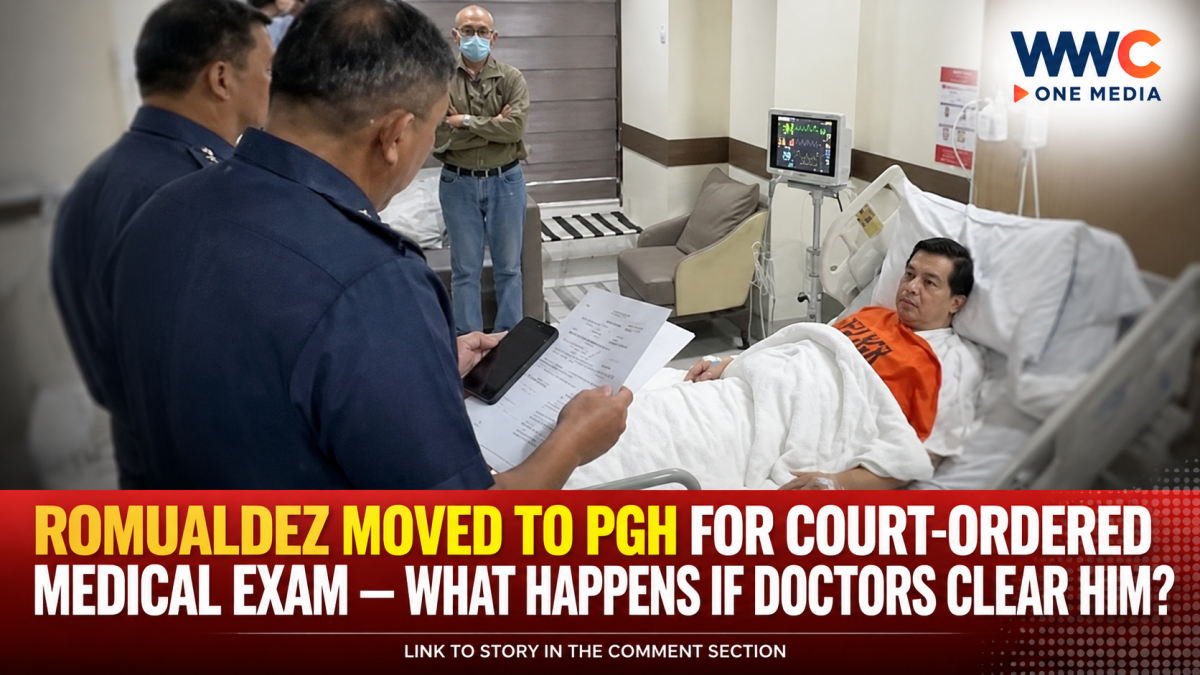
MANILA, Philippines — Former House Speaker and Leyte Rep. Martin Romualdez was transferred to the Philippine General Hospital (PGH) on Saturday for an independent medical examination ordered by the Sandiganbayan, putting his hospital confinement under renewed court scrutiny.
Romualdez arrived at PGH from Cardinal Santos Medical Center in San Juan City at around 8:30 a.m. on September 12, according to reports from GMA News and other Philippine media outlets. The transfer was ordered by the Sandiganbayan Third Division to determine whether his medical condition requires continued hospital confinement or whether he can be transferred to a detention facility.
The examination is a significant development because Romualdez is currently under arrest in connection with a P7.4-billion plunder case linked to alleged irregularities in government flood-control projects.
Why was Romualdez brought to PGH?
The Sandiganbayan ordered the Bureau of Jail Management and Penology (BJMP), with assistance from the Philippine National Police and judiciary marshals, to facilitate the transfer from Cardinal Santos Medical Center to the government-run PGH for an independent assessment.
The purpose is to independently assess whether Romualdez remains medically unfit for detention in a regular jail.
His transfer follows several days of hearings over his request to remain confined in a hospital rather than be committed to jail.
The former Speaker’s physicians have cited several medical concerns, while the prosecution and government authorities have challenged whether continued confinement at a private hospital is necessary.
Sandiganbayan questioned proposed recovery period
During hearings on Romualdez’s request for hospital detention, one of his physicians testified that the former Speaker could require four to six weeks of recovery because of his medical condition and the effects of stress.
Sandiganbayan Associate Justice Ronald Moreno, however, questioned the proposed recovery period during the proceedings, underscoring the court’s responsibility to determine whether hospital confinement should continue.
The court had also previously summoned Romualdez’s attending physicians and required them to present the results of his medical examinations.
Among the medical conditions cited in court records and reports are cardiovascular and cerebrovascular ailments, hypertension, diabetes, dyslipidemia and hypothyroidism. Romualdez has also previously undergone a coronary procedure.
Romualdez was arrested while hospitalized
The former Speaker was served an arrest warrant on September 7 while he was confined at Cardinal Santos Medical Center.
Authorities said he had been admitted after experiencing what officials described as a cardiovascular event, unstable blood pressure and an anxiety attack.
His arrest stemmed from a plunder complaint involving P7.4 billion allegedly diverted through transactions connected to anomalous flood-control projects.
Romualdez has denied wrongdoing.
The broader flood-control scandal has drawn intense public attention, with authorities investigating thousands of projects nationwide amid allegations of overpriced, defective or nonexistent infrastructure. The Associated Press reported that nearly 10,000 flood-control projects worth more than P545 billion have come under scrutiny since the Marcos administration began.
What happens after the PGH examination?
The independent assessment could become crucial in determining Romualdez’s immediate legal and custodial situation.
If PGH doctors determine that he requires continued hospital care, the court could consider allowing him to remain in medical confinement. If he is found fit for detention, he could be transferred to a jail facility under the custody of authorities.
The Sandiganbayan’s decision comes as the court attempts to balance Romualdez’s constitutional and medical rights with the enforcement of its arrest warrant.
For now, the PGH examination could determine whether Romualdez remains in a hospital—or takes the next step toward regular detention.




Leave a Reply