
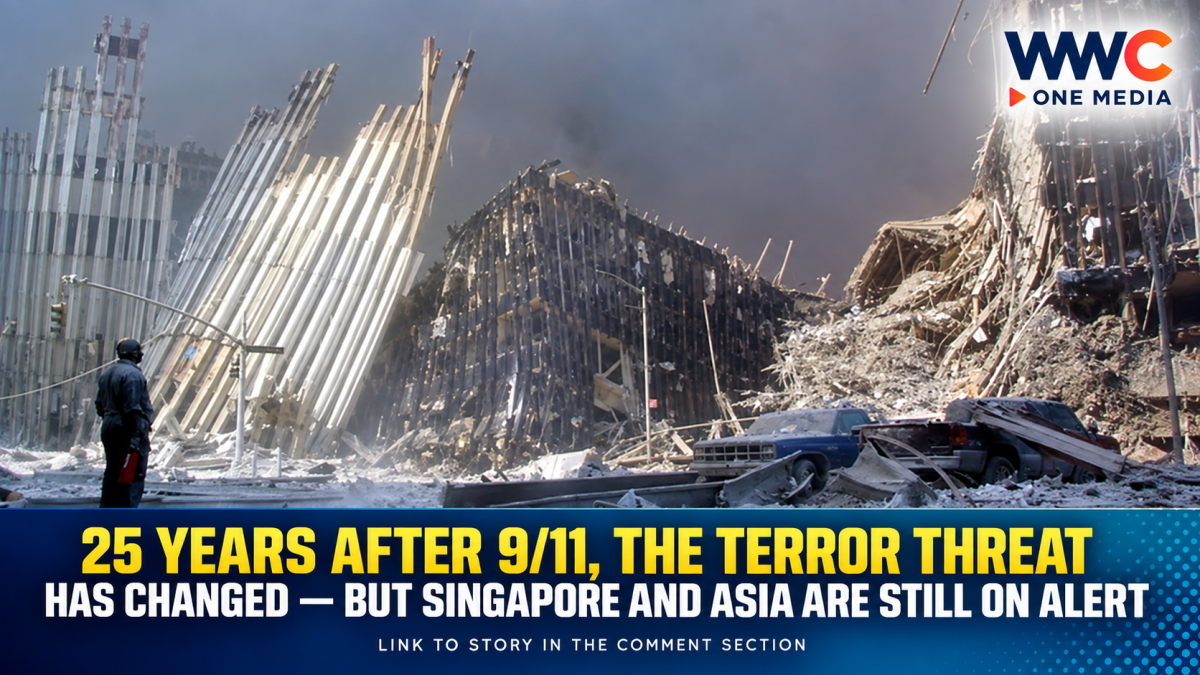
SINGAPORE — Twenty-five years after hijacked planes struck the United States on Sept 11, 2001, killing nearly 3,000 people and changing global security forever, one uncomfortable question remains: Has the world really defeated terrorism — or has the threat simply evolved?
For Singapore and Southeast Asia, the answer is increasingly clear.
The large, centrally coordinated terrorist networks that dominated the post-9/11 era may no longer look the same, but extremist violence has adapted to the digital age. Terror groups continue to recruit online, individuals can become radicalised without ever meeting a terrorist handler, and younger people are increasingly being exposed to multiple extremist ideologies.
Singapore’s latest terrorism assessment, released on Sept 10, 2026 — just one day before the 25th anniversary of 9/11 — warned that the country’s terrorism threat remains high.
The timing is a stark reminder that while the world has changed dramatically since the destruction of the World Trade Center, the danger that emerged so violently on Sept 11, 2001 has not simply disappeared.
From Al-Qaeda’s Spectacular Attacks to a More Fragmented Threat
The 9/11 attacks represented one of the most devastating demonstrations of transnational terrorism in modern history.
Al-Qaeda operatives hijacked four commercial aircraft. Two were flown into the World Trade Center in New York, one struck the Pentagon, while the fourth crashed in Pennsylvania after passengers fought back.
The attacks triggered the US-led global “War on Terror”, reshaped airport security, intelligence-sharing and surveillance, and led to decades of military operations in Afghanistan and elsewhere.
But 25 years later, the terrorism landscape is no longer dominated by the same model.
Al-Qaeda has been significantly weakened compared with its peak, while ISIS lost the territorial “caliphate” it once controlled in Iraq and Syria. Yet the decline of their physical territory did not eliminate extremist ideology.
Instead, terrorist propaganda moved deeper into the digital world.
Singapore’s authorities have repeatedly warned that the internet allows extremist narratives to reach individuals directly, shortening the distance between exposure, radicalisation and potential violence. The threat increasingly includes self-radicalised individuals and so-called lone actors who may operate without the traditional command structures associated with earlier terrorist networks.
Singapore Was Already Facing Its Own Terror Threat on 9/11
For Singapore, the events of Sept 11 were never simply a distant American tragedy.
On the very day the attacks unfolded in the United States, members of the Al-Qaeda-linked Jemaah Islamiyah, or JI, network were already in advanced stages of planning attacks in Singapore.
The plots included simultaneous truck bomb attacks targeting the US Embassy and other Western interests, according to Singapore authorities and previous accounts of the investigation.
Singapore’s Internal Security Department eventually launched operations against the network in December 2001, disrupting the plots and crippling the local JI network.
The operation would later expose wider extremist networks across Southeast Asia and reinforce fears that the region could become a major front for transnational terrorism.
Those fears were tragically realised less than a year later.
The 2002 Bali bombings killed more than 200 people and demonstrated that Southeast Asia was not merely vulnerable to extremist influence — it could become the site of catastrophic terrorist attacks.
The Bali attacks also underscored how deeply interconnected regional militant networks had become, with JI maintaining links to Al-Qaeda and extremist cells across Southeast Asia.
Singapore’s Latest Warning: The Threat Is Still High
A quarter-century after 9/11, Singapore’s Internal Security Department is warning that terrorism remains a serious concern.
According to the Singapore Terrorism Threat Assessment Report 2026, Singapore and its interests remain attractive targets for terrorist elements.
The report said global terror groups including Al-Qaeda and ISIS continue to recruit supporters online and inspire attacks around the world.
Ongoing conflicts in the Middle East have also contributed to a volatile global security environment and can act as triggers for radicalisation beyond the immediate conflict zones.
Singapore authorities also warned that the possible return of foreign terrorist fighters to Southeast Asia could increase the regional threat.
Importantly, the threat is no longer confined to one ideology.
While Islamist extremism remains a major security concern, Singapore’s latest assessment also highlighted the growing relevance of far-right extremism, anti-Semitic narratives, incel ideologies, accelerationism and other forms of violent extremism.
This creates a more complicated security environment than the one governments confronted immediately after 9/11.
A New Generation Is Being Radicalised Online
Perhaps one of the most alarming findings in Singapore’s latest report concerns young people.
Singapore said the number of youth cases dealt with under the Internal Security Act has almost quadrupled when comparing the five years from 2017 to 2021 with the period since 2022.
Of eight new cases dealt with since July 2025, six involved individuals below the age of 21, according to the latest assessment.
The report also highlighted what authorities described as Singapore’s first cases of Composite Violent Extremism, involving young people influenced by multiple extremist ideologies rather than a single belief system.
The internet and online platforms remain central to this evolving threat.
Unlike the 9/11 era, when extremist organisations relied more heavily on physical networks, training camps and direct contact, modern radicalisation can occur through online content, encrypted communications and digital communities.
That means a person may be exposed to extremist narratives without crossing borders or meeting an established terrorist operative.
Terrorism’s Most Dangerous Weapon May Be Division
Singapore’s experience since 9/11 has also reinforced another lesson: terrorism is not only about bombs, guns or physical destruction.
It can also be designed to destroy trust.
In a multicultural and multireligious society such as Singapore, a successful extremist attack could potentially trigger fear, suspicion and hostility between communities.
Former Prime Minister Lee Hsien Loong warned during the 20th anniversary of 9/11 that terrorism posed not only a physical security threat, but also a danger to Singapore’s social cohesion.
Authorities and community groups worked to prevent the JI threat from creating broader distrust between Muslims and non-Muslims, while rehabilitation and aftercare programmes were established to support efforts to counter extremist ideology.
Singapore’s experience demonstrated that counterterrorism is not solely the responsibility of security agencies. Maintaining trust between communities can also be a critical defence against extremists whose goal is often to create fear and division.
No Imminent Attack — But No Room for Complacency
Singapore has stressed that there is currently no specific or credible intelligence indicating an imminent terrorist attack.
However, authorities continue to assess the overall terrorism threat as high.
That distinction is important.
The absence of intelligence about an immediate attack does not mean the disappearance of the underlying threat. Terrorism can evolve rapidly, particularly when individuals radicalise online and operate with little direct connection to established networks.
Singapore’s security agencies have therefore increasingly focused on early detection, intervention and community awareness alongside traditional intelligence and counterterrorism operations.
Twenty-Five Years Later, the Lesson of 9/11 Is Still Unfinished
The world that existed before Sept 11, 2001 is gone.
The attacks reshaped international politics, security, aviation, intelligence operations and military strategy. The decades that followed brought wars, the rise and territorial defeat of ISIS, and a new generation of extremists operating in a vastly different technological environment.
Today, terrorism may be less centralised than it was during Al-Qaeda’s rise.
But in some ways, it has become harder to predict.
A global organisation can be weakened. Training camps can be destroyed. Leaders can be captured or killed.
But an ideology that spreads through digital platforms — and inspires individuals across borders — presents a different challenge.
For Singapore and Southeast Asia, the lesson of 9/11 is therefore not simply about remembering what happened 25 years ago.
It is about recognising that the next threat may not look like the last one.
The aircraft hijackings, truck bombs and coordinated networks that defined the early years of the War on Terror may no longer represent the most likely model of attack.
Today’s danger could emerge from a lone actor, a radicalised teenager, an online extremist community — or an individual influenced simultaneously by several violent ideologies.
Twenty-five years after 9/11, the question is no longer whether terrorism has changed.
It has.
The more urgent question is whether the world can change fast enough to stop whatever comes next.


Leave a Reply