
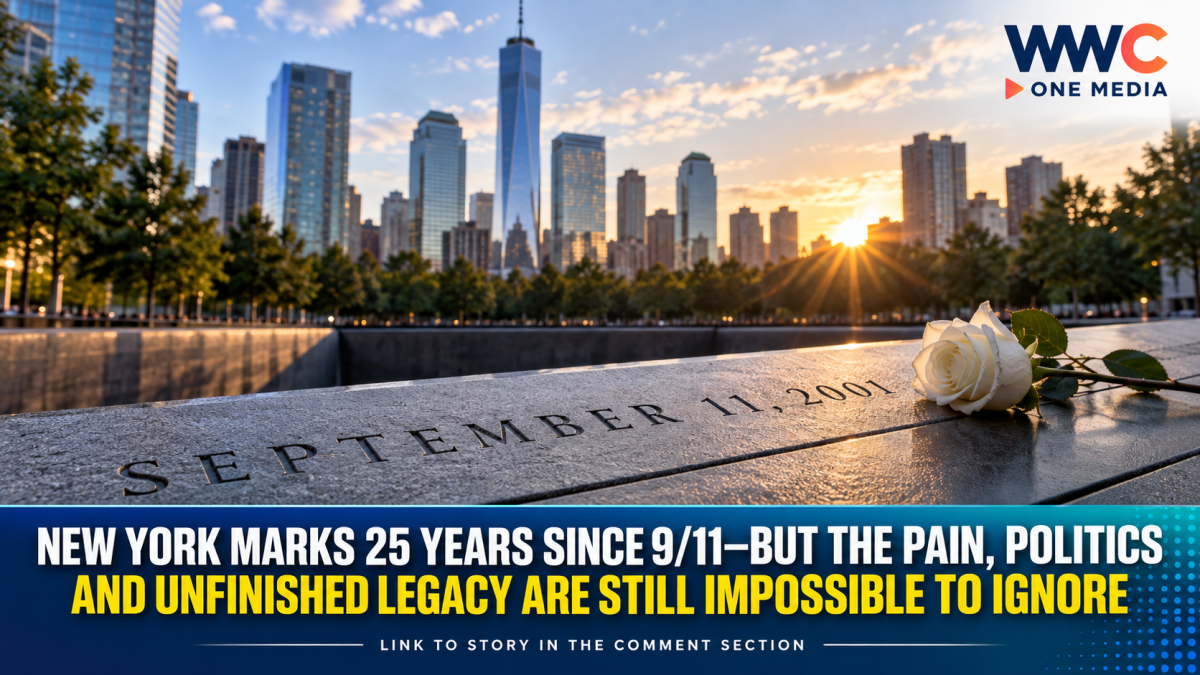
NEW YORK — Twenty-five years after the September 11, 2001 terrorist attacks forever changed New York City and the United States, the city is once again gathering at Ground Zero to remember the nearly 3,000 people killed—and the thousands more whose lives were altered in the years that followed.
The 25th anniversary commemoration on Friday, September 11, centers on the families of those who died. Relatives are reading aloud the names of the victims at the 9/11 Memorial plaza, while moments of silence mark the critical moments of the attacks, including when the first plane struck the World Trade Center at 8:46 a.m.
But this year’s anniversary carries a significance that goes beyond remembrance.
A growing number of Americans were not yet born—or were too young to understand what happened—when hijacked planes struck the World Trade Center, the Pentagon and a field near Shanksville, Pennsylvania.
The 9/11 Memorial & Museum estimates that 100 million Americans are now too young to personally remember the attacks, making the 25th anniversary an important moment for passing the history of that day to another generation.
A city remembers—and looks back
The attacks killed nearly 3,000 people and transformed New York’s skyline, its emergency-response systems and the broader American approach to national security.
Twenty-five years later, the physical landscape around Ground Zero has been rebuilt, but the consequences of September 11 remain visible in the lives of survivors, first responders and families.
Reuters reported this week that the legacy continues to affect Americans through personal loss, illnesses linked to exposure at Ground Zero and the broader national consequences of the attacks, including decades of war and major changes in U.S. security policy.
The health consequences have become one of the most painful chapters of the post-9/11 story.
New York City officials say more than 600 FDNY members have died from 9/11-related health complications since the attacks. The FDNY has also continued commemorating members who became sick after working at the World Trade Center site.
The NYPD has likewise continued to lose members to illnesses associated with Ground Zero exposure.
‘Never Forget’ takes on a new meaning
For New York officials, the anniversary is increasingly about ensuring that remembrance survives as firsthand memories disappear.
Mayor Zohran Mamdani recently established September 11 as an annual Day of Remembrance and Service in New York City, encouraging residents to honor victims and first responders through remembrance and community service. He also signed an executive order updating city emergency-preparedness and continuity policies.
The city has also launched Memory Markers: 9/11, a digital tribute displayed through LinkNYC kiosks that tells stories of ordinary New Yorkers who helped during the rescue, recovery and cleanup efforts following the attacks.
The initiative highlights a part of the 9/11 story that can sometimes disappear behind the images of the collapsing towers: the thousands of people who helped strangers in the days and months that followed.
According to the city, more than 3,700 Department of Sanitation workers were involved in the recovery effort, while New York’s transportation system helped move tens of thousands of people away from Manhattan after the attacks.
Ground Zero remains the heart of the commemoration
The 9/11 Memorial & Museum’s 25th-anniversary program includes the reading of the names of those killed in the September 11 attacks and the 1993 World Trade Center bombing.
The ceremony also includes moments of silence corresponding to the strikes and collapses of the towers, the Pentagon attack and the crash of United Airlines Flight 93 in Pennsylvania, as well as a moment honoring people who later died from 9/11-related illnesses.
Across New York, additional ceremonies, concerts, exhibitions and service projects are being held throughout the anniversary period. Time Out New York reported that commemorations include performances, exhibitions and volunteer activities designed to connect remembrance with the city’s continuing story of resilience.
The annual Tribute in Light will again illuminate the Manhattan skyline, recreating the twin beams that have become one of the most recognizable symbols of remembrance.
A solemn anniversary amid political divisions
The 25th anniversary is also unfolding against a backdrop of political disagreement.
President Donald Trump is not attending the Ground Zero ceremony and is instead scheduled to observe the anniversary at the Pentagon. Vice President JD Vance is expected to attend the New York ceremony.
At the same time, Mamdani’s participation has become politically contentious, with some 9/11 families and critics calling on the mayor to stay away from the ceremony. His supporters and city officials have defended his participation and emphasized that the anniversary should focus on the victims, survivors and first responders.
That controversy underscores how much the meaning of 9/11 has evolved over a quarter-century.
For those who lived through it, September 11 remains a personal memory.
For younger Americans, it is increasingly history.
And for New York, it remains both.
25 years later, the promise remains
The anniversary is ultimately less about the passage of time than about what survives it.
The towers are gone. Lower Manhattan has been rebuilt. A generation has grown up without firsthand memories of the morning that changed the city.
But the names remain.
The families remain.
The first responders’ stories remain.
And the health consequences continue to affect survivors and emergency workers decades later.
The 9/11 Memorial & Museum says the anniversary is intended not only to remember the unimaginable loss, but also the bravery, compassion, unity and service that emerged in its aftermath.
Twenty-five years later, New York is once again asking the same question that has followed the city since that morning:
How do you remember something that changed the world—and make sure the next generation never forgets why it mattered?



Leave a Reply