
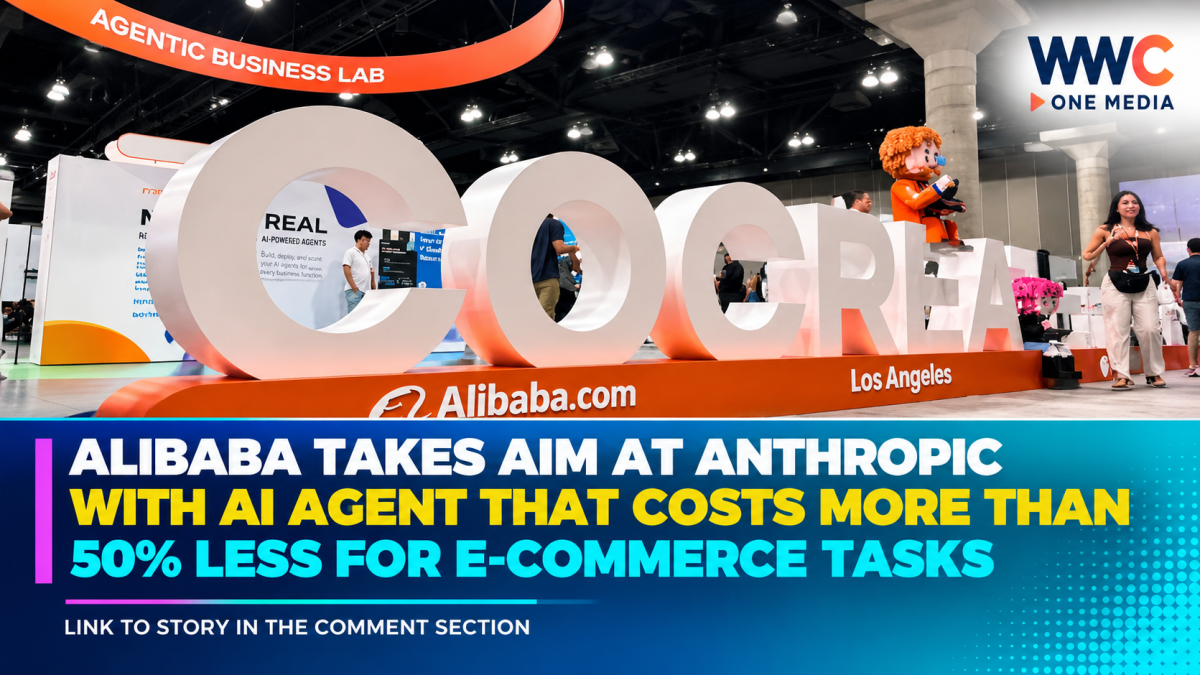
LOS ANGELES — Alibaba is escalating the global race for AI agents with a new version of its Accio platform, claiming the e-commerce-focused AI agent can complete a wide range of commercial tasks at more than 50% lower estimated cost than general-purpose tools from OpenAI and Anthropic.
Alibaba announced the results September 9 at its CoCreate event for entrepreneurs and small businesses, saying Accio matched comparable completion quality while using substantially less estimated AI cost across a 107-task benchmark.
The announcement puts Alibaba directly into an increasingly competitive market for agentic AI—systems designed not merely to answer questions but to perform multi-step tasks on behalf of users and businesses.
Alibaba’s Cost Challenge to Anthropic
According to Alibaba’s benchmark, Accio completed e-commerce tasks at more than 50% lower estimated cost than Anthropic’s Claude Code and OpenAI’s Codex.
That comparison is significant because Anthropic has been actively expanding Claude’s role in commerce.
On September 2, Anthropic introduced tools and blueprints for retailers, marketplaces and other businesses to build shopping and merchant agents using Claude. The company said enterprise customers using Claude-powered commerce agents had seen larger shopping carts and higher purchase completion rates.
Alibaba is therefore competing on a crucial question for businesses: How much does it cost for an AI agent to actually get the job done?
For smaller companies in particular, operating costs can determine whether advanced AI is practical at scale.
Accio Goes Beyond Simple Product Search
Alibaba’s expanded Accio is designed around more than conventional shopping assistance.
The company says the platform brings together research, sourcing and day-to-day e-commerce operations in a single AI workspace aimed particularly at small and medium-sized businesses.
That reflects a broader shift in the AI industry.
Instead of asking an AI chatbot to draft a product description or find information, businesses increasingly want agents that can execute several connected steps—from researching products and suppliers to supporting store operations.
Alibaba has already been moving in this direction through its broader AI ecosystem.
The company’s Qwen Shopping Assistant, integrated into Taobao, is designed to assist consumers throughout the shopping journey, including product discovery, order management and post-purchase services. Alibaba has also been adding agentic capabilities to merchant-management tools.
Why the 50% Figure Needs Context
The “50% cheaper” claim is attention-grabbing, but it should not be interpreted as a universal price comparison between Alibaba and Anthropic.
The figure comes from Alibaba’s own 107-task benchmark and refers to estimated costs for the tested tasks.
Actual costs can vary depending on the model used, task complexity, token consumption, infrastructure, tool calls and how an individual company deploys an agent.
In other words, Alibaba’s result suggests a potentially significant cost advantage for the tested e-commerce workloads—but it does not establish that Accio will always cost half as much as Claude for every AI task.
That distinction is important as companies increasingly evaluate AI based on measurable business outcomes rather than headline model performance alone.
The Bigger Battle Is Agentic Commerce
The Accio announcement arrives as the technology industry moves toward agentic commerce, in which AI systems can increasingly search, compare, recommend and eventually execute transactions.
Anthropic has been building commerce-agent infrastructure for retailers and marketplaces, while Alibaba is attempting to leverage its enormous e-commerce ecosystem to give its own agents direct access to commerce-related services.
Alibaba’s advantage is its existing connection to platforms, merchants and supply chains.
That could allow it to develop agents specifically optimized for commerce rather than relying solely on a general-purpose AI model.
The competition is therefore no longer just about who has the smartest chatbot.
It is increasingly about which AI company can build the most useful agent at the lowest sustainable cost.
Alibaba’s AI Strategy Is Expanding
The company has been rapidly integrating AI across its business.
Alibaba’s recent corporate reporting says it has reorganized its operations to combine its e-commerce businesses more closely with its AI capabilities, while continuing to expand Qwen-powered consumer and enterprise applications.
The company has also been integrating Qwen with services including Taobao, Alipay, Fliggy and Amap, allowing its consumer AI application to handle increasingly complex tasks.
That strategy gives Alibaba something many AI startups do not have: a massive commercial ecosystem in which its agents can potentially operate.
A New Cost War Could Be Emerging
The significance of Accio may ultimately extend beyond e-commerce.
As AI agents become more autonomous, businesses will run far more AI operations than they do simple chatbot conversations today.
That could make inference costs a major competitive weapon.
A model that performs a task slightly better but costs substantially more could lose to a cheaper system if the difference in quality does not justify the additional expense.
That is particularly important for small businesses, which Alibaba is explicitly targeting.
The company’s message is straightforward: sophisticated AI should not be limited to companies with enormous technology budgets.
But the AI Race Is Getting More Complicated
Alibaba’s announcement also arrives amid growing geopolitical scrutiny of Chinese AI companies.
On September 8, U.S. officials accused several Chinese AI companies, including Alibaba, of using AI “distillation” techniques to obtain capabilities from leading American models. China rejected the accusations as unfounded and defended distillation as a legitimate technology.
That controversy adds another layer to Alibaba’s international AI ambitions.
The company is competing not only on price and performance but within a technology industry increasingly shaped by questions about intellectual property, model security and geopolitical competition.
The Next AI Battlefield May Be Commerce
Alibaba’s Accio announcement highlights where the AI race could be heading next.
The question is becoming less about whether AI can answer a question and more about whether it can complete an entire business process efficiently, reliably and cheaply.
Anthropic is pushing Claude deeper into commerce. Alibaba is leveraging its e-commerce ecosystem to build specialized agents. OpenAI and other major AI companies are also developing increasingly capable agentic systems.
For businesses, that competition could eventually mean more powerful tools at lower prices.
But Alibaba’s latest benchmark still needs to be viewed in context: the more-than-50% cost advantage is the company’s own benchmark result, not an independent industry-wide finding.
And if Alibaba can turn that benchmark advantage into reliable real-world performance at scale, the next major AI battle may not be fought over who has the biggest model—but over who can make AI agents cheap enough to run an entire business.


Leave a Reply