
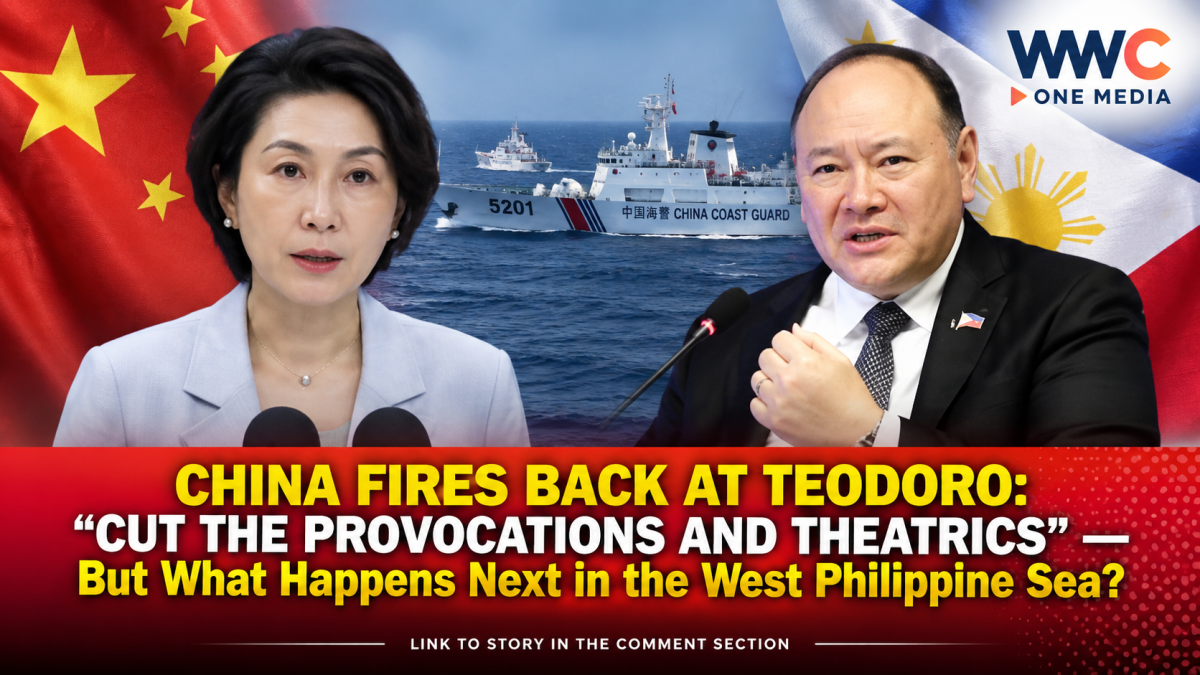
China has hit back at Philippine Defense Secretary Gilberto “Gibo” Teodoro Jr. after his fiery response to a Chinese position paper handed to him during a defense forum in Seoul, escalating an already tense exchange over the South China Sea and the 2016 arbitral ruling.
Chinese Foreign Ministry spokesperson Mao Ning said Beijing was not fully aware of what happened at the event but reiterated China’s rejection of the 2016 arbitration case and called on the Philippine side to “cut the provocations and theatrics.”
The remarks came a day after Teodoro publicly challenged China’s position while participating in the Seoul Defense Dialogue in South Korea.
THE MOMENT THAT TRIGGERED THE LATEST CLASH
Teodoro was answering a question about China’s activities in the South China Sea when a note was delivered to him.
The document reiterated Beijing’s position that the 2016 South China Sea arbitral award was “illegal, null and void” and carried no binding force, according to reports from GMA News and Philstar.com.
Teodoro read portions of the message aloud before responding sharply.
He questioned why China was making its position known through a note rather than participating directly in the discussion.
He then delivered the line that quickly became the centerpiece of the incident:
“Of course. Because you lost.”
Teodoro also criticized what he characterized as China’s coercive conduct and said the delivery of the note was inappropriate in the setting.
According to the Philippine News Agency, organizers later traced the note to a Chinese military attaché at the Chinese Embassy in Seoul.
CHINA: STOP THE “PROVOCATIONS AND THEATRICS”
Beijing responded the following day.
Mao said China’s position on the arbitration case had remained “clear” and accused the Philippines of misusing the dispute-settlement mechanism under the United Nations Convention on the Law of the Sea (UNCLOS).
She then urged the “certain individual” on the Philippine side to stop what Beijing described as “provocations and theatrics” and warned against undermining China-Philippines relations and stability in the South China Sea.
The exchange effectively turned a moment at an international defense forum into the latest public confrontation between Manila and Beijing.
WHAT DOES THE 2016 RULING ACTUALLY SAY?
This is where accuracy matters.
The 2016 South China Sea arbitral award did not decide sovereignty over every island or maritime feature in the South China Sea. Instead, the tribunal examined maritime entitlements, historic-rights claims, the status of certain features and alleged violations of UNCLOS.
The Permanent Court of Arbitration-hosted tribunal concluded that there was no legal basis for China’s claim to historic rights to resources in the sea areas covered by the so-called nine-dash line, insofar as those claims exceeded the maritime entitlements permitted under UNCLOS.
The tribunal also found that China had violated Philippine sovereign rights in certain areas of the Philippines’ exclusive economic zone, including through interference with fishing and petroleum exploration and construction of artificial islands.
China, however, has consistently rejected the award and did not participate in the arbitration proceedings. The PCA records that China maintained its position of non-acceptance and non-participation throughout the case.
TEODORO’S WARNING GOES BEYOND THE VERBAL SPAT
The confrontation comes as Manila continues to raise concerns about China’s activities in the West Philippine Sea.
Just days before the Seoul incident, the Armed Forces of the Philippines said it had monitored 27 Chinese vessels from September 1 to 7 across several disputed features, including Ayungin Shoal, Bajo de Masinloc, Escoda Shoal and the waters around Pag-asa Island.
The Philippine government has also continued filing diplomatic protests over Chinese activities.
The Department of Foreign Affairs reported earlier this month that Manila had lodged 39 diplomatic protests against China’s actions in the West Philippine Sea in 2026, bringing the total since 2022 to 296.
Foreign Affairs Secretary Ma. Theresa Lazaro has meanwhile reiterated that the Philippines’ position is anchored on UNCLOS and the 2016 arbitral award, while saying Manila remains open to dialogue with Beijing.
WHY THE SEOUL INCIDENT MATTERS
The exchange happened against a wider backdrop of growing regional security concerns.
Teodoro has been warning that China could take advantage of perceived gaps in the Indo-Pacific security architecture. In an interview with Reuters earlier during his Seoul visit, he said Beijing could exploit reductions in U.S.-South Korean military exercises, although he stressed that Washington had assured Manila that its commitments to the Philippines remained unchanged.
At the same time, Manila and Seoul are working to deepen defense-industry and maritime-security cooperation, with the two countries discussing greater cooperation as part of their strategic partnership.
Teodoro has also emphasized that UNCLOS is particularly important to the Philippines because of its status as an archipelagic state and vowed that Manila would continue resisting aggression against Philippine territory.
THE BIGGER QUESTION
The latest war of words is unlikely to settle the underlying dispute.
China continues to reject the 2016 arbitral award, while the Philippines continues to invoke it as a key foundation of its position under international law.
And with Chinese and Philippine vessels continuing to operate around contested areas, the real concern is no longer simply who gets the last word at a diplomatic forum.
It is whether another confrontation at sea could push the already tense relationship into an even more dangerous phase.



Leave a Reply