
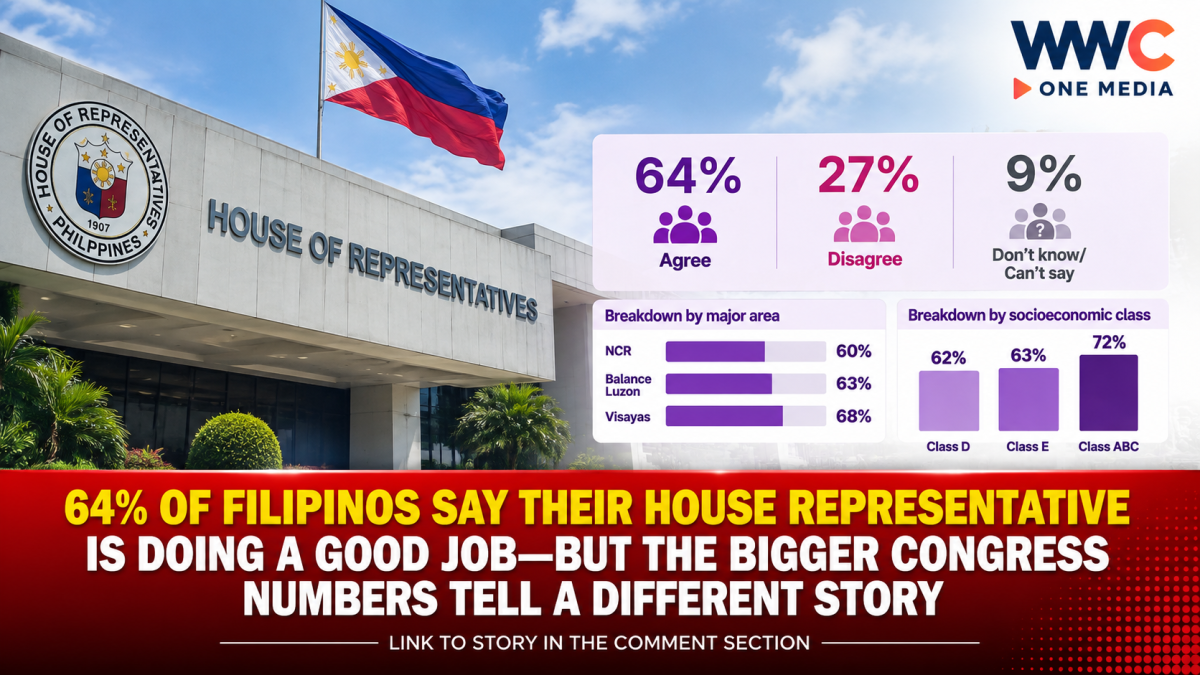
MANILA, Philippines — Filipinos appear to have a more favorable view of the lawmakers representing their own districts than they do of Congress as an institution, according to recent public-opinion surveys.
A survey cited in an Inquirer report found that 64% of Filipinos believe their own House representative is doing a good job, highlighting a notable gap between how constituents perceive their individual lawmakers and how the public views the House of Representatives as a whole.
The distinction is important: a constituent may be satisfied with the services or assistance delivered by a local representative while holding a more critical view of Congress because of national political controversies, legislative disputes or broader concerns about government performance.
Local lawmakers get stronger marks
Earlier nationwide polling provides additional context.
A March 2026 Philippine Public Opinion Monitor survey by WR Numero Research, reported by the Philippine News Agency, found that 71% of respondents were satisfied with the performance of their local House representatives.
The survey was conducted through face-to-face interviews with 1,455 adult Filipinos from March 10 to 17, with a margin of error of ±3 percentage points at a 95% confidence level.
The findings suggest that many Filipinos judge their district representatives based on what they directly experience in their communities—from assistance programs and local projects to responsiveness to constituents.
But the picture changes when Filipinos are asked to assess the House of Representatives itself.
House ratings improve—but remain far from overwhelming
The latest OCTA Research Tugon ng Masa survey showed that public trust in the House increased from 36% in the first quarter of 2026 to 38% in the second quarter.
At the same time, distrust dropped from 33% to 28%.
Satisfaction with the House’s performance also increased, rising from 35% to 37%, while dissatisfaction declined from 35% to 32%.
The OCTA survey was conducted among 1,200 Filipino adults from July 4 to 11, 2026, with a ±3 percentage-point margin of error at a 95% confidence level.
The regional numbers also reveal significant differences.
Trust in the House was highest in the Visayas at 42%, followed by Balance Luzon at 40%, Mindanao at 37%, and the National Capital Region at just 29%.
That means the national improvement does not necessarily translate into strong confidence everywhere.
Why the gap matters
The contrasting numbers point to a potentially important feature of Philippine politics: voters may distinguish sharply between their own representative and Congress as a national institution.
A lawmaker who regularly interacts with constituents can receive positive feedback because people see or experience services directly in their communities.
Institutional ratings, meanwhile, can be affected by national political controversies and highly publicized congressional events.
The timing of the latest OCTA survey is particularly significant.
Fieldwork took place in early July, overlapping with the leadership struggle and eventual change in the Senate, as well as the opening days of the Senate impeachment trial of Vice President Sara Duterte.
BusinessMirror noted that the survey period’s intense focus on the Senate may have influenced how the public perceived both chambers, although OCTA cautioned that a single survey cannot establish a definite cause-and-effect relationship.
House leadership welcomes the improvement
House leaders have seized on the latest numbers as evidence that their focus on legislation and public service is beginning to resonate with Filipinos.
Senior Deputy Speaker Ferdinand “Dinand” Hernandez said the improvement in the House’s trust and satisfaction ratings was an encouraging sign under Speaker Faustino “Bojie” Dy III.
The House’s official statement pointed to the rise in trust from 36% to 38% and satisfaction from 35% to 37% as evidence of improving public confidence.
Still, the numbers also show that a large portion of Filipinos remain unconvinced or undecided.
In the OCTA survey, 33% said they were undecided on whether they trusted the House, while 31% were undecided when asked about its performance.
That undecided bloc could prove significant as lawmakers face continued scrutiny over their legislative priorities, public spending, political alliances and performance ahead of the next electoral cycle.
The bigger question
The strongest takeaway from the surveys may therefore not be simply that Filipinos approve of their representatives.
It is that Filipinos appear capable of separating the performance of their own district lawmaker from their opinion of Congress as a whole.
With district-level satisfaction reported at considerably higher levels than the House’s overall institutional ratings, the challenge for lawmakers is clear: Can the positive perception enjoyed by individual representatives translate into broader public confidence in Congress?
For now, the numbers suggest that many constituents are willing to give their own representatives credit—but the House still has a much bigger trust gap to close.



Leave a Reply