
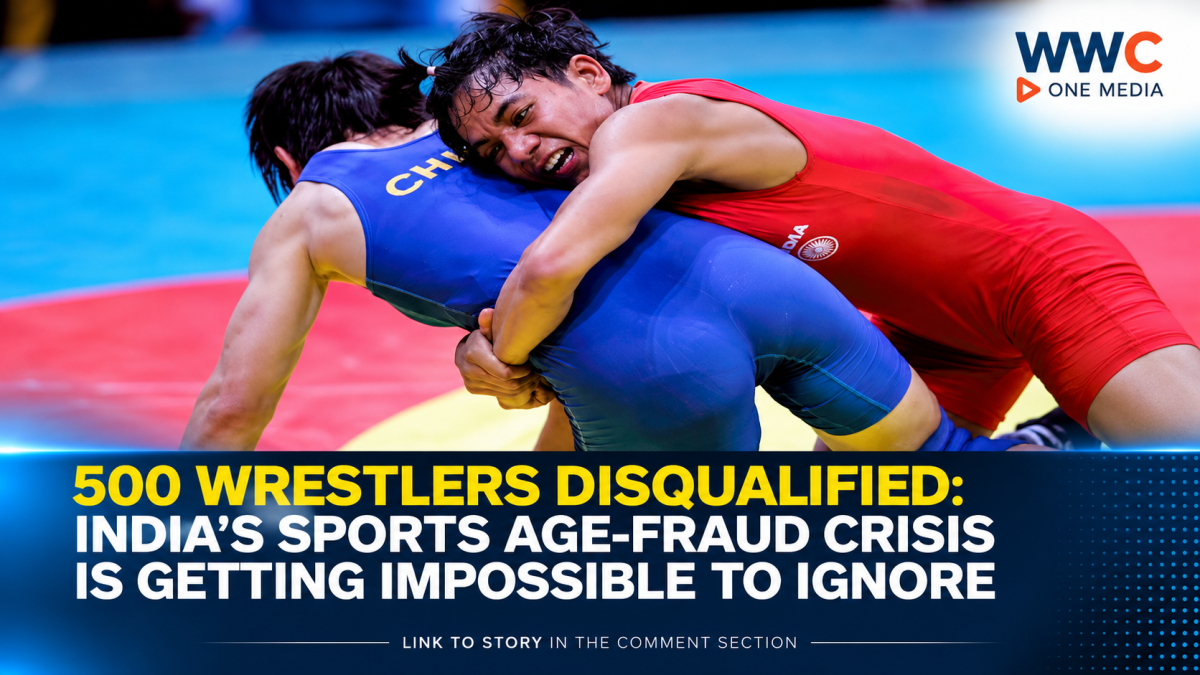
India is facing a growing integrity problem in youth sports after more than 500 wrestlers were disqualified from an Under-17 national tournament over age-related discrepancies, exposing what experts describe as a deeply entrenched problem across multiple sporting disciplines.
The mass exclusions came during the U-17 National Open Ranking Tournament in Gonda, Uttar Pradesh, in June, where roughly 1,200 wrestlers had registered across men’s freestyle, Greco-Roman and women’s events. The Wrestling Federation of India (WFI) used an Aadhaar-based verification process alongside birth certificates, uncovering discrepancies in athletes’ age and birth records.
The episode has now reignited a much bigger debate: How can India protect genuine young athletes when competitors can potentially manipulate their ages to enter younger categories?
More than 500 wrestlers caught in one tournament
The scale of the Gonda crackdown was striking.
According to reporting by Reuters and Indian media, more than 500 wrestlers were removed from the competition after the WFI’s enhanced verification process detected inconsistencies between documents. The tournament had attracted approximately 1,200 registrations.
The WFI’s verification process required athletes to provide their birth certificates as well as Aadhaar documentation linked to their mobile numbers, with OTP authentication through the Aadhaar system.
Reports said discrepancies were found not only in dates of birth but also in places of birth.
In one reported case, a birth certificate indicated a 2007 birth in Delhi, while Aadhaar records indicated a 2004 birth in Haryana.
The WFI has said it intends to continue the enhanced verification system at future age-group competitions.
Why age manipulation can be such a big advantage
Age categories exist for a reason.
A teenager who is several years older than competitors can have advantages in physical development, strength, size and experience, potentially affecting results and opportunities.
Those advantages can become particularly valuable when youth competitions are connected to:
- Scholarships
- Sponsorships
- National-team selection
- Recognition by scouts
- Professional opportunities
Cricket adds another enormous incentive.
Reuters reported that age-category competition can potentially provide aspiring players with an earlier pathway toward opportunities connected to India’s lucrative professional cricket system, including the Indian Premier League.
That makes age verification more than an administrative issue.
It is a question of competitive fairness.
Wrestling isn’t the only sport affected
The problem extends beyond wrestling.
Reuters reported that approximately 20 teams were expelled from the Subroto Cup school football tournament less than a year before the wrestling crackdown after being found to have fielded overage players.
The concern therefore reaches across sports where athletes compete in age-restricted categories.
Sports lawyer Aahna Mehrotra described the problem to Reuters as widespread, particularly at the sub-junior and junior levels, where the rewards can be high while verification can be more difficult.
Why is age fraud so difficult to stop?
One of India’s biggest challenges is documentation.
Reuters reported that India’s fragmented birth-registration system and the absence of a single centralized digital database for athletes have historically created opportunities for manipulation.
If an athlete has inconsistent documents across different systems, determining the correct age can become complicated.
And once an athlete enters an age-restricted competition using questionable documentation, the consequences can extend to other competitors who may lose opportunities despite being eligible.
Can bone testing solve the problem?
India’s cricket authorities have been using medical age-assessment measures for years.
The Board of Control for Cricket in India (BCCI) adopted the TW3 skeletal-age assessment method in 2012. The process uses an X-ray of the left hand and wrist to estimate skeletal maturity.
India’s football and tennis federations have also adopted forms of skeletal-age testing.
But experts caution that medical testing is not a perfect solution.
Sports medicine specialist P.S.M. Chandran told Reuters that testing can have weaknesses, including the possibility of improper or substituted documentation.
There is also a scientific limitation: skeletal maturity does not always correspond precisely to chronological age.
Mehrotra told Reuters that TW3 has improved the verification system but has limitations and can potentially flag naturally early-maturing teenagers as overage.
That means authorities face a difficult balancing act:
Catch deliberate fraud without unfairly excluding legitimate young athletes.
The Vaibhav Sooryavanshi debate
The issue has also followed one of India’s most talked-about young cricket talents, Vaibhav Sooryavanshi.
Questions about his age surfaced online after his rapid rise through professional cricket.
The BCCI has said Sooryavanshi has undergone bone-density testing since he was eight, with such testing mandatory for players participating in board-approved tournaments.
Reuters reported that Sooryavanshi’s case illustrates why age verification has become such a sensitive subject in Indian sport.
However, online speculation about an individual athlete should not be treated as proof of age fraud.
The broader issue is the verification system itself—not an assumption that a particular athlete has falsified records.
India is now preparing a national response
The controversy comes as India’s Ministry of Youth Affairs and Sports moves forward with a national framework specifically targeting age fraud.
The ministry’s current National Code Against Age Fraud in Sports says the objective is to create a mechanism to prevent, detect and penalize age-related violations and applies to sports federations and sporting bodies.
The policy development has been underway for some time.
A draft version was previously released for public and stakeholder comments, demonstrating that the government has been working toward a broader national system rather than relying solely on individual federations.
The framework emphasizes stronger identity verification and enforcement across sports.The proposed solution goes beyond birth certificates
The proposed national approach envisions a more comprehensive verification system rather than relying on one document or one medical test.
Reuters reported that the proposed measures include:
Digital identity records — establishing a more secure central database for athletes.
Multiple verification methods — combining documentary evidence with medical assessments.
Medical checks — potentially including skeletal, dental and physical examinations.
Stronger deterrence — making deliberate manipulation more costly.
An amnesty mechanism — allowing athletes to correct inaccurate records under certain conditions.
The government’s official code states that age fraud undermines fair play and can deprive legitimate athletes of opportunities.
But young athletes may also be victims
This is perhaps the most important part of the debate.
Not every minor whose documents contain an age discrepancy is necessarily the person responsible for creating it.
Children can depend on parents, coaches, clubs and administrators for registration and competition paperwork.
Mehrotra therefore argued that enforcement should distinguish between those who deliberately facilitate fraud and young athletes who may have been caught in systems controlled by adults. Reuters reported that she also emphasized strong appeal mechanisms and data protection because many of those involved are minors.
That creates a difficult policy question:
How do you punish deliberate fraud without destroying the sporting future of a child who may not have created the false record?
The bigger threat is to India’s sporting credibility
Age fraud isn’t simply about one tournament.
If widespread manipulation is allowed to continue, it can undermine confidence in national championships, talent identification, school competitions and youth development programs.
A legitimate 14-year-old competing against an older athlete who has deliberately entered an Under-17 category could lose opportunities despite following every rule.
That can have a damaging ripple effect.
The athlete may miss selection.
The athlete may lose a scholarship.
Another competitor may receive the sponsorship.
And the sport itself risks losing credibility.
The road ahead
The Gonda wrestling crackdown demonstrated that stronger technology can expose discrepancies that traditional paperwork may miss.
But it also showed why India needs a consistent national system across sports, rather than isolated enforcement whenever a federation detects suspicious records.
The Ministry of Youth Affairs and Sports now has a national code addressing the issue, while federations such as the WFI are already strengthening their own verification procedures.
The ultimate test will be enforcement.
Because as one expert effectively warned in the Reuters report, a punishment announced on paper means little if it is not consistently applied.
India has found hundreds of questionable records. Now the bigger challenge is building a system that makes age fraud much harder to attempt in the first place.
WWC ONE MEDIA J.M.D

Leave a Reply