
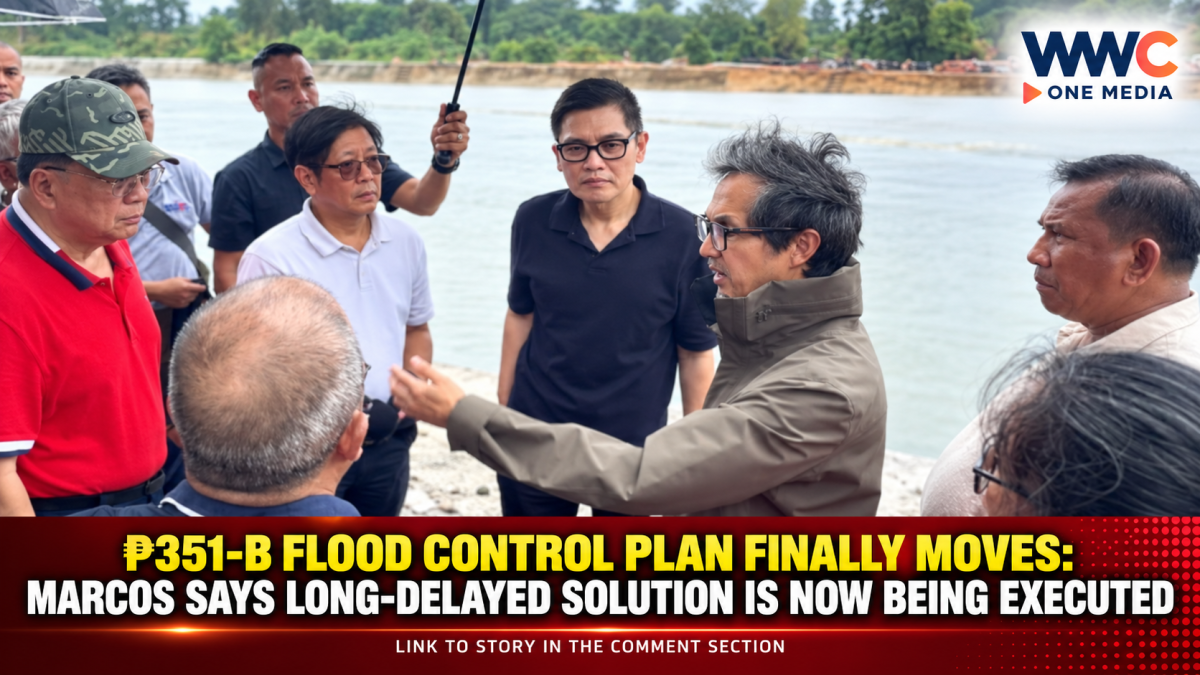
MANILA, Philippines — After decades of recurring floods, billions of pesos in infrastructure spending and repeated calls for a long-term solution, the Marcos administration is moving to implement a massive flood-management strategy worth about ₱351 billion.
President Ferdinand Marcos Jr. said the country already has a flood-control master plan but that it had not been fully carried out by previous administrations. He made the remarks amid widespread flooding triggered by heavy monsoon rains and tropical cyclones across Luzon.
“We already have a master plan; it’s just never been executed,” Marcos said, according to reports from The Manila Times and Inquirer.net.
The President said the government is now moving to execute the long-delayed plan as flooding continues to disrupt communities, transportation and economic activity.
Government shifts toward long-term flood protection
The Department of Public Works and Highways (DPWH) is not simply relying on a single old blueprint.
Public Works Secretary Vince Dizon has ordered the updating of flood-management master plans nationwide, with the department working with the University of the Philippines–Project Nationwide Operational Assessment of Hazards (UP-NOAH), local governments and other agencies.
The objective is to incorporate updated hazard maps, scientific data and changing climate conditions into the engineering plans for future flood-control projects.
Dizon said many existing flood master plans are outdated or incomplete, making revisions necessary as rainfall patterns, urban development and climate risks change.
The DPWH is also prioritizing plans for major river basins instead of treating flooding as a problem that can be solved through isolated projects.
₱351 billion plan dates back to Aquino administration
The ₱351-billion figure is closely associated with the Aquino-Singson flood-management master plan, approved during the administration of former President Benigno Aquino III and then-Public Works Secretary Rogelio Singson in 2012.
The plan was designed as a long-term program for reducing flood risks in Metro Manila and surrounding areas and involved major infrastructure projects that were expected to take years to complete.
Malacañang said earlier this week that the Aquino-Singson plan is among the flood-management strategies that the DPWH may review, alongside master plans covering major river basins.
GMA News reported that the government is considering consolidating and updating these plans to account for climate-change impacts and present-day conditions.
That history is important because the current announcement does not necessarily mean that every component of the original 2012 plan will be built exactly as designed. The government’s current approach involves reviewing and updating existing plans and using newer scientific and hazard data before projects are implemented.
DPWH says flood plans are already at different stages
The latest DPWH information shows that flood-management planning and implementation are already taking place in various parts of the country.
According to the Philippine News Agency, detailed engineering designs are ongoing in several river basins, including the Pampanga, Agno, Panay, Jalaur, Bicol, Mindanao, Agusan, Davao and Buayan-Malungon systems, among others.
The agency also reported that some areas already have completed updated master plans and engineering designs, while other projects are under construction or preparatory work.
For Metro Manila and surrounding areas, the DPWH’s flood-management framework includes the Pasig-Marikina River system and Laguna de Bay, where flood-control work is already underway.
Philstar.com likewise reported that Dizon has ordered the updating of flood master plans and that the DPWH is working with UP-NOAH and local governments to establish a more science-based foundation for future projects.
Why the announcement matters now
The renewed push comes as the Philippines faces another severe flooding episode.
Recent flooding has affected Metro Manila and several provinces, with communities forced to evacuate as heavy rains from the southwest monsoon and tropical weather systems caused rivers and waterways to swell.
Inquirer.net reported that millions of people across Luzon had been displaced by flooding since August 1, with the National Disaster Risk Reduction and Management Council also recording deaths, injuries and missing persons during the period covered by its report.
The recent disasters have renewed questions about whether the country’s existing flood-control infrastructure is adequate for increasingly severe rainfall events.
More rain could test the government’s response
The urgency is heightened by continuing southwest monsoon activity.
Recent forecasts cited by The Manila Times indicated that several areas of Luzon could receive substantial rainfall over successive days, with mountainous and elevated areas potentially experiencing heavier precipitation.
That means the government faces a difficult challenge: developing a long-term flood-management system while communities are still dealing with immediate flooding threats.
The DPWH’s current strategy emphasizes river-basin planning, updated hazard assessments, engineering studies and coordination among national agencies and local governments.
The bigger question: implementation
The announcement of a ₱351-billion flood-management program is significant, but the real test will be implementation, transparency and measurable results.
The Philippines has had flood-control master plans for decades. Some projects have been completed, others remain under construction, and several plans have been revised as conditions changed.
President Marcos’ statement that the government is finally executing a long-delayed master plan therefore raises a larger question: Can the government turn another ambitious flood-control blueprint into infrastructure that actually protects communities before the next major flood arrives?
For millions of Filipinos living in flood-prone areas, that is ultimately the measure that will matter—not the size of the plan, but whether the water finally stops reaching their homes, roads and livelihoods.
WWC ONE MEDIA J.M.S



Leave a Reply