
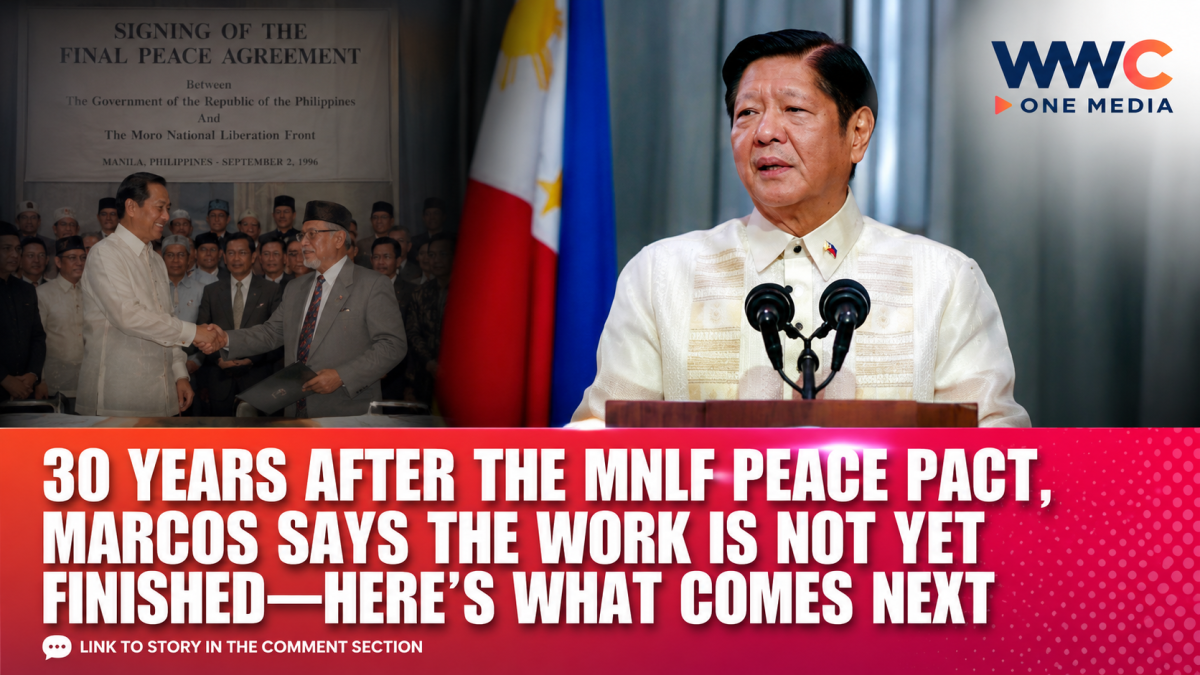
MANILA, Philippines — Thirty years after the Philippine government and the Moro National Liberation Front (MNLF) signed a landmark peace agreement, President Ferdinand Marcos Jr. called for renewed efforts to protect and strengthen the gains of the Mindanao peace process.
Marcos led the commemoration of the 30th anniversary of the 1996 Final Peace Agreement (FPA) between the Government of the Philippines and the MNLF at Malacañang Palace on September 1, 2026, as part of the opening of the National Peace Consciousness Month.
The agreement itself was signed on September 2, 1996, in Manila and was designed to advance the implementation of the 1976 Tripoli Agreement and establish mechanisms for peace, autonomy, development and the transition of former MNLF members into civilian and government life.
Marcos: Peace must be protected
Speaking before peace stakeholders and government officials, Marcos described the 1996 agreement as a major achievement forged through the sacrifices of MNLF members and the government’s commitment to dialogue.
But the President also stressed that the peace process cannot simply be treated as a historical milestone.
“Our work is not yet finished,” Marcos said, emphasizing that the agreement remains a continuing commitment to justice, dignity and self-determination through peaceful means.
He urged Filipinos to regard peace as an ongoing responsibility, saying that it must be chosen, lived, protected and strengthened.
For the administration, the message comes at a critical moment for the Bangsamoro region, where the gains of decades of peace negotiations are increasingly being tested through political and democratic institutions.
From the battlefield to democratic institutions
One of the biggest developments surrounding this year’s anniversary is the upcoming first parliamentary elections in the Bangsamoro Autonomous Region in Muslim Mindanao (BARMM).
Marcos said the government is prepared to support the September 14 elections and vowed that authorities will work to ensure that the polls are safe, peaceful and credible. He also emphasized the right of Bangsamoro voters to participate freely and without fear.
The elections are particularly significant because they represent another stage in the region’s transition toward a permanent autonomous government.
MindaNews reported that approximately 2.4 million voters are expected to elect 80 members of the Bangsamoro Parliament, consisting of political party, district and sectoral representatives.
The transformation is notable because former combatants who once participated in armed struggle are now taking part in political and community institutions.
Marcos himself pointed to this shift as evidence of how the peace process has changed the political landscape of Mindanao.
What happened to the 1996 peace agreement?
The 1996 FPA was the product of years of negotiations between the Philippine government and the MNLF and served as the framework for implementing the 1976 Tripoli Agreement.
According to the Office of the Presidential Adviser on Peace, Reconciliation and Unity (OPAPRU), the agreement included provisions involving the integration of MNLF members into the Armed Forces of the Philippines and Philippine National Police, transitional mechanisms and socioeconomic development programs in areas affected by the conflict.
Implementation, however, has continued for decades, with several commitments requiring additional mechanisms and programs.
The Marcos administration says it is continuing efforts to address those remaining commitments while improving socioeconomic opportunities for MNLF members, their families and communities.
Thousands of MNLF members benefit from transition programs
OPAPRU reported that 2,442 MNLF combatants have completed socioeconomic profiling and received transitional cash assistance, while 1,947 have benefited from cash-for-work programs.
The agency also reported that 1,141 MNLF members received civil registration documents, while 518 students benefited from the MNLF Educational Assistance Program.
On the peace and security side, 2,552 firearms have been documented and inventoried through joint peace and security mechanisms, according to OPAPRU.
The government is also developing a 2026–2028 Transformation Program Roadmap aimed at improving sustainable livelihood opportunities for MNLF combatants and their families.
Meanwhile, the Payapa at Masaganang Pamayanan (PAMANA) program has implemented 140 projects in 50 MNLF communities, including roads, bridges, water systems and housing projects.
MNLF leaders reaffirm commitment to peace
MNLF Central Committee Minister and Chairperson Muslimin Sema said the decision decades ago to pursue peace with the Philippine government was the right one.
Abdulkarim Misuari, chairperson of the MNLF Peace Implementing Panel, meanwhile emphasized the importance of cooperation and mutual trust in carrying out the remaining provisions of the peace agreements.
The government currently works through established mechanisms involving different MNLF groups, including the GPH-MNLF Peace Implementing Committee and the GPH-MNLF Management Committee.
A peace milestone—but also a new test
The 30th anniversary comes as the Philippines marks other important milestones in its broader peace process.
The September 1 ceremony also commemorated the 40th anniversary of the 1986 Mount Data Peace Accord, while the government and the Cordillera Bodong Administration-Cordillera People’s Liberation Army (CBA-CPLA) signed an agreement concerning the fulfillment of that accord. Marcos described the development as a historic achievement.
For Mindanao, however, the next major test is already approaching.
The first regular parliamentary elections in BARMM are scheduled for September 14, 2026, following previous postponements. The vote will determine the region’s 80-member Parliament and represents a major step in translating the gains of the peace process into democratic governance.
Thirty years after the MNLF peace agreement was signed, the Philippines is therefore facing a different kind of challenge: whether the peace achieved through negotiations can continue to produce stable institutions, economic opportunities and meaningful political participation.
Marcos’ message was clear: commemorating the agreement is not the end of the journey.
For the government and the Bangsamoro, the next chapter of the peace process is already underway.
WWC ONE MEDIA MJE



Leave a Reply