
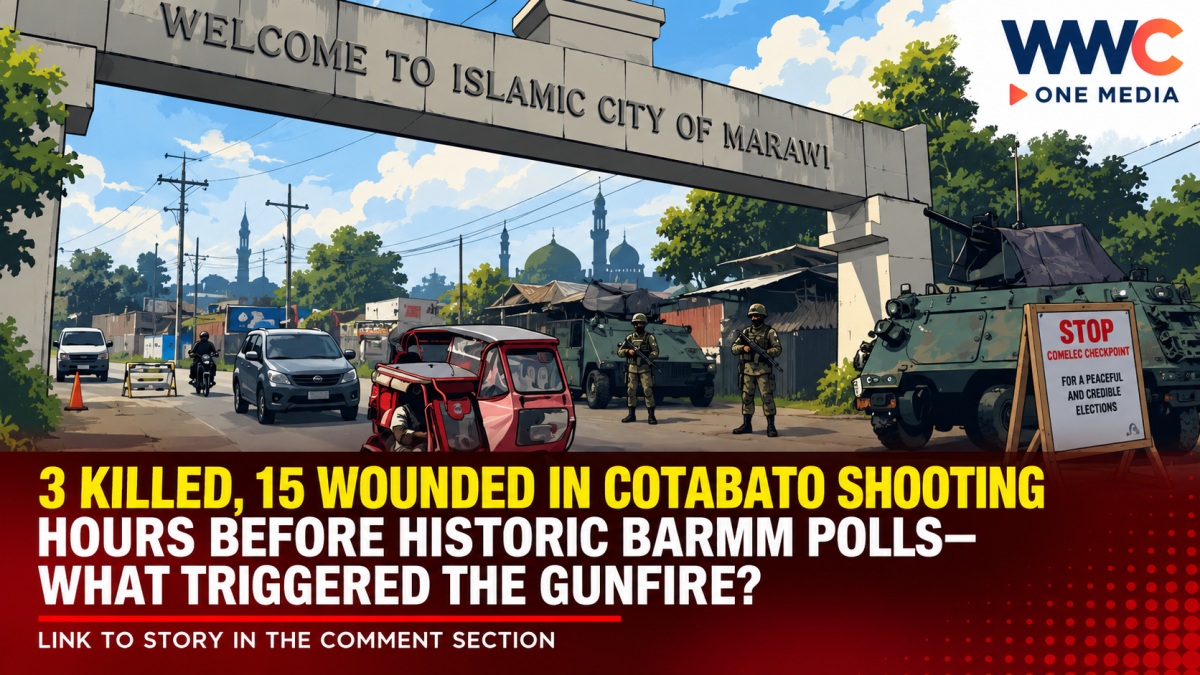
COTABATO CITY, Philippines — What was supposed to be a historic moment for the Bangsamoro region was marred by deadly violence just hours before voting began.
Three people were killed and 15 others were wounded after gunfire erupted near a polling center in Barangay Bagua 2, Cotabato City, shortly before the opening of the Bangsamoro Autonomous Region in Muslim Mindanao (BARMM) parliamentary elections on Monday, September 14.
The shooting occurred at the Datu Usman Mampen school site, which was being used as a polling location for the region’s first parliamentary elections. Philippine authorities said the violence stemmed from a confrontation involving supporters of rival political factions.
According to Cotabato City police chief Col. Jibin Bongcayao, the dispute reportedly began over the positioning of supporters in the voting queue. What started as a struggle for position escalated into shoving and a fistfight before gunfire erupted in the crowded area.
The incident involved supporters identified with rival political camps that emerged from the Moro Islamic Liberation Front (MILF), the former rebel organization that entered into a peace process with the Philippine government and eventually became a major force in the Bangsamoro transition.
The shooting underscores the security challenges surrounding the historic vote. BARMM’s parliamentary elections are the culmination of a decades-long peace process aimed at giving the predominantly Muslim region greater political autonomy after years of insurgency and conflict.
Historic election under heavy security
The September 14 elections are the first parliamentary elections in BARMM, with voters choosing representatives who will form an 80-member parliament. Nearly 2.4 million registered voters across the region are eligible to participate.
The parliament will eventually choose the region’s chief minister, making the elections a critical step in BARMM’s transition from an interim government toward a more permanent elected regional administration.
Authorities had already anticipated heightened security risks before election day.
The Philippine National Police previously identified 108 areas of concern across BARMM, with Lanao del Sur carrying the largest number of areas classified as high-risk. Maguindanao del Sur, Maguindanao del Norte and Basilan also faced varying levels of security concerns.
More than 20,000 soldiers and police personnel were deployed throughout the region for the elections, with security forces conducting checkpoints and patrols to prevent election-related violence.
The heightened security followed a series of violent incidents in the weeks leading up to the polls, including an August ambush targeting the convoy of BARMM Interim Chief Minister Abdulraof “Sammy Gambar” Macacua. Despite the attack, the government and Commission on Elections maintained that the September 14 vote would proceed as scheduled.
Comelec placed Cotabato City under control
The latest shooting comes as the Commission on Elections has taken stronger measures in response to election-related security incidents.
Cotabato City and Maluso town in Basilan were placed under Comelec control amid concerns over election security, according to Manila Standard.
The development highlights the delicate balance facing authorities: ensuring voters can participate freely while preventing long-standing political rivalries, clan conflicts and election-related disputes from escalating into violence.
The violence also came despite appeals from election officials and political leaders for a peaceful and credible vote.
Comelec Chairman George Erwin Garcia had warned that individuals attempting to sow violence or engage in vote-buying would face charges. He described the election as the culmination of generations of Bangsamoro struggle for identity, self-determination and political recognition.
A historic vote overshadowed by violence
The BARMM parliamentary elections carry significance far beyond the selection of 80 lawmakers.
The region was created through the implementation of the 2014 peace agreement between the Philippine government and the MILF, which abandoned its decades-long push for a separate state in exchange for expanded autonomy. The agreement included the commitment to demobilize roughly 40,000 MILF fighters and integrate them into civilian life.
The southern Philippines has endured decades of armed conflict, with AP reporting that roughly 150,000 combatants and civilians have died since the 1970s. The prolonged conflict also contributed to widespread underdevelopment in the region.
That history makes Monday’s vote particularly consequential.
For many Bangsamoro voters, the election represents a chance to move political struggles from the battlefield into democratic institutions.
But the deadly confrontation in Cotabato City is a stark reminder that the region’s transition to lasting peace remains unfinished.
Authorities are continuing to investigate the shooting and determine the circumstances surrounding the deaths and injuries.
As millions of Bangsamoro voters cast their ballots in the region’s first parliamentary election, the question now extends beyond who will win the 80 seats: Can the historic vote become a genuine turning point toward lasting peace—or will old political rivalries continue to threaten the region’s fragile democratic transition?




Leave a Reply