
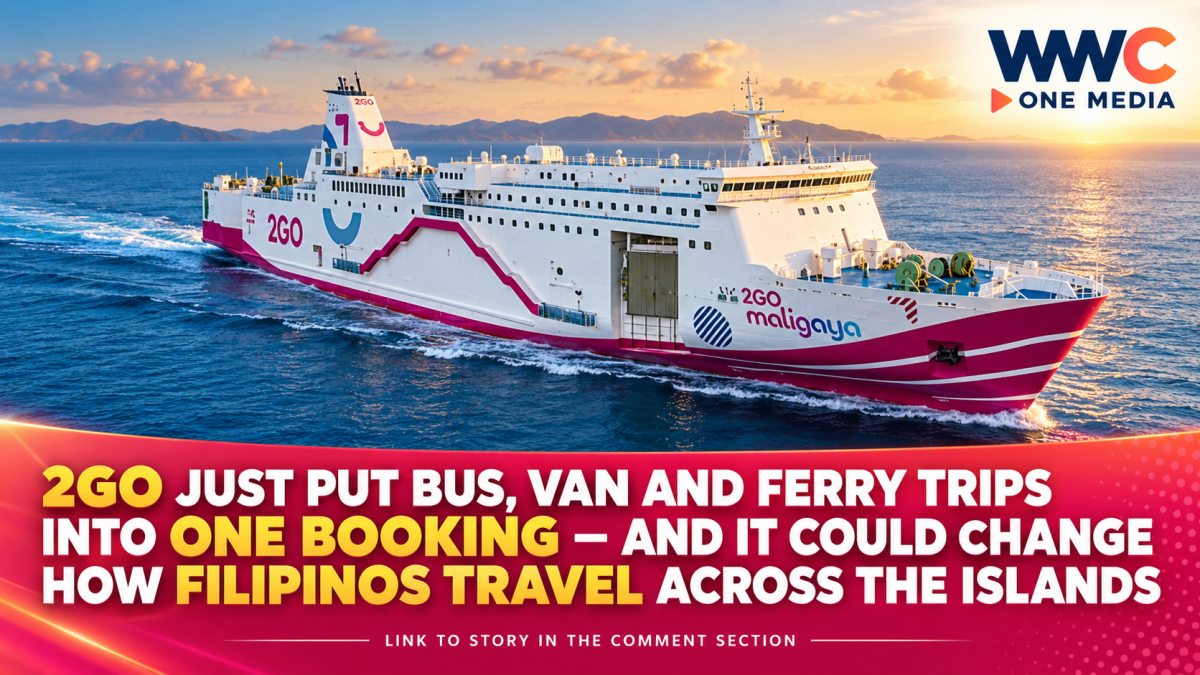
MANILA — For millions of Filipinos, getting from one island to another has often meant stitching together separate bus tickets, ferry bookings, van transfers and terminal schedules. 2GO Travel now wants to turn that fragmented journey into one itinerary.
The shipping company has launched TraveLink, a multimodal travel service that combines 2GO sea fares with connecting bus and van transportation, allowing passengers to arrange multiple legs of a domestic trip under a single booking.
Instead of separately coordinating a bus, a ferry and another land transfer, travelers can select an integrated journey designed to take them beyond the port and closer to their final destination.
It sounds like a booking upgrade.
But in an archipelago of more than 7,000 islands, it could become something much bigger: an attempt to make land-and-sea travel behave more like one national transport network rather than a collection of disconnected operators.
Five Routes Are Leading the Rollout
The initial TraveLink network includes:
- Manila–El Nido
- Manila–Caticlan, gateway to Boracay
- Baguio–Cebu
- Baguio–Bacolod
- Baguio–Siargao
2GO Travel head Francis John Chua said the company designed the system around a basic reality of Philippine travel: many journeys do not begin or end at a seaport.
The new platform is meant to reduce the need for passengers to coordinate different transport providers and booking confirmations independently.
That point is particularly important for travelers coming from inland cities such as Baguio or heading to tourism destinations located far from the port where a ferry arrives.
12Go Is the Technology Behind the Connections
2GO is not building the entire land-transport booking infrastructure from scratch.
TraveLink is powered by a partnership with 12Go Asia, a travel-booking platform specializing in multimodal transportation across Asia.
The arrangement combines 12Go’s booking technology and network of bus and van operators with 2GO’s domestic shipping routes, giving travelers access to linked land-and-sea journeys through one itinerary.
That makes the strategy different from simply adding another ferry route.
2GO is attempting to compete at the journey-planning level.
The company no longer wants the passenger relationship to begin only when someone enters a terminal.
It wants to become part of the trip from the traveler’s original city to the destination at the other end.
This Strategy Actually Started Months Ago
TraveLink did not emerge completely out of nowhere.
In May, 2GO announced a partnership with Vallacar Transit, the operator of Ceres Liner, to connect arriving ferry passengers with dedicated buses.
The first service linked Nasipit Port with a Ceres terminal in Butuan City, while Cebu and Cagayan de Oro were identified as locations planned to follow.
2GO has also previously used the TraveLink name for shuttle services serving arriving passengers in Manila and Puerto Princesa. Its current travel information describes those transfers as a way to connect passengers from ships to city destinations.
The latest rollout therefore represents a broader evolution of that idea.
Instead of merely providing transportation after passengers leave a ship, 2GO is increasingly trying to integrate the complete trip before the traveler departs.
Why This Matters More in the Philippines Than in Many Countries
Multimodal booking is hardly revolutionary globally.
But geography makes it unusually valuable in the Philippines.
Domestic travelers frequently move among buses, vans, ferries and other local transportation simply to reach another province or island.
That creates friction at almost every stage:
separate tickets, different departure points, different booking systems, changing schedules and uncertainty over how much time to allow between connections.
A single itinerary can potentially remove some of that complexity.
And the potential market is enormous.
Philippine Statistics Authority data show that domestic tourism spending reached ₱3.26 trillion in 2025, up 3% from ₱3.16 trillion a year earlier.
Tourism overall directly accounted for 8.1% of Philippine GDP, while tourism-related industries employed around 7.7 million people last year.
That means even modest improvements in domestic mobility can have consequences beyond transportation companies.
Hotels, restaurants, tourism operators, provincial businesses and local attractions all benefit when travelers can reach destinations more easily.
2GO Has a Big Network to Build Around
The company already has substantial infrastructure.
2GO says its passenger sea-travel operation serves 19 ports across Luzon, Visayas and Mindanao, supported by nine ROPAX vessels capable of carrying both passengers and cargo.
Its routes reach major destinations including Cebu, Iloilo, Bacolod, Cagayan de Oro, Davao, General Santos, Puerto Princesa, Coron, Zamboanga and others.
But ports have always imposed a natural limitation.
A ferry can bring a traveler to Palawan, Cebu or Mindanao.
It cannot necessarily bring that traveler to the hotel, municipality or tourism destination several hours inland.
That is the gap TraveLink is trying to close.
It Also Comes at an Important Moment for 2GO
The company enters the rollout from a relatively strong financial position.
2GO reported ₱1.05 billion in net income for 2025, up 28%, while revenue increased 6% to ₱18.9 billion, according to BusinessWorld.
Shipping revenue, which includes passenger travel and sea freight, grew 3%, while logistics and other services increased 9%.
But the maritime business still faces major cost pressures.
Fuel prices have forced Philippine shipping operators to closely manage routes and capacity, and 2GO has said it continues reviewing destinations and vessel utilization to maintain profitability.
That makes digital distribution and integrated transport potentially attractive.
Instead of depending exclusively on adding ships or opening expensive new sea routes, 2GO can expand the destinations it effectively serves by connecting its existing network to buses and vans.
In other words, TraveLink could allow the company to expand its travel footprint faster than its physical fleet.
But “One Itinerary” Still Has to Prove Itself
The concept is appealing.
The real test will come in execution.
The public launch materials clearly state that passengers can combine bus, van and ferry transportation in a single itinerary.
What they do not yet explain in detail is how every disruption scenario will work.
For example:
What happens when bad weather delays a ferry and a connecting bus is missed?
Will the next leg automatically be rebooked?
Who handles refunds when different transport operators are involved?
How much buffer time is built between connections?
And will an integrated itinerary actually cost less than purchasing each segment independently?
Those questions will matter because the hardest part of multimodal transport is not simply selling several tickets together.
It is making the entire chain work when one part of the journey fails.
2GO and 12Go have not publicly detailed all of those operational protections in the launch information reviewed for this story.
That distinction is important.
One booking does not automatically guarantee one seamless travel experience.
12Go Data Already Shows Why Reliability Matters
12Go currently lists multiple transport combinations on popular Philippine routes, including Manila–Caticlan, where travelers can choose among buses, ferries, flights and mixed bus-and-ferry options.
The platform also warns travelers that ferry schedules can be affected by weather and that transport delays are possible.
Those realities are unavoidable in an archipelagic transport network.
So the long-term value of TraveLink may depend less on whether consumers can click “book” once and more on whether the companies involved can manage missed connections, schedule changes and passenger support better than travelers could on their own.
The Bigger Opportunity: Turning Ports Into Gateways
That is where TraveLink could become strategically important.
For decades, Philippine maritime travel has largely been organized around port-to-port transportation.
The new model shifts toward origin-to-destination transportation.
That sounds like a small difference.
Commercially, it is enormous.
A company selling Manila-to-Cebu ferry tickets is competing primarily against other ships and airlines.
A company selling an integrated Baguio-to-Cebu journey is competing for control of the passenger’s entire travel experience.
That creates opportunities for packaged tourism, hotel transfers, provincial connectivity, business travel and eventually more complicated multi-island itineraries.
It also gives 2GO a larger reason to develop partnerships with bus companies, vans, tourism operators and technology platforms.
The Real Test Comes After the Booking
TraveLink solves one obvious problem: travelers no longer have to arrange every transport segment separately on selected routes.
But the biggest question is not whether the technology can combine a ferry and a bus on one screen.
It is whether the system can make Philippine inter-island travel genuinely easier from beginning to end.
If it succeeds, 2GO could move beyond being primarily a sea-transport company and become something closer to a nationwide multimodal travel platform.
If it does not, TraveLink risks becoming little more than several separate tickets packaged behind a cleaner booking interface.
For travelers, the difference will become obvious the first time a ferry is late, a bus connection changes or weather interrupts an island crossing.
The booking may now be unified.
The bigger challenge is proving that the journey can be, too.
WWC ONE MEDIA M.J.E




Leave a Reply