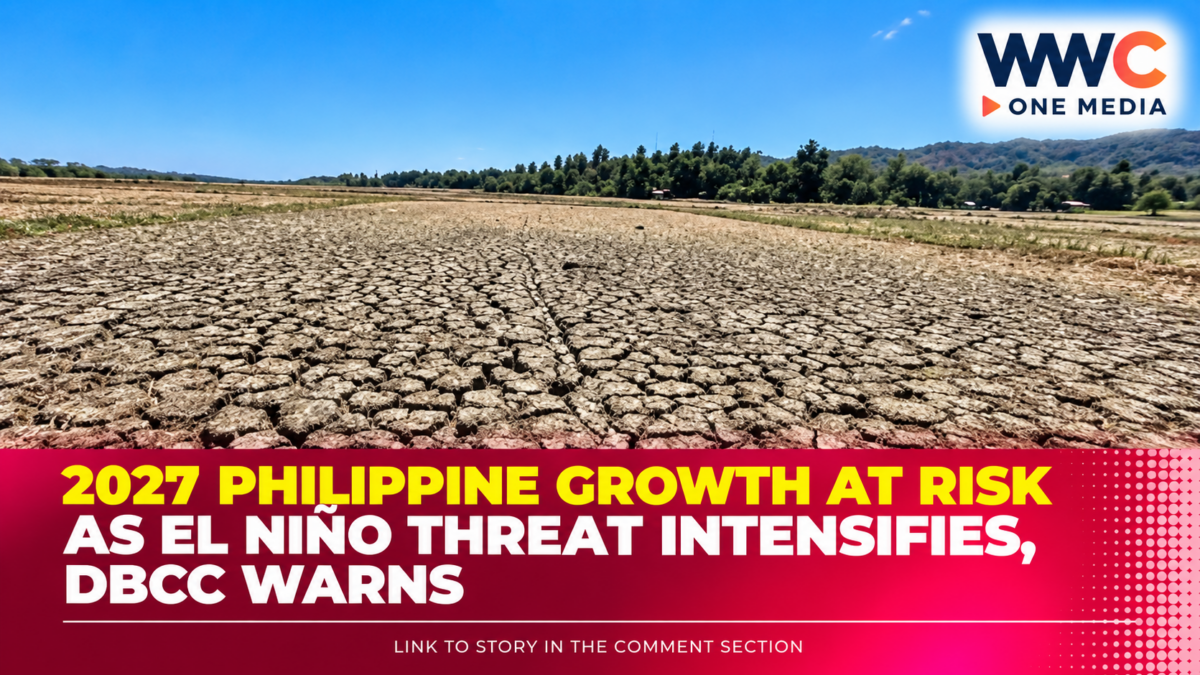
The Philippines’ expected economic recovery in 2027 could face another major setback if El Niño intensifies as projected, with the Development Budget Coordination Committee warning that prolonged dry conditions could weigh on agriculture, food supply, water resources, energy and overall economic activity.
In its 2027 Fiscal Risks Statement, the DBCC identified a stronger-than-expected El Niño as one of the key downside risks to the country’s growth outlook. The committee warned that the weather phenomenon could significantly reduce agricultural productivity and create wider economic and fiscal pressures.
The government currently expects the Philippine economy to grow by 5 percent to 6 percent from 2027 through 2030. That projection is already lower than the previous targets of 5.5 percent to 6.5 percent for 2027 and 6 percent to 7 percent for 2028.
For 2026, the DBCC has lowered its growth target to 3.5 percent to 4.5 percent from the earlier 5 percent to 6 percent range. The committee said growth could weaken further if the effects of a strong El Niño persist alongside other domestic and international uncertainties.
The weather threat is becoming more pronounced. DOST-PAGASA said in September that a Strong El Niño was already active in the tropical Pacific and was expected to intensify into a Very Strong El Niño between September and December 2026. The agency said the phenomenon could persist through the first half of 2027.
The warming is expected to peak during the first quarter of 2027, according to the government’s fiscal-risk assessment. For the Philippines, El Niño generally increases the likelihood of below-normal rainfall, prolonged dry spells and above-normal temperatures.
Those conditions could put additional pressure on farmers, particularly if water shortages disrupt planting schedules, irrigation and crop production. Lower agricultural output could then affect food availability and prices, adding another challenge for households already dealing with higher living costs.
The effects could extend beyond agriculture. The DBCC warned that water shortages could affect households and businesses, while reduced water availability could also create challenges for energy production. Prolonged heat could increase health risks, particularly for vulnerable communities and people exposed to extreme temperatures.
A severe El Niño could also place additional pressure on the government’s finances. Lower agricultural production would reduce economic activity and potentially shrink the tax base, while higher food prices could require increased government spending on emergency assistance, subsidies and social protection programs.
The DBCC said such additional spending could reduce the government’s fiscal space to respond to other economic shocks. This makes the weather event not only an agricultural concern but also a potential budget and economic-management issue.
The government has said it is already preparing for the potential impact rather than waiting until 2027. The Department of Budget and Management said interventions for farmers have been brought forward, including additional support for farm inputs, fertilizer and fuel as farmers adjust planting schedules.
Officials are also examining irrigation measures, including possible solar-powered irrigation projects, while agencies are being encouraged to maximize existing budgets for food security and water-related preparations.
The proposed 2027 national budget includes P45.67 billion for the National Disaster Risk Reduction and Management Fund, which the government describes as an additional fiscal buffer for El Niño and other disasters. The proposed allocation is 14.68 percent higher than the FY 2026 level under the General Appropriations Act.
Beyond El Niño, the DBCC identified several other risks to the medium-term outlook. These include volatile global trade policies, geopolitical tensions, supply-chain disruptions and the possibility of higher-than-expected wage increases, transport fares and utility rates.
The combination of these pressures could raise costs for businesses and households while complicating the government’s efforts to support economic growth and maintain fiscal stability.
The International Monetary Fund has also identified climate-related events as a domestic downside risk to Philippine growth. Its September 2026 assessment projected Philippine growth at 3.4 percent in 2026 and 5.1 percent in 2027, while warning that more frequent climate events could weigh on the recovery.
The government plans to strengthen water and irrigation management, maintain flood-control systems, expand disease surveillance and heat-health measures, preposition medical supplies and increase public information efforts as El Niño develops.
With PAGASA expecting the climate phenomenon to remain a concern into 2027, the coming months will be critical for agriculture, water management and disaster preparedness. The DBCC’s warning underscores how weather conditions can affect not only farms and food prices but also government spending, household costs and the pace of the country’s broader economic recovery.