
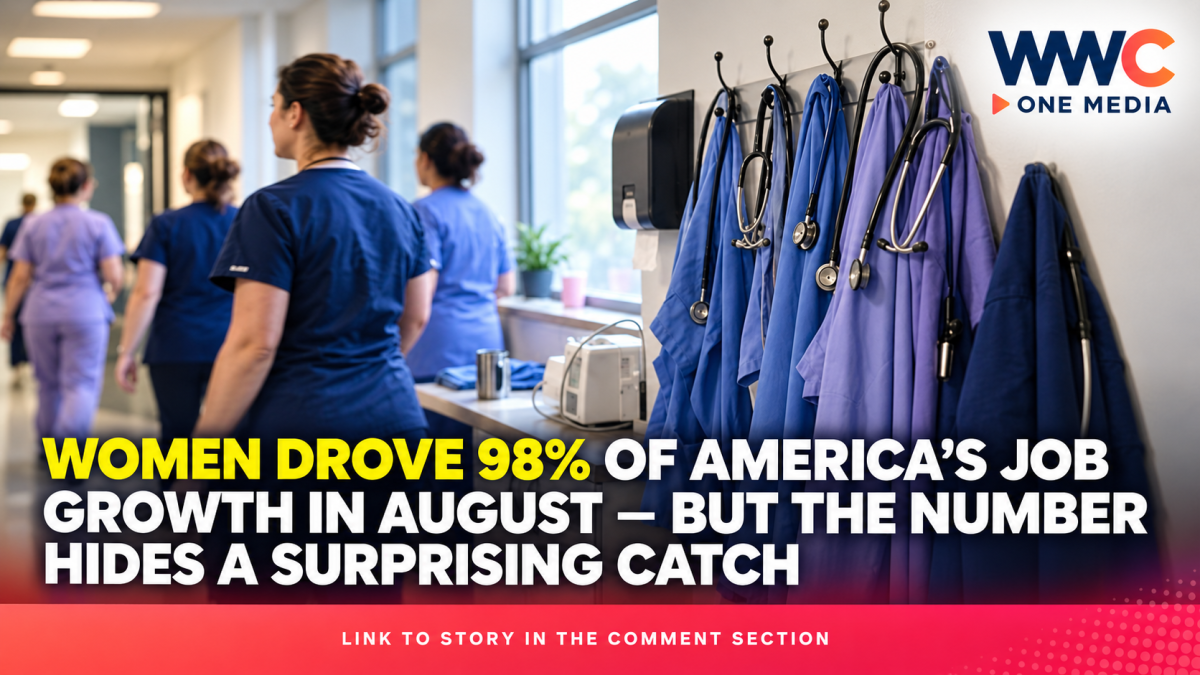
WASHINGTON — America’s surprisingly strong August jobs report came with an extraordinary statistic buried beneath the headline: women accounted for virtually all of the net jobs added to U.S. payrolls.
Women’s nonfarm payroll employment jumped by 158,000 positions in August, representing roughly 98% of the economy’s total 162,000-job increase, according to Bureau of Labor Statistics data analyzed by CNBC. Men, by comparison, accounted for a net gain of only about 4,000 jobs.
The imbalance is striking enough on its own. But it also points toward a potentially deeper shift taking place inside the American labor market—one increasingly shaped by the industries where women make up a large portion of the workforce.
And there is an important catch: August’s blockbuster headline does not necessarily mean the labor market suddenly became overwhelmingly stronger for women.
Women Now Hold a Slight Majority of U.S. Payroll Jobs
BLS figures show women held approximately 79.749 million nonfarm payroll positions in August, up from 79.591 million in July.
That put women at roughly 50.1% of total U.S. nonfarm payroll employment, continuing a historic shift in the gender composition of the American workforce.
Fortune reported that women had already moved ahead of men in overall payroll employment earlier in 2026, only the third such crossover in modern U.S. labor history. The previous episodes occurred around the Great Recession and just before the Covid-19 pandemic, but the latest transition may be driven more by long-term changes in the industries creating jobs.
That distinction matters.
Some of America’s strongest hiring engines—health care, education and parts of hospitality—employ disproportionately large numbers of women. Meanwhile, some traditionally male-heavy industries have faced slower employment growth, technological disruption or cyclical pressure.
Laura Ullrich, director of economic research at Indeed Hiring Lab, told CNBC that the gap between jobs held by women and men has climbed to unprecedented levels, describing the labor market as being in the middle of a significant shift.
Restaurants and Schools Powered Much of the August Boom
The biggest clue to August’s unusual gender split lies in where the jobs were created.
Restaurants and bars added 59,000 jobs, while local-government education added another 42,000.
Together, those categories represented more than 60% of August’s total employment gain, according to Reuters and BLS figures. Leisure and hospitality overall gained 62,000 positions.
Those are sectors where women account for a substantial share of workers.
Fortune reported that women gained roughly 68,000 leisure-and-hospitality jobs during August even though the sector itself added only around 62,000 positions overall—meaning male employment within the sector declined on a net basis.
Local-government education also rebounded sharply after weakness during the previous month, something economists say may partly reflect seasonal hiring patterns surrounding the beginning of the school year.
That is one reason economists are warning against treating one month’s dramatic gender split as evidence that the entire economy has fundamentally changed overnight.
The Headline Jobs Report Was Much Stronger Than Wall Street Expected
The gender story emerged from an employment report that surprised Wall Street on nearly every major headline measure.
The U.S. economy added 162,000 nonfarm jobs in August, nearly triple the 56,000 increase expected by economists surveyed by Reuters.
July’s previously reported 23,000-job decline was also revised into a 21,000 gain, while June was revised upward as well.
The unemployment rate remained at 4.1%, even as the labor force expanded by 683,000 people and the labor-force participation rate climbed from 61.4% to 61.6%.
Those numbers eased fears that the U.S. labor market was sliding rapidly toward recession after several weak months.
But they also revived another concern for investors: interest rates.
Reuters reported that financial markets increased their expectations that the Federal Reserve could raise rates at its September meeting following the stronger employment figures, with rate-hike probabilities moving sharply higher after the report.
Women Are Also Outperforming Men on Some Broader Employment Measures
The contrast between men and women extends beyond August payroll growth.
The BLS household survey shows that seasonally adjusted employment among women aged 16 and older increased from roughly 76.536 million in August 2025 to 77.409 million in August 2026—an increase of about 873,000.
Male employment went in the opposite direction, falling from roughly 86.834 million to 85.337 million over the same period, a decline of nearly 1.5 million.
The unemployment rate for women aged 16 and older was 3.9% in August, compared with 4.4% for men.
Those longer-term figures make the August payroll split more difficult to dismiss entirely as statistical noise.
Still, the picture for women is far from universally positive.
The Hidden Warning Behind the 98% Number
A headline saying women generated nearly all U.S. job growth sounds unquestionably bullish.
Economists say the reality is more complicated.
The National Women’s Law Center noted that although 212,000 women returned to the labor force in August, there were still about 633,000 fewer women aged 20 and older participating in the labor force than in January.
The Institute for Women’s Policy Research likewise cautioned that the broader U.S. employment market remains characterized by relatively weak hiring and slow wage growth despite August’s unexpectedly strong report.
CNBC also highlighted another potential concern: women remain more likely than men to hold multiple jobs, while many of the sectors currently producing employment growth are lower-paying service industries.
That means some of the surge could reflect workers taking additional positions or moving into jobs that do not necessarily deliver stronger household purchasing power.
In other words, more jobs held by women does not automatically translate into dramatically better economic conditions for women.
America’s Labor Market May Be Changing Faster Than the Headline Suggests
The most important takeaway from August may therefore not be that women captured 98% of one month’s job growth.
It may be the composition of the economy underneath that number.
Health care, education, hospitality and other service industries where women have substantial representation continue to play an increasingly important role in employment growth, while technology, automation and changing economic conditions are putting pressure on some traditional sources of male employment.
At the same time, August provided signs that the broader labor market remains resilient: manufacturing added 16,000 jobs, construction gained 22,000, and health care increased employment by another 13,000, Reuters reported.
Whether the extraordinary August gender divide becomes a durable economic trend will require several more months of data.
But one statistic is already difficult to ignore:
Out of every 100 net jobs America added in August, roughly 98 were added to women’s payroll employment.
That may prove to be an unusual monthly distortion driven by schools and restaurants.
Or it may be an early glimpse of a much bigger transformation in who is powering the American workforce.
WWC ONE MEDIA M.J.E




Leave a Reply