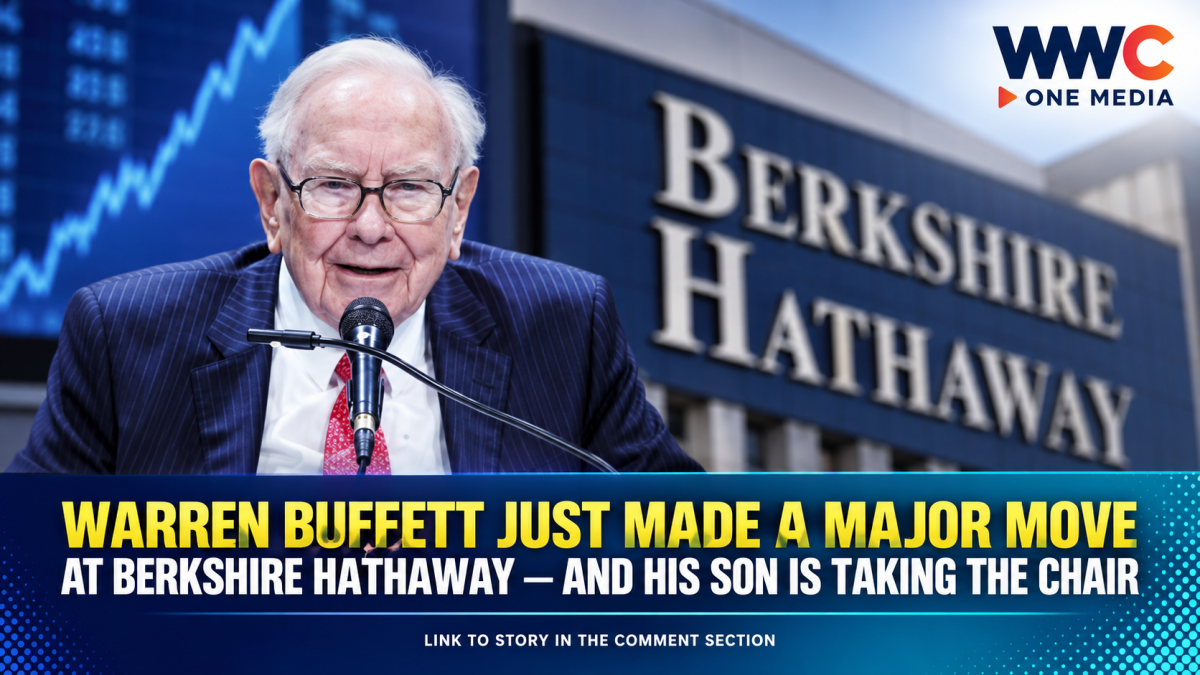
OMAHA, Nebraska — Warren Buffett has taken another major step back from Berkshire Hathaway, the conglomerate he transformed over six decades, after the company named him chairman emeritus effective immediately.
The 96-year-old Buffett will remain on Berkshire Hathaway’s board of directors and continue providing his judgment and perspective, but his longtime position as chairman will now be held by his son, Howard G. Buffett.
The move marks another major chapter in Berkshire Hathaway’s carefully planned leadership transition. Greg Abel became chief executive officer at the start of 2026 after Buffett stepped down as CEO, ending his roughly 60-year run overseeing the company’s day-to-day operations.
Howard Buffett takes the chairman’s seat
Howard Buffett, 71, has served on Berkshire Hathaway’s board since 1993. He will now become chairman, while Susan Decker continues as lead independent director, according to Berkshire’s announcement.
CEO Greg Abel said Warren Buffett’s influence on Berkshire and its shareholders was unparalleled and that the company’s culture and values would remain central under Howard Buffett’s leadership.
The appointment gives Berkshire a leadership structure in which Greg Abel runs the company as CEO, Howard Buffett chairs the board, and Warren Buffett remains involved as chairman emeritus and a director.
That distinction is important: Buffett has not completely severed his connection with Berkshire.
Buffett’s next role: still on the board
Berkshire said Buffett will remain a member of the board and continue to offer his “judgment and perspective.”
In a letter to shareholders announcing the latest change, Buffett acknowledged the passage of time, writing that Father Time ultimately wins but had been generous to him.
His continued board role means Berkshire shareholders will still have access to the company’s most recognizable figure, even though operational leadership has moved to Abel and the chairmanship has moved to Howard Buffett.
The change also follows Buffett’s July 2026 disclosure that he intended to dispose of his remaining Berkshire shares over time. Berkshire said Buffett planned for his remaining holdings to ultimately be donated to four foundations by the end of 2034.
The Buffett-to-Abel transition is now entering a new phase
Berkshire’s succession process has been unfolding for years.
Buffett announced in 2025 that Greg Abel would succeed him as CEO. Abel officially assumed the role on January 1, 2026, while Buffett remained chairman.
At Berkshire’s first annual meeting under Abel’s leadership in May, Buffett was still present and briefly addressed shareholders. CNA reported that Abel emphasized Berkshire’s long-standing preference for avoiding bureaucracy and maintaining a disciplined approach to capital allocation.
The change in leadership has attracted considerable attention because Berkshire’s identity has been closely tied to Buffett since he took control of the company in 1965.
The company that Buffett inherited was a struggling textile manufacturer. Over the decades, Berkshire evolved into a sprawling conglomerate with major interests in insurance, railroads, energy, manufacturing, retail and publicly traded companies. Reuters reported that Berkshire is now valued at more than US$1 trillion.
Berkshire’s investment strategy is also evolving
The leadership transition comes as Berkshire continues making significant capital-allocation decisions under Abel.
In June, Berkshire agreed to invest US$10 billion in Alphabet, the parent company of Google, as the technology company expanded spending on artificial intelligence infrastructure. CNA reported that Abel subsequently described AI data-center expansion as a significant opportunity for Berkshire, including through its energy operations.
Berkshire has also continued its long-running investments in Japan. Abel said in September that the company holds stakes of more than 10% in five major Japanese trading houses and has developed a strategic relationship with Tokio Marine.
These moves offer a glimpse of Berkshire’s investment approach under its new CEO, while Buffett’s influence remains part of the company’s institutional DNA.
Why the chairman change matters
For investors, the latest announcement is more than a change in title.
Buffett has been Berkshire’s chairman since the early years of his control of the company, making the position closely associated with his leadership and investment philosophy.
Now, three distinct roles have emerged:
- Greg Abel: CEO and responsible for running Berkshire’s operations.
- Howard Buffett: Chairman of the board.
- Warren Buffett: Chairman emeritus and continuing board member.
The arrangement allows Berkshire to move further into the post-Buffett era without completely removing Buffett from the company’s governance.
Financial Times reported that Howard Buffett’s appointment represents another step in Berkshire’s succession plan following Abel’s elevation to CEO.
A company built around one extraordinary era
Buffett took control of Berkshire in 1965 and spent decades turning it into one of the world’s most closely watched companies.
His approach — acquiring businesses, investing for the long term and maintaining substantial financial reserves — became synonymous with Berkshire’s corporate identity.
But Berkshire’s scale has also changed dramatically. Today it owns businesses across insurance, rail transportation, energy, manufacturing, retail and other sectors, while holding a major portfolio of publicly traded companies.
The question now is not simply who occupies Berkshire’s top offices.
It is how much of Buffett’s investment culture can be maintained while Abel and the company’s board navigate a business that is vastly larger and more complex than the Berkshire Buffett took control of in 1965.
For now, Buffett remains close enough to the company to advise its leaders — but the latest move makes one thing clear: the transition to the post-Buffett era is no longer just being planned. It is happening in real time.