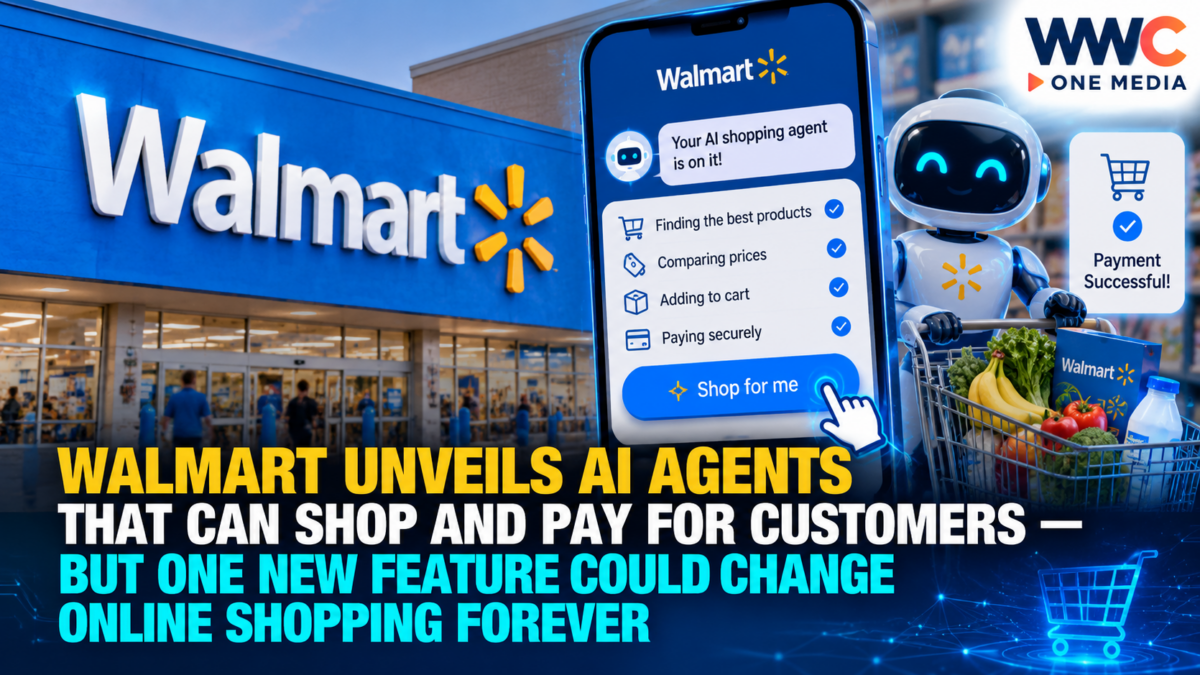
BENTONVILLE, ARKANSAS — Walmart has introduced a new set of tools designed to let artificial intelligence agents search for products, manage shopping tasks and purchase items on behalf of customers.
Announced on October 21, 2026, the initiative is a significant expansion of the retailer’s strategy to integrate AI into online commerce.
The system introduces three key components: Agent Profiles, Walmart Agent Gateway and new operating rules for AI shopping agents.
Together, the tools are designed to support purchases through external AI assistants while giving Walmart customers control over permissions, approvals and spending.
The move comes as retailers and technology companies explore agentic commerce — a shopping model in which AI software can go beyond recommending products and perform authorized actions for consumers.
Walmart’s approach also contrasts with that of rival Amazon, which has restricted some third-party AI agents from accessing its shopping platform.
But Walmart is making a crucial distinction: AI agents may carry out shopping tasks, but customers are supposed to retain control over what they are allowed to purchase.
What Exactly Is an AI Shopping Agent?
Traditional online shopping requires consumers to search for items, compare prices, add products to their carts and complete checkout themselves.
An AI shopping agent is designed to handle some or all of those steps after receiving instructions.
For example, instead of browsing multiple product pages, a customer could ask an authorized assistant to find a particular grocery item, compare available choices and prepare a purchase.
Depending on the permissions granted, the assistant could then complete the transaction.
The difference is that an AI agent can act, rather than simply answer questions.
Walmart’s announcement seeks to establish a more structured way for those automated actions to happen, including ways to identify individual agents and limit their purchasing authority.
Walmart’s Three New AI Shopping Tools
1. Agent Profiles
Dedicated profiles will let customers authorize individual AI agents, review their transactions separately and set purchase permissions.
2. Walmart Agent Gateway
A technical connection designed to let compatible AI assistants interact more directly with Walmart and Sam’s Club shopping systems instead of navigating websites like human users.
3. Terms for AI Agents
Rules requiring agents to respect customer instructions, limit data access, avoid unauthorized payment changes and follow Walmart’s shopping policies.
Walmart says Agent Profiles are scheduled to become available in November 2026. Its gateway is being introduced through a beta programme for developers and companies.
That means the announcement should not be interpreted as confirmation that every AI assistant can already complete every type of purchase through Walmart today.
Customers Can Set Spending Limits — or Approve Every Purchase
One of the most important features is the ability to decide how much authority an AI agent receives.
EXAMPLES OF CUSTOMER-CONTROLLED SPENDING LIMITS
$50
Example limit
$100
Example limit
$200
Example limit
These are examples Walmart gave of limits customers could choose, not mandatory spending thresholds or announced purchase amounts.
Customers will be able to require approval for every transaction or grant an agent permission to make purchases within a predefined limit.
Purchases made by each AI assistant will appear separately from the customer’s own orders.
Users can also disable an agent’s access.
Walmart says customers must approve AI-agent purchases by default, and it may require additional approval even where spending permissions have been granted.
The company is therefore not announcing a system in which AI assistants automatically receive unlimited authority over a shopper’s account.
Walmart News & Leadership
How the New Shopping System Is Intended to Work
- Start with a compatible AI assistant.The customer asks the assistant to help find or buy a product.
- Connect the agent to Walmart.The shopper signs in through Walmart and authorizes a dedicated Agent Profile.
- Choose purchase permissions.The customer sets approvals or spending limits before allowing transactions.
- Let the agent perform authorized shopping tasks.The assistant can use Walmart’s supported systems to find products and, where permitted, complete purchases.
- Review or revoke access.The customer can distinguish agent purchases from personal orders and remove authorization.
Illustrative workflow based on Walmart’s announced Agent Profile and Agent Gateway design. Availability depends on the rollout and the specific AI assistant.
ChatGPT, Gemini and Muse Are Part of Walmart’s AI Commerce Strategy
Walmart says it wants customers to shop through the apps and assistants they already use.
Its broader strategy includes connections involving ChatGPT, Gemini and Meta’s Muse.
The retailer also operates its own AI-powered shopping assistant, Sparky, which helps customers find products, compare options, summarize reviews and plan purchases.
The new gateway is intended to provide a more reliable pathway for compatible external agents to interact with Walmart’s shopping systems.
Instead of asking automated software to click through webpages designed for people, Walmart plans to provide a structured technical interface.
The company says this should reduce errors and improve reliability when agents search for products or prepare transactions.
Walmart Versus Amazon: Two Different AI Shopping Strategies
The announcement reveals an important difference between two major U.S. retailers.
| Walmart | Amazon |
|---|---|
| Welcoming compatible third-party shopping agents through its planned gateway | Has restricted some third-party agents from accessing its shopping platform |
| Developing individual Agent Profiles and permission controls | Emphasizing its own shopping ecosystem and AI tools |
| Allowing authorized purchases within defined controls | Retaining tighter control over outside agents operating on its site |
| Building integrations with external AI services | Developing its own AI-assisted shopping experiences |
Amazon also uses artificial intelligence in its retail operations. The contrast is not that Walmart supports AI while Amazon rejects it; it concerns how much access each retailer gives external AI agents.
Neither approach has yet been proven superior across customer satisfaction, security and long-term profitability.
Can AI Shopping Agents Be Trusted With Payment Information?
One of the biggest concerns with AI-driven purchases is security.
Walmart says it has built several safeguards into its new system:
- AI agents cannot access customers’ payment-card information.
- Agents cannot add or change payment methods.
- Customers can revoke an agent’s access.
- Walmart’s ordinary returns process applies to agent purchases, including situations where an agent does not behave as intended.
- Agents may only access information needed for an authorized task.
The retailer also says its prices will remain consistent whether a customer shops directly or uses an AI agent. Any applicable offers and fees should be displayed before purchase.
However, customers must still consider the privacy practices of the AI assistant they choose. Walmart’s rules govern its own shopping system, while external AI providers may have separate policies for handling information shared with them.
Does This Mean AI Will Automatically Shop Without Permission?
No. Walmart’s announced system does not give an AI assistant unrestricted access to a shopper’s money.
For purchases requiring approval, customers must authorize the transaction. If they choose to permit purchases within spending limits, agents may operate within those boundaries, subject to additional Walmart checks.
This distinction is central to how the company is positioning its technology.
Rather than requiring shoppers to choose between completely manual shopping and completely autonomous purchasing, Walmart is introducing different levels of permission.
The practical effectiveness of those safeguards will become clearer as the system is rolled out and more customers begin using it.
Could AI Shopping Change Online Retail Forever?
The commercial opportunity is substantial.
AI assistants could eventually simplify routine shopping, identify products based on customer preferences and reduce the effort involved in comparing items.
For retailers, easier purchasing could improve customer convenience and potentially influence conversion rates.
For brands, however, it may change how products are discovered.
Instead of competing only for placement in search results and advertisements, businesses may increasingly need product information that AI systems can understand and compare reliably.
This could place greater importance on accurate product descriptions, up-to-date inventory information, clear pricing, trustworthy reviews and structured product data.
Walmart’s move also arrives as other technology companies explore AI-assisted commerce.
In September, Anthropic announced tools to help retailers build shopping agents. Reuters reported that Adobe Analytics had observed higher conversion rates among certain AI-driven retail visits, although those findings do not establish that all AI shopping agents generate better results.
What This Means for Philippine E-Commerce Businesses
The announcement could offer a preview of how online shopping evolves in the Philippines and across ASEAN.
Businesses using marketplaces, independent e-commerce websites and social commerce channels may eventually encounter customers who rely on AI assistants to evaluate products.
For Philippine merchants, some practical considerations include maintaining accurate inventories, displaying complete product specifications, making delivery costs transparent and offering clear refund policies.
There may also be opportunities for developers building customer-service systems and shopping assistants.
However, Walmart has not announced a Philippine launch of this Agent Profiles system, and its October 21 announcement should not be presented as a new service available through Philippine marketplaces.
The immediate development concerns Walmart and Sam’s Club customers using supported accounts, apps and participating AI services.