
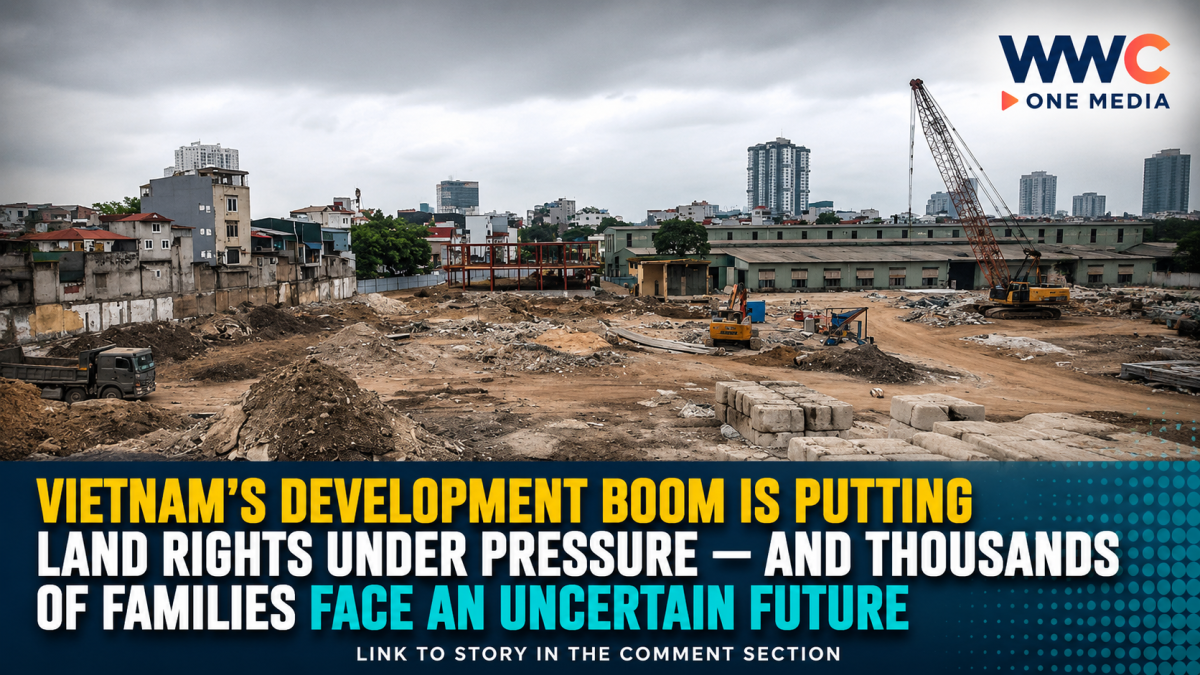
HANOI — Vietnam’s rapid push to transform its cities, expand infrastructure and accelerate economic growth is creating a difficult question: how much should communities have to give up for development?
A new investigation by The Diplomat examines the human cost of Vietnam’s accelerating development drive, focusing on residents in Hanoi and elsewhere who are being displaced as land is cleared for major infrastructure and urban projects.
The issue is becoming increasingly important as the government pursues ambitious economic targets and prepares further changes to the country’s land regulations.
A development push collides with residents’ homes
One case highlighted by The Diplomat involves a Hanoi resident identified as Thanh, whose home near West Lake was demolished to make way for the planned Pearl Theater project.
According to the report, Thanh’s two-story, 230-square-meter property was valued at more than 300 billion Vietnamese dong, or roughly US$11.5 million, based on the current market estimate cited by The Diplomat. She received 3 billion dong in compensation, along with a monthly allowance, while designated resettlement housing was reportedly not yet ready.
Her experience illustrates the central controversy surrounding land acquisition in Vietnam: the difference between the value residents believe they are losing and the compensation they receive under state-led land recovery procedures.
Importantly, the valuation figures and allegations in this individual case come from The Diplomat’s reporting and should not be treated as independently established facts beyond that report.
Hanoi’s transformation could affect hundreds of thousands
The issue extends well beyond one neighborhood.
The Diplomat reports that Hanoi’s long-term master plan could eventually affect around 860,000 people, or more than 10 percent of the capital’s population, through large-scale redevelopment and associated displacement.
Among the projects highlighted is the Red River Scenic Avenue Corridor, which reportedly passes through 16 communes and wards and covers approximately 11,418 hectares, potentially affecting around 200,000 residents.
Other major projects cited include the Gia Bình International Airport project in Bắc Ninh, which is expected to require nearly 1,960 hectares and affect about 7,100 households and 118 organizations, as well as the Long Thành Airport project in Đồng Nai, which involves roughly 5,000 hectares and thousands of affected households.
These projects are part of a much broader infrastructure and urban-development push rather than a single nationwide land-clearance program.
Why land is so important in Vietnam
Vietnam’s land system is different from countries where individuals hold conventional private ownership of land.
Under Vietnam’s legal framework, land is owned by the entire people, with the state acting as representative and granting land-use rights to individuals, households and organizations.
Those land-use rights are legally protected, but the state can recover land in defined circumstances, including projects serving national defense, security or socioeconomic development in the national or public interest.
The government’s own policy documents acknowledge the need for safeguards.
A resolution on land policy calls for clear criteria defining when land recovery is necessary and stresses that compulsory recovery should be strictly controlled to prevent abuse while not obstructing projects. It also calls for fairness in land access and protection of lawful land-use rights.
Compensation remains the flashpoint
The biggest disputes often revolve around compensation, resettlement and livelihoods.
A recent analysis published by VnEconomy argues that Vietnam’s existing framework does not yet provide sufficiently comprehensive mechanisms for compensation, resettlement and livelihood restoration in major transit-oriented development projects.
It warns that residents relocated from central or high-value areas can lose access not only to their homes but also to employment opportunities, public services and established communities.
Vietnam’s 2024 Land Law introduced mechanisms for land recovery around transportation hubs and corridors with development potential, as well as provisions concerning land pooling and readjustment. But VnEconomy’s analysis says these mechanisms remain largely principle-based and have rarely been implemented in practice.
That creates a difficult balancing act: Vietnam wants to unlock land for infrastructure and urban development while ensuring people displaced by those projects can rebuild their lives.
Vietnam is now considering faster land acquisition
The debate has become even more urgent because Hanoi is trying to accelerate construction.
In August, Vietnam proposed changes to land-acquisition rules that could allow authorities to acquire land and begin construction before compensation and resettlement plans are fully finalized.
Reuters reported that the proposal is intended to eliminate delays caused by disputes and help Vietnam pursue its target of at least 10 percent annual economic growth through 2030.
The proposal would also seek to change compensation policy toward rebuilding affected people’s lives and improving access to replacement land, while using more data-driven approaches to land valuation.
That creates a potentially explosive policy tension: faster construction could mean faster economic development — but it could also intensify concerns among residents who have not yet secured compensation or replacement housing.
The government says reforms should protect affected residents
Vietnamese authorities are not ignoring the compensation problem.
Government policy calls for attention to the housing, living conditions and livelihoods of people affected by land acquisition. In August, authorities directed several southern localities to accelerate compensation, support and resettlement work for major transportation projects while specifically emphasizing the welfare of affected residents.
Legal analysis of the 2024 Land Law likewise identifies compensation, complaint procedures and litigation as important safeguards for people affected by state land recovery.
The challenge is therefore not simply whether Vietnam should build.
It is how quickly it can build while maintaining public trust in the process.
A long-running problem gets a new sense of urgency
Land disputes are not new in Vietnam.
The World Bank has previously documented the prominence of land-related administrative disputes and complaints, particularly those involving acquisition, compensation and resettlement. More recent World Bank work has similarly identified land acquisition and compensation as major sources of administrative disputes.
What has changed is the scale and speed of development.
Vietnam is simultaneously pursuing new airports, highways, railways, urban districts, industrial zones and major redevelopment projects.
The country’s economic strategy increasingly depends on unlocking land and infrastructure quickly.
But every cleared site can represent a home, a livelihood or a community that existed there before the construction cranes arrived.
The human cost behind Vietnam’s economic transformation
The debate is ultimately about more than property prices.
For families forced to relocate, losing a home can mean losing proximity to jobs, schools, relatives, businesses and long-established communities.
That is why compensation alone may not settle the issue.
As Vietnam’s cities become more valuable and infrastructure investment pushes land prices higher, the question of who benefits from rising land values — and who bears the cost of redevelopment — is likely to become increasingly important.
Vietnam’s development ambitions are enormous. The government wants faster growth, modern infrastructure and a high-income economy by 2045.
WWC ONE MEDIA G.A




Leave a Reply