
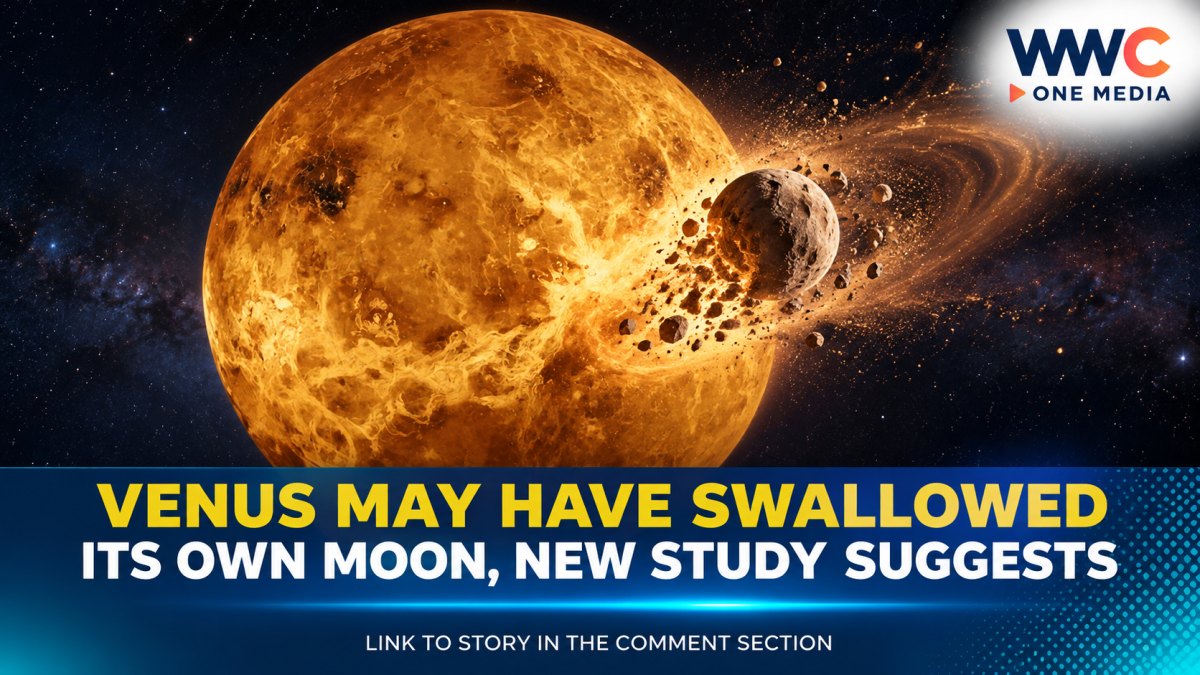
Venus may once have had a moon before its slow rotation caused the satellite to spiral inward and eventually crash into the planet, according to a new study offering a possible explanation for why Earth’s closest planetary counterpart has no natural satellite today.
The research, led by astrophysicist Stephen Kane of the University of California, Riverside, proposes that Venus did not necessarily form without a moon. Instead, any moon it once possessed may have been doomed by the planet’s unusually slow rotation.
Venus may have lost a moon in a cosmic collision
Venus is similar to Earth in size, mass and overall structure, yet there is one striking difference: Earth has a large moon while Venus has none.
Scientists have previously considered several explanations, including the possibility that Venus never formed a moon or that a large collision destroyed or removed one.
The new study proposes another scenario.
If Venus once had a moon, gravitational interactions between the planet and its satellite could have caused the moon to gradually lose orbital energy and move closer to Venus.
Eventually, the moon would have entered a region where the planet’s gravity could tear it apart or send it crashing into the surface.
The researchers’ computer simulations suggest that hypothetical moons around Venus would generally face this fate.
Venus spins unusually slowly
The key to the theory is Venus’ extremely slow rotation.
Venus takes about 243 Earth days to complete one rotation on its axis, and it rotates in the opposite direction to most planets in the Solar System.
That slow, retrograde rotation creates a very different tidal environment from Earth’s.
On Earth, tidal interactions gradually transfer energy to the Moon’s orbit, causing our satellite to move away from the planet by roughly 3.8 centimetres each year.
The researchers argue that the situation would have been dramatically different on Venus.
Instead of being pushed outward, a moon around Venus would tend to spiral inward.
The larger the hypothetical moon, the more rapidly its orbit could have deteriorated under the simulated conditions.
A moon would not necessarily survive for billions of years
The simulations suggest that Venus’ slow rotation would make long-term moon survival difficult.
A satellite could initially have formed around the planet following a major impact or another event capable of placing material into orbit.
But over astronomical timescales, tidal forces could have steadily altered its orbit.
Eventually, the moon would approach Venus closely enough to be destroyed or consumed.
That means Venus’ lack of a moon today does not necessarily mean the planet never had one.
Instead, the moon could have disappeared billions of years ago, leaving Venus with no obvious satellite for modern astronomers to observe.
Why Earth kept its moon
The comparison with Earth is particularly important.
Earth’s Moon is moving slowly outward because of tidal interactions between the two bodies.
That process is fundamentally different from what the researchers believe would happen around slowly rotating Venus.
The study therefore highlights how a planet’s rotation can influence whether a moon remains in a stable orbit over geological timescales.
Two planets that are otherwise similar can consequently end up with completely different satellite histories.
The theory remains unproven
There is currently no direct evidence showing that Venus definitely once had a moon.
The researchers’ work is a theoretical explanation based on computer simulations and the known dynamics of planetary systems.
Other explanations for Venus’ lack of a moon remain possible.
The study nevertheless provides a new way of thinking about Venus’ history and raises questions about how common moons may be around other rocky planets.
If a planet’s rotation can determine whether a moon survives, similar processes could also influence the evolution of planets beyond our Solar System.
Future missions could provide more clues
Scientists hope future missions to Venus will provide additional information about the planet’s geological and chemical history.
NASA’s DAVINCI and VERITAS missions are expected to study Venus’ atmosphere, surface and geological evolution, potentially providing clues about events that shaped the planet billions of years ago.
For now, the idea that Venus may have swallowed its own moon remains a fascinating possibility rather than a confirmed fact.
But if the theory is correct, Venus’ empty sky may be the aftermath of a dramatic event in the planet’s distant past — one in which its missing moon ultimately became part of the world it once orbited.




Leave a Reply