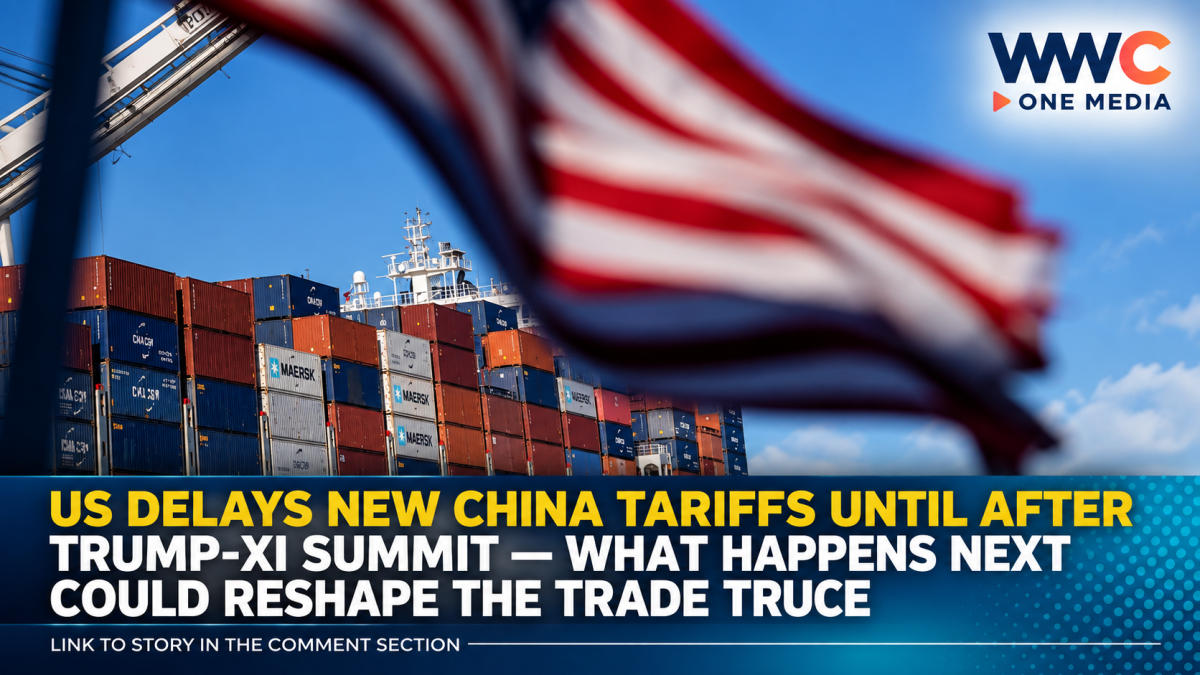
WASHINGTON — September 19, 2026 — The United States is expected to postpone announcing new tariffs targeting what Washington describes as excess manufacturing capacity until after President Donald Trump meets Chinese President Xi Jinping in Washington next week, according to people familiar with the matter cited by Bloomberg.
The reported delay comes just days before the scheduled September 24 Trump-Xi summit, putting a potentially significant new round of US trade measures on hold while the two governments prepare for high-level negotiations.
The move does not mean the proposed tariffs have been cancelled. Bloomberg reported that the Trump administration had previously planned to release a trade report ahead of the summit recommending a 7.5% tariff on Chinese goods over excess manufacturing capacity. The reason for delaying the announcement remains unclear, and the final tariff rate could still change.
Why the 7.5% tariff matters
The proposed measure stems from a broader US investigation into what Washington calls structural excess capacity and production in manufacturing.
In March, the US Trade Representative launched Section 301 investigations covering 16 economies, including China, the European Union, Singapore, Japan, India, South Korea, Vietnam, Malaysia, Thailand, Mexico and others.
The investigation is examining whether policies and practices in those economies contribute to excess manufacturing capacity that could harm US commerce.
For China, the previously reported 7.5% tariff would bring the overall US tariff burden on Chinese imports back toward 20%, according to Bloomberg reporting. That figure is significant because it corresponds broadly with the tariff level associated with the existing US-China trade truce.
However, the precise structure and timing of any new duties remain uncertain.
The timing points directly to the Xi-Trump talks
The delay comes as Washington and Beijing intensify preparations for the September 24 summit.
Reuters reported that Trump and Xi are expected to discuss a wide range of issues, including trade, the existing tariff truce, critical minerals and rare-earth supplies, artificial intelligence, Taiwan, Iran and Chinese exports of fentanyl precursors.
Trade remains one of the central issues, with both governments seeking to prevent tensions from escalating while negotiating areas where economic cooperation could resume.
US Treasury Secretary Scott Bessent is also scheduled to meet Chinese Vice Premier He Lifeng in New York ahead of the summit. Reuters reported that their discussions are expected to include trade, AI, rare earths and the possibility of extending the existing tariff truce, which is due to expire on November 10.
That makes the timing of the tariff announcement particularly important: a new tariff announcement before the summit could have complicated negotiations, while postponing it leaves the measure available as a potential negotiating issue.
More trade talks are already underway
The tariff story comes as Washington and Beijing appear to be exploring possible areas for reciprocal concessions.
Reuters reported Friday that the two countries are discussing a potential reduction or elimination of China’s 15% tariff on US liquefied natural gas, alongside a broader framework that could involve each side cutting tariffs on roughly $30 billion worth of goods.
The discussions are not final, but they illustrate the economic issues being negotiated ahead of Xi’s Washington visit.
The two governments are also discussing other trade issues, including Chinese purchases of US agricultural products and Boeing aircraft, as well as access to critical minerals and rare-earth materials.
The tariff threat has been building for weeks
The latest development represents a change in timing rather than a complete reversal of the administration’s approach.
In August, Bloomberg reported that the United States was preparing a 7.5% tariff on Chinese goods linked to excess manufacturing capacity ahead of the planned Trump-Xi meeting.
Reuters subsequently reported the Bloomberg story but noted at the time that it could not independently verify the report.
The US investigation itself, however, is official.
USTR announced in March that its Section 301 probe would examine structural excess capacity and production across 16 trading partners. Public hearings were subsequently held in May.
China is facing a broader US trade challenge
The excess-capacity investigation is only one component of the wider US-China economic relationship.
Washington continues to maintain a range of trade restrictions and investigations involving China, while Beijing has its own tariffs and regulatory measures affecting US goods.
At the same time, companies on both sides are adapting to the prolonged trade friction.
Reuters reported this week that some companies that shifted production and sourcing away from China to avoid US tariffs are beginning to reconsider those decisions, highlighting how complicated and costly the restructuring of global supply chains has become.
What happens after September 24?
For businesses, investors and global manufacturers, the crucial question may no longer be whether Washington intends to pursue excess-capacity tariffs, but when and at what rate those tariffs will actually be imposed.
The administration has not publicly confirmed the reported delay or the final tariff rate. Bloomberg’s report is based on people familiar with the matter, while Reuters and other outlets have separately reported on the underlying tariff plans and the upcoming negotiations.
The September 24 Trump-Xi summit could therefore become an important checkpoint for the next phase of US-China trade policy.
Until then, the proposed tariffs remain a possibility rather than a finalized new duty — leaving companies and markets watching closely for what Washington and Beijing decide once the two leaders sit down.