
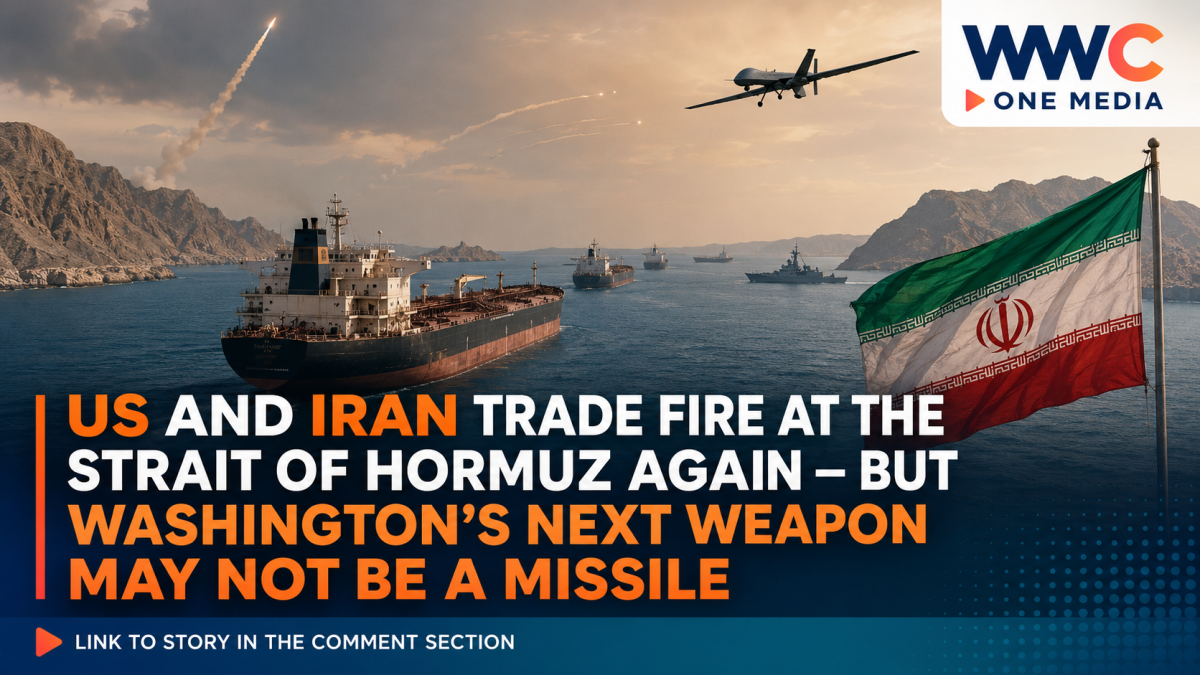
WASHINGTON/TEHRAN, Aug. 31, 2026 — The United States and Iran have exchanged fire around one of the world’s most important energy corridors, breaking weeks of relative military restraint and raising fresh fears that the six-month conflict could again spill into global oil markets.
U.S. forces struck two Iranian rocket launchers on Larak Island on Sunday, August 30, in what was described as the first known American military attack on Iran since late July. Iran subsequently launched ballistic missiles toward U.S. military positions in Jordan, according to Iranian media and U.S. reporting.
But while the renewed shooting has captured immediate attention, Washington is preparing another form of pressure that could have consequences well beyond the battlefield: a campaign of increasingly frequent sanctions aimed not only at Iran but also at banks and businesses around the world that continue handling Iranian money.
Why the US struck Larak Island
Larak Island sits near Bandar Abbas at the entrance to the Strait of Hormuz, placing it beside shipping lanes that connect Gulf energy producers with international markets.
A U.S. official told Reuters that American forces targeted two Iranian launchers after Islamic Revolutionary Guard Corps personnel were allegedly observed preparing rockets and sea mines that could threaten vessels in the Strait.
U.S. Central Command characterized the operation as a limited and precise action against what Washington said was an imminent maritime threat. Iran disputes the broader U.S. narrative surrounding the conflict and has accused Washington of aggression.
The distinction matters: Washington is portraying the attack as defensive action designed to keep the shipping route open rather than the beginning of a new large-scale offensive against Iran.
Whether that restraint lasts is now one of the biggest questions facing the region.
Iran fires back toward US bases in Jordan
Tehran responded with ballistic missile attacks targeting two U.S. bases in Jordan, according to Iranian state media.
Jordanian defenses intercepted incoming missiles, while U.S.-linked reporting indicated that most of the weapons were stopped and that there was no immediate indication of major damage to American facilities.
Iran’s Revolutionary Guards, meanwhile, said the U.S. attack on Larak Island caused deaths and injuries among fighters and civilians and promised further retaliation. No independently verified casualty figure was immediately available.
That uncertainty makes the next several days particularly important. Even a relatively contained exchange can escalate if either side suffers significant casualties or believes the other is changing the rules of engagement.
The Strait of Hormuz is the real pressure point
The confrontation is especially dangerous because of where it occurred.
The Strait of Hormuz is among the most strategically important shipping corridors on Earth. U.S. Energy Information Administration figures show that flows through the strait in 2024 and early 2025 were equivalent to roughly 20% of global petroleum liquids consumption and more than a quarter of global seaborne oil trade.
About one-fifth of worldwide liquefied natural gas trade also passed through Hormuz in 2024.
And there are limited alternatives.
Saudi Arabian and UAE pipelines capable of bypassing Hormuz provide only a fraction of the capacity normally transported through the waterway, according to the EIA.
Shipping traffic has already been severely disrupted during the conflict. CNA, citing shipping data, reported that only around five visible commodity vessels a day were transiting the strait over the weekend, although the true figure may be higher because some ships switch off their tracking systems for security reasons.
Oil prices react immediately
Energy markets did not ignore the latest escalation.
Brent crude jumped more than 2% after news of the Larak Island strikes, reaching around US$90.60 a barrel, while West Texas Intermediate also climbed as traders priced in the possibility of another disruption to Gulf supplies.
The market response illustrates why even relatively small military incidents around Hormuz can have global consequences.
A prolonged closure or major attack on commercial shipping could raise transportation and insurance costs, interrupt energy supplies and renew inflation pressure far beyond the Middle East.
For Asian economies heavily dependent on imported energy, the stakes are particularly high.
Bessent says more sanctions are coming — potentially every week
At the same time, Treasury Secretary Scott Bessent is signaling that Washington increasingly intends to fight Iran through the international financial system.
Bessent told Reuters that new secondary sanctions could be announced weekly, initially targeting financial institutions facilitating Iranian transactions.
The strategy means foreign banks and companies could face a stark choice: maintain certain financial relationships with Iran or risk losing access to the U.S. dollar-based financial system.
The Treasury Department has already begun acting.
On August 28, the department’s Financial Crimes Enforcement Network proposed cutting the UAE operations of Egypt’s Banque Misr off from correspondent banking relationships with U.S. financial institutions.
Treasury alleged that Banque Misr UAE had processed billions of dollars in transactions connected to Iran over roughly two and a half years. The department also sanctioned Reza Mohammad Taeedi, manager of Bank Melli’s Dubai branch.
Washington calls the broader initiative Operation Economic Outcast.
The significance goes beyond one bank. If Treasury follows through with sanctions every week, institutions in financial hubs across the Middle East and Asia could face growing pressure to examine any exposure to Iranian transactions.
A military war is becoming an economic war too
That appears to be the larger shift taking shape.
After six months of conflict, neither Washington nor Tehran has achieved a clear strategic victory. Reuters has described the confrontation as increasingly resembling an energy-focused war of endurance, with control of shipping routes, oil exports and financial access becoming as important as direct military strikes.
The conflict began on February 28 with major U.S.-Israeli attacks on Iran and has since evolved through missile exchanges, attacks on infrastructure, shipping disruptions and repeated diplomatic deadlock.
The latest Larak Island clash therefore may be less important for the physical damage it caused than for what it reveals: the military confrontation remains capable of reigniting even as Washington expands its economic campaign.
Trump makes new Kharg Island claim — but evidence remains unconfirmed
Hours after the latest escalation, President Donald Trump claimed on social media that Iran’s strategically important Kharg Island oil hub was being heavily damaged.
But there is an important factual warning.
Reuters reported that Trump did not provide independently verifiable evidence for the claim, while a video accompanying the post was determined by Reuters analysis to be synthetically generated. At the time of reporting, there was no independent confirmation from Iranian media or other U.S. officials that a new attack of the scale suggested by Trump had occurred.
Kharg Island nevertheless remains extraordinarily important because it has historically served as the center of Iran’s crude export infrastructure. That makes any confirmed major attack there potentially far more consequential for energy markets than the limited strike on Larak.
For now, however, claims of new destruction at Kharg should be treated as unverified unless corroborated by independent evidence or official military confirmation.
What happens next could matter far beyond Iran
The immediate question is whether the United States and Iran stop after the latest exchange or enter another cycle of retaliation.
But a second battle is already accelerating quietly through banks, shipping companies and global payment networks.
Bessent’s warning of weekly secondary sanctions suggests the Trump administration may increasingly force international financial institutions to decide how much access to Iran is worth risking their access to the U.S. financial system.
And that could turn what began as another exchange of missiles near Hormuz into a much broader economic confrontation — one capable of affecting oil prices, shipping routes, banks and governments thousands of miles from the battlefield.




Leave a Reply