
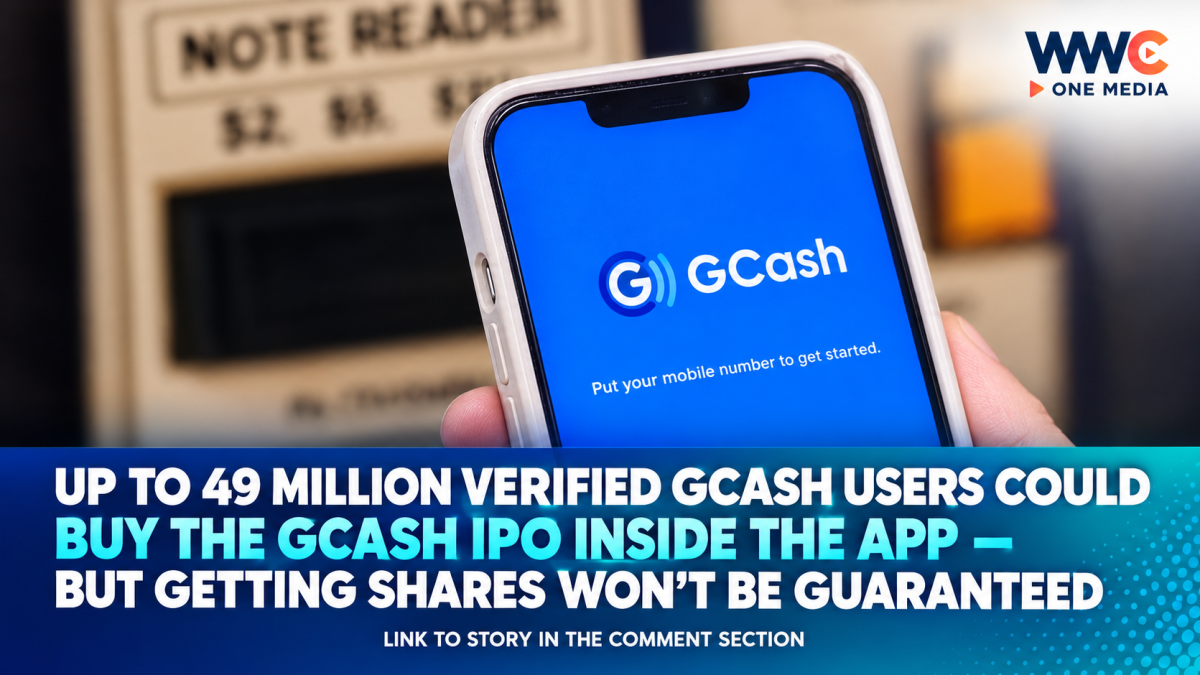
MANILA — September 17, 2026 — The Philippines’ biggest digital wallet could soon ask millions of its users to do something very different with their GCash balance:
Buy a piece of GCash itself.
GCash parent Mynt Inc. is preparing to allow eligible users to subscribe to its blockbuster initial public offering directly through the GCash app, according to multiple company sources cited by InsiderPH — potentially turning one of the country’s most widely used financial apps into a distribution channel for what could become the largest IPO in Philippine history.
InsiderPH reported that as many as 49 million verified GCash users could potentially become eligible for the offering if the planned feature is finalized and they satisfy the necessary know-your-customer requirements.
The idea is strikingly simple: Filipinos who already use GCash for payments, transfers, savings and loans could potentially move into stock ownership without leaving the same app.
But several important qualifications remain.
The in-app GCash IPO distribution arrangement has not yet been formally finalized publicly. The final IPO price has not been set. Investors are not guaranteed an allocation. And Mynt’s own website currently says its registration statement has not yet become effective and that the required SEC permit to offer securities has not yet been issued.
So this is potentially a major expansion of Philippine retail investing — but it is not yet as simple as tapping “Buy” on GCash today.
InsiderPH: As Many as 49 Million Verified Users Could Participate
According to InsiderPH, company sources expect verified GCash customers to be given a way to subscribe to Mynt’s IPO using GStocks PH, GCash’s domestic stock-investment platform.
The report said as many as 49 million fully verified users could potentially qualify, subject to identity verification and other KYC requirements.
That would represent an extraordinary potential retail-investor pool.
For comparison, the Philippine Stock Exchange had only 3.64 million stock-market accounts in 2025, according to figures cited by Mynt itself. About 3.22 million of those were online retail accounts.
GCash’s potential reach is therefore many times larger than the existing Philippine stock-investing population.
But there is an important distinction.
Being a fully verified GCash user does not automatically mean someone already has an active brokerage account.
GCash’s official instructions say fully verified users still have to enter GStocks PH, register and complete the required digital KYC process. GStocks PH operates through licensed broker AB Capital Securities Inc.
So the 49-million figure should be understood as a potential eligible audience cited by InsiderPH sources — not 49 million guaranteed IPO buyers.
GCash Already Has the Infrastructure for IPO Subscriptions
The concept is not being built completely from scratch.
GCash’s official Help Center already says users can subscribe to participating IPOs through GStocks PH directly inside the GCash app.
The process currently involves opening the Invest section, entering GStocks PH, selecting an IPO, choosing the desired number of shares and submitting the order.
GCash also explicitly warns users that an IPO application does not guarantee shares.
Depending on demand, a subscriber may receive:
the full number requested, only part of the order, or no allocation at all.
That becomes particularly relevant for the Mynt IPO because retail demand could be enormous if millions of existing GCash customers are invited to participate.
And GStocks is already a meaningful player.
Mynt said in August that GStocks PH had about 1.7 million users, representing approximately 53% of all online retail stock-market accounts reported by the PSE in 2025.
That means GCash already controls one of the largest digital gateways into Philippine equities before its own shares even reach the market.
The Minimum Investment Could Be Surprisingly Small
InsiderPH reported that people familiar with the offering expect the minimum subscription to be around 100 shares.
Sources cited by the publication said an IPO price in the neighborhood of ₱7 to ₱8 per share could therefore put the smallest investment at roughly ₱700 to ₱800.
However, those numbers are not final.
A more recent public estimate from BDO Capital & Investment Corp. President Eduardo Francisco put the likely offer price around ₱7.50 to ₱8.50 per share, below Mynt’s official maximum indicative price of ₱10.
At 100 shares, that indicative range would translate to roughly ₱750 to ₱850, before any applicable fees or final terms.
Francisco stressed that no final price had been decided.
The ₱10 figure is a ceiling, not necessarily the price investors will ultimately pay.
That distinction matters because pricing the IPO lower could potentially improve its attractiveness to retail and institutional investors while leaving more room for the stock to trade above its offer price after listing.
There is, of course, no guarantee that it will.
IPO shares can rise or fall after listing.
This Could Still Become the Biggest IPO in Philippine History
The scale of Mynt’s listing is unprecedented for the Philippine market.
Its planned base offering consists of up to 8.027 billion common shares, with another 1.204 billion shares available through an overallotment option.
At the maximum indicative price of ₱10 per share, the base offer could reach about ₱80.3 billion.
If the overallotment option is fully exercised, the total transaction could reach approximately ₱92.3 billion.
That would exceed the size of previous Philippine IPO records.
At the ₱10 maximum price, Mynt’s implied equity valuation would be around ₱669 billion, or roughly $11 billion based on figures in its preliminary prospectus.
That would represent a dramatic increase from Mynt’s roughly $5 billion valuation when Japan’s MUFG Bank invested in the company in 2024-2025.
But Most of the IPO Money Would Not Go to GCash
The headline size of the offering also requires context.
Most of the shares being offered are secondary shares, meaning they are being sold by existing Mynt shareholders rather than newly issued by the company.
Of the maximum 8.027 billion shares in the base offer, only about 1.605 billion are new primary shares.
The remaining approximately 6.422 billion shares are secondary shares sold by existing investors.
InsiderPH calculated from Mynt’s preliminary prospectus that, assuming the ₱10 maximum price, roughly ₱14.9 billion in net proceeds would go to Mynt itself, while a much larger amount would ultimately go to selling shareholders if the deal and overallotment were fully completed.
That does not make the IPO unusual or improper — large private-equity-backed listings often include significant secondary sales.
But it matters for investors because buying shares from an existing shareholder does not inject the purchase price directly into Mynt’s expansion budget.
Mynt says proceeds from its new primary shares are intended for areas including CreditTech expansion, product development, strategic cash reserves and general corporate purposes.
Some of GCash’s Biggest Investors Aren’t Leaving
The IPO should also not automatically be interpreted as GCash’s major strategic backers heading for the exits.
Based on the preliminary prospectus, several large shareholders were not listed as selling shareholders, including Globe-linked entities, Ant International Technologies, the Ayala-Mitsubishi joint venture AM 50 Ventures, and Japan’s MUFG Bank.
Mynt’s strategic shareholders include some of Asia’s biggest corporate names.
Its ownership has included Globe Telecom, Ayala interests, Ant-linked entities, MUFG and Mitsubishi-related investments, alongside global investment funds.
The IPO instead gives some earlier financial investors and other shareholders an opportunity to monetize part of their holdings while creating publicly traded shares that Filipino and international investors can purchase.
GCash Has Become Much More Than an E-Wallet
The reason the IPO is receiving so much attention is that Mynt has become one of the Philippines’ largest financial-technology businesses.
According to figures in its prospectus, Mynt had about 40.4 million monthly active users as of March 31, 2026.
Its users were carrying out an average 62.4 million transactions per day, while its QR-payment network covered about 2.1 million merchants.
The company reported:
₱79.7 billion in adjusted revenue in 2025, up from ₱54.1 billion in 2024.
₱17.25 billion in net income, compared with ₱11.13 billion in the previous year.
For the first quarter of 2026 alone, net income reached about ₱5.6 billion.
GCash has also expanded well beyond payments.
Its ecosystem now spans lending, savings, investment funds, Philippine equities, insurance and other financial products.
That explains why Mynt increasingly describes GCash as a finance superapp, rather than simply a mobile wallet.
The IPO Could Turn GCash Customers Into GCash Owners
This is where the in-app subscription idea becomes more interesting than a normal IPO distribution strategy.
Most companies going public spend heavily trying to attract retail investors who may have little existing relationship with the business.
Mynt potentially starts with tens of millions of people who already interact with its product.
A GCash customer could use the app to pay electricity bills in the morning, send money to a relative in the afternoon — and potentially subscribe for shares in the company behind the same platform before the day ends.
That would blur the line between customer and shareholder in a way few Philippine IPOs have previously attempted at this scale.
And Mynt has been building toward that position.
The company said GStocks already allows users to invest without physically visiting a brokerage office, while its broader GInvest ecosystem provides access to stocks, funds and bonds.
It is also working to make IPO subscriptions inside GStocks more seamless.
So using the same infrastructure to distribute Mynt’s own IPO would be a logical next step.
But One Major Regulatory Step Is Still Outstanding
This is arguably the most important caveat for anyone reading claims that the IPO is ready to buy.
The Securities and Exchange Commission announced on September 4 that it had approved Mynt’s planned IPO, and PSE disclosures show Mynt received a favorable pre-effective letter concerning its proposed offer.
However, Mynt’s own IPO website currently carries a more specific legal warning.
It says:
the registration statement has been filed but has not yet been rendered effective, and no purchase money can be accepted until the SEC issues the Certificate of Permit to Offer Securities for Sale.
In practical terms, that means Mynt has cleared an important regulatory hurdle, but the final legal conditions allowing investors actually to subscribe must still be completed.
The in-app GCash subscription mechanism therefore remains something investors should watch for in the final prospectus and official GCash/PSE announcements, rather than treating leaked or preliminary details as guaranteed terms.
The Current IPO Timeline Points to October
Recent Philippine reporting indicates that Mynt is targeting an October 2026 listing.
Daily Tribune reported that the current timetable calls for price-setting around October 1, followed by the public offer period in early October and a targeted PSE debut around October 20.
IPO schedules frequently change until the final offer documentation is released, however, particularly when regulatory approvals and final pricing are still pending.
Mynt itself continues to state that the IPO remains subject to regulatory requirements, market conditions and final offer terms.
That makes the next few weeks critical.
Investors should soon learn the final price, exact minimum subscription, final retail allocation, offer dates and whether the planned GCash-app subscription channel proceeds exactly as InsiderPH’s sources expect.
The Bigger Story May Be What Happens to Philippine Investing After the IPO
If even a small percentage of GCash’s enormous user base opens brokerage accounts to participate, the impact could extend beyond Mynt.
The PSE has historically struggled with a relatively small domestic investor base compared with the size of the Philippine population.
Yet that has already begun to change.
The number of Philippine stock-market accounts increased 27.3% in 2025, reaching 3.64 million, while online retail accounts climbed more than 30%, according to PSE figures cited by Mynt.
GCash has the potential to accelerate that trend because it removes much of the friction traditionally associated with opening a brokerage account.
That is why this IPO could become more than a record fundraising exercise.
If Mynt succeeds in convincing ordinary GCash users to become investors, it could introduce millions of Filipinos to the stock market through a product they already use every day.
The irony is difficult to miss.
GCash originally grew by persuading Filipinos that money did not have to stay inside a traditional bank.
Its IPO could now try to persuade many of the same people that investing in companies does not have to begin inside a traditional brokerage either.
But for now, one distinction remains essential:
The technology exists. The massive IPO is moving forward. The in-app subscription plan is being prepared. But the final price, allocation mechanics and SEC permit still need to be completed before anyone can actually buy GCash shares.

Leave a Reply