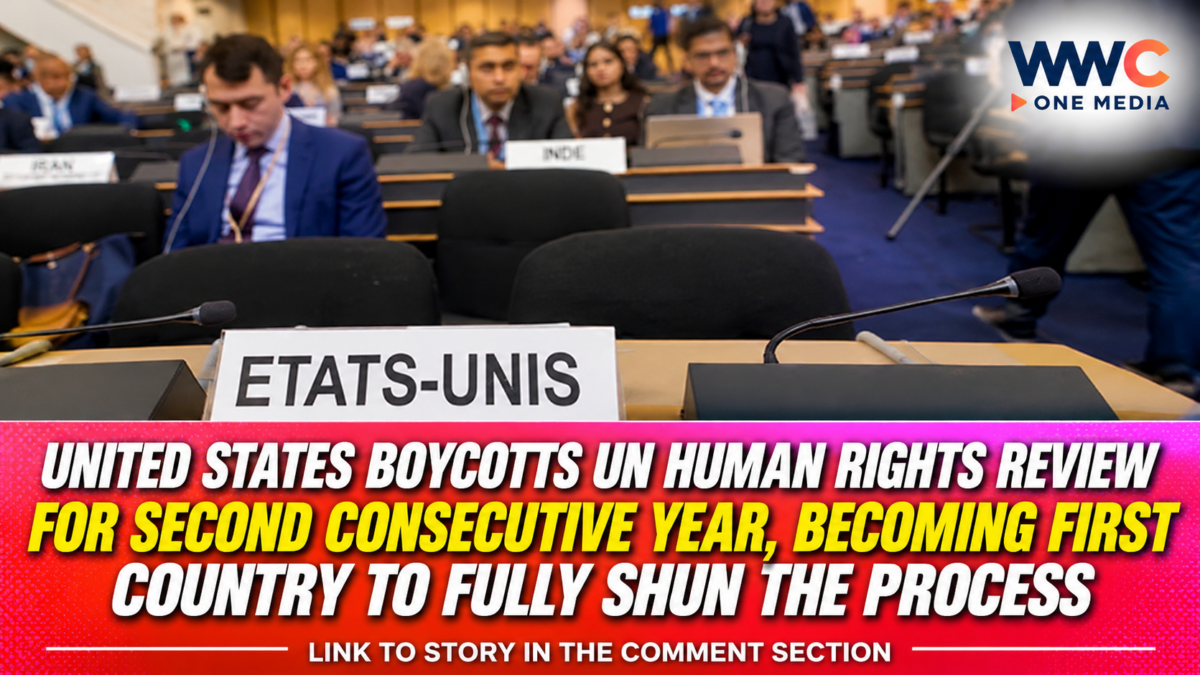
The United States has become the first country in the history of the United Nations’ Universal Periodic Review (UPR) to completely refuse participation in the human rights assessment process, after the Trump administration again failed to send a delegation to Geneva on November 10, 2026.
The unprecedented move has intensified criticism from international human rights organizations, lawmakers and civil society groups, who warn that Washington’s refusal to submit to scrutiny could weaken a system designed to hold every UN member state accountable.
The UN Human Rights Council had scheduled the US review for November 10 after postponing it from November 2025, when the American government also failed to appear. With Washington absent for a second consecutive year, the council decided to postpone the assessment again, this time until January 2027.
The controversy is especially significant because the UPR is intended to cover all 193 UN member states, regardless of their political influence, economic power or position in international affairs.
The US administration maintains that participating would imply endorsement of a council it considers biased and ineffective. Critics, however, argue that refusing the review risks creating a dangerous precedent: if one of the world’s most powerful countries can reject international scrutiny, other governments may eventually follow.
How the US Became the First Country to Completely Boycott the UN Review
The United States’ decision is particularly significant because it goes beyond simply withdrawing from the Human Rights Council.
The Trump administration announced its withdrawal from the council in February 2025, arguing that the organization had demonstrated anti-American and anti-Israel bias and failed to address serious human rights violations.
The administration also directed the United States not to participate in the council and not to seek election to it.
However, the Universal Periodic Review is a separate mechanism. It covers all 193 UN member states, including countries that are not elected members of the 47-seat Human Rights Council.
This distinction is central to the controversy: leaving the council does not automatically remove a country from the universal review process.
The United States had previously participated in its reviews in 2010, 2015 and 2020. Its refusal to attend the 2025 and 2026 sessions has now created an unprecedented situation in the mechanism’s nearly 20-year history.
What Is the UN Universal Periodic Review?
The Universal Periodic Review is a peer-assessment system established by the United Nations Human Rights Council in 2006.
It examines the human rights records of every UN member state, generally once every four to five years.
During the process, governments present information about their human rights policies and practices. Other countries examine the record, raise questions and make recommendations on areas that need improvement.
Civil society organizations and human rights groups can also submit information, giving victims and advocacy organizations an opportunity to bring concerns before the international community.
Recommendations made through the UPR are generally non-binding. The process is intended to encourage transparency, dialogue and improvements rather than impose automatic punishments.
Its defining principle is universality: every country is expected to face the same review process, regardless of its international influence.
That is why the US boycott has generated such strong reactions.
Why Washington Refuses to Participate
The Trump administration has repeatedly criticized the UN Human Rights Council, accusing it of applying double standards and displaying hostility toward the United States and Israel.
A State Department spokesperson defended the latest decision, saying participation would imply endorsement of the council’s work.
The spokesperson described the organization as an institution that makes a mockery of human rights through its alleged failure to uphold its own values and its promotion of anti-American rhetoric.
Washington has also criticized the council for what it considers inadequate action against serious human rights abuses committed by other governments.
The administration has not accepted the premise that the council is an impartial forum deserving US participation.
However, critics argue that refusing to participate does not answer the allegations raised about the United States itself.
The dispute has therefore become a wider confrontation over international accountability, the authority of multilateral institutions and whether governments should be able to reject scrutiny when they disagree with the reviewing body.
Human Rights Groups Raise Concerns About US Policies
The US absence comes as international organizations and civil society groups have raised concerns about several areas of American policy.
Nearly 200 submissions from US and international organizations were reportedly provided for consideration in the review process.
Issues expected to be raised by participating countries included:
- Immigration enforcement and deportations.
- Racial discrimination and equal protection.
- LGBTQ rights.
- Freedom of expression and the right to protest.
- Abortion rights.
- The death penalty.
- Civil liberties and the treatment of vulnerable communities.
The American Civil Liberties Union was among the organizations pushing for international scrutiny.
Its human rights director, Jamil Dakwar, criticized the administration’s decision and argued that the United States should not be exempt from accountability.
Human Rights Watch also warned that Washington’s refusal could encourage other governments to treat participation as optional.
These are concerns and allegations raised by advocacy organizations, not findings issued through a completed UN assessment of the United States.
UN Human Rights Council Gives the United States Another Opportunity
Despite Washington’s continued absence, the UN Human Rights Council has decided to give the country another opportunity to participate.
On November 10, the council expressed regret over the United States’ continued non-cooperation and urged the government to resume participation in the Universal Periodic Review.
It also requested that the council president continue efforts to encourage American cooperation.
The next review has been rescheduled for January 18–29, 2027, during the 54th session of the UPR Working Group.
The council also indicated that it could consider additional appropriate measures before that session concludes.
The decision reflects the council’s preference for keeping the door open rather than immediately abandoning the possibility of US participation.
However, the repeated postponement has frustrated human rights advocates who believe the international community must respond more firmly to the American government’s refusal.
Could Other Countries Follow America’s Example?
One of the most serious concerns is the possibility that other governments could use the American boycott as justification for refusing their own reviews.
Countries frequently criticized over their human rights records may argue that they should not be expected to cooperate with a process that a major global power has chosen to ignore.
Human Rights Watch has warned that allowing repeated non-participation without consequences could weaken the credibility of the entire mechanism.
The International Service for Human Rights has also called on member states to maintain scrutiny of the United States and push for a response to its refusal.
The concern is not simply about America’s absence. It is about whether the principle of equal treatment can survive if influential governments are able to disregard the process.
If more countries adopt a similar approach, the UPR could lose some of its ability to encourage governments to explain their human rights policies and respond to international criticism.
Why the United Nations Cannot Simply Force the US to Attend
The controversy also exposes a limitation of the international human rights system.
The UPR is designed around cooperation between UN member states. It is not a criminal trial, and the Human Rights Council does not have the power to physically compel a government to send a delegation.
Without representatives from the country being examined, the normal review cannot proceed as intended.
That is why the council has postponed the American assessment rather than completing the standard process without Washington’s participation.
The United States’ absence does not prevent human rights organizations from documenting alleged violations or submitting evidence to UN bodies.
However, it makes the formal peer-review process much more difficult because the government concerned is not present to answer questions, explain policies or respond to recommendations.
This leaves the council facing a difficult choice: continue offering opportunities for cooperation or consider stronger measures to protect the credibility of the system.
What Happens Next?
The next major date is January 18–29, 2027, when the United States’ review is scheduled to return to the agenda.
Washington will have another opportunity to reconsider its position, but the administration has given no indication that it intends to reverse its decision.
Human Rights Watch has urged the council to request a briefing from the UN High Commissioner for Human Rights on the situation in the United States during the council’s March 2027 session.
Advocates also want civil society organizations and people affected by alleged human rights violations to have an opportunity to present their experiences.
The larger question is whether the UN can preserve a system built on universal participation when one of its most powerful member states refuses to cooperate.
For the United States, the decision reflects its continuing confrontation with international institutions it considers biased.
For the United Nations, it represents a test of whether its human rights review process can maintain credibility without the participation of every country.
And for the rest of the world, the outcome could determine whether international scrutiny remains a shared expectation or becomes something powerful governments can simply choose to ignore.