
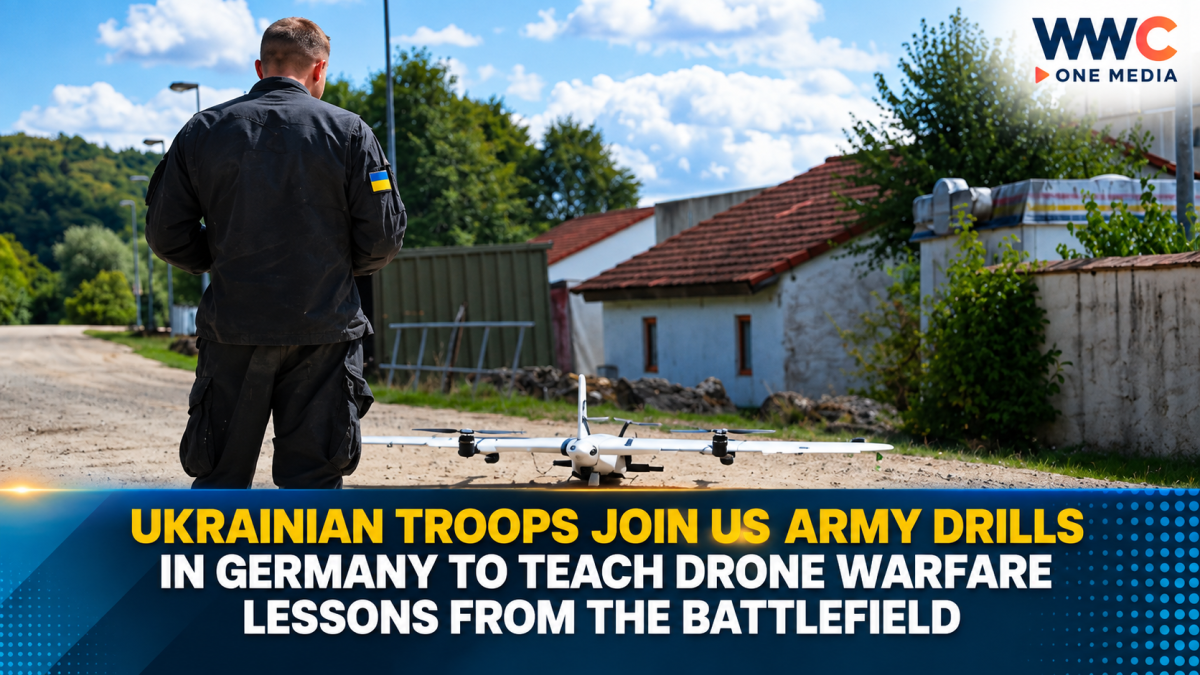
Ukrainian military personnel have embedded with US troops during major exercises in Germany, giving American soldiers firsthand lessons in the rapidly evolving tactics of drone warfare developed during the war against Russia.
The cooperation took place during the US Army’s Saber Junction exercises at the Hohenfels training area in Germany, where Ukrainian personnel joined American forces to demonstrate how drones are being used for reconnaissance, targeting and attacks on the modern battlefield.
The training comes as the US Army seeks to adapt to a battlefield where relatively inexpensive unmanned aircraft can expose troop movements, locate armoured vehicles and rapidly pass targeting information to strike forces.
About 1,900 drones were used during the exercises, underscoring how extensively unmanned systems have become integrated into military training.
Ukraine’s battlefield experience becomes a training tool
Ukraine has spent more than four years fighting a war in which drones have become central to nearly every stage of combat.
Both Ukrainian and Russian forces routinely use unmanned aircraft for surveillance, artillery spotting, electronic warfare and direct attacks. Ukraine has also developed specialised drone units and rapidly adapted its tactics as Russia has introduced new countermeasures.
That battlefield experience is now being used to help American forces understand what a drone-heavy conflict could look like.
Ukrainian troops participating in the German exercises were able to demonstrate tactics based on lessons learned in actual combat rather than solely from simulated scenarios.
US troops have already experienced the difference
The latest training follows another US-Ukrainian exercise in Germany that attracted attention after Ukrainian drone operators were able to detect and engage American units during simulated combat.
Reports from that exercise said Ukrainian operators repeatedly located US forces and demonstrated how difficult it can be for conventional units to conceal themselves when operating under persistent drone surveillance.
US commanders have since pushed back against descriptions that the exercise simply showed American forces being “destroyed” by Ukrainian drones.
One US company commander said the exercise instead demonstrated how American troops could adapt their tactics after facing Ukrainian drone teams. He said Ukrainian reconnaissance drones forced his unit to change how it moved, concealed itself and operated its armoured vehicles.
The experience nevertheless highlighted a major challenge for the US military: equipment and tactics designed for previous forms of warfare may not be sufficient against an opponent capable of maintaining constant drone surveillance.
The battlefield is changing
For decades, tanks, armoured vehicles and infantry formations formed the core of ground combat.
Drones have changed that equation.
Small unmanned aircraft can be relatively cheap compared with the vehicles they threaten, while their ability to provide real-time information means troops can potentially be detected long before they see the enemy.
That creates a difficult calculation for military planners.
A heavily armoured vehicle may provide protection and mobility, but once its location is identified by drones, it can become vulnerable to artillery, missiles or attack drones.
The US Army is therefore testing ways to incorporate drones and counter-drone systems throughout its formations rather than treating unmanned warfare as the responsibility of a small specialist unit.
US Army rethinks how drones should be organised
The Army’s approach is still evolving.
A specialised drone-focused battalion within the 173rd Airborne Brigade was created as an experiment to explore how unmanned systems could be integrated into combat formations.
The unit is now being returned to a more traditional airborne infantry role, but Army officials have said the experiment was intended to spread drone expertise throughout the wider force rather than permanently concentrate it in one specialised formation.
That reflects a broader debate inside the military over whether drone warfare should be handled by dedicated units or embedded throughout conventional formations.
Ukraine’s experience strongly favours the latter approach, with drones increasingly treated as an ordinary part of combat operations rather than a niche capability.
Lessons extend beyond drones
The exercises are also giving US commanders a closer look at how conventional forces can survive and operate when drones are constantly present overhead.
US troops have experimented with concealment, dispersal, movement and other techniques intended to reduce their electronic and visual signatures.
The goal is not simply to acquire more drones, but to rethink how soldiers, tanks, artillery and command units operate when an enemy can potentially observe them from above at almost any time.
Ukrainian battlefield experience is particularly valuable because these tactics are being tested under real combat conditions against a technologically capable opponent.
A glimpse of future warfare
The growing cooperation between Ukrainian and US forces highlights how quickly battlefield technology is changing.
For Ukraine, drone warfare has become a matter of survival. For the United States and other NATO militaries, the conflict has become an unprecedented source of information about what a large-scale, drone-saturated war could look like.
The lessons coming out of Germany are therefore about more than one military exercise.
They point to a broader transformation in modern warfare, where the ability to detect an enemy, hide from drones and rapidly connect surveillance to a strike may be just as important as the number of tanks or soldiers a force can deploy.
For the US Army, Ukrainian troops are providing something that conventional training exercises cannot easily replicate: years of hard-earned experience from a battlefield where drone warfare has already become the norm.




Leave a Reply