
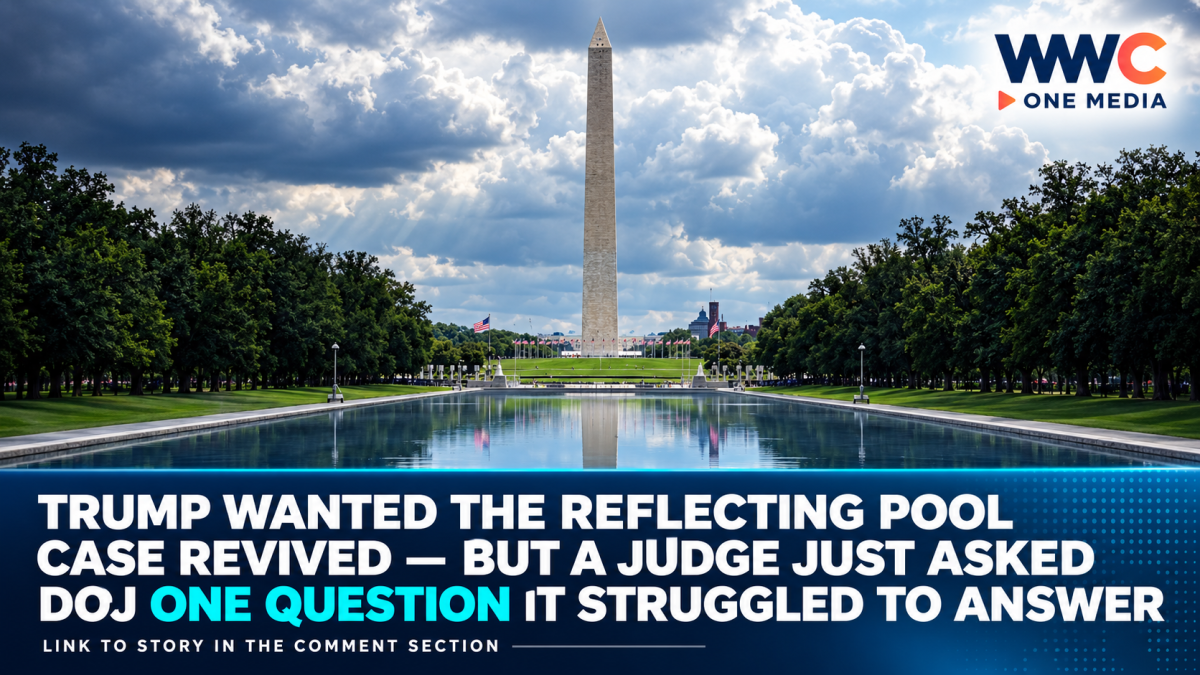
Former U.S. Olympic canoeist David Hearn thought his Reflecting Pool prosecution was effectively over when the Justice Department admitted it could not prove its felony case. Now a Washington judge is deciding whether to close the door permanently — as President Donald Trump continues to insist that vandals, not just faulty construction, were responsible for damage to one of Washington’s best-known landmarks.
WASHINGTON — A criminal case that began with allegations of vandalism at the Lincoln Memorial Reflecting Pool has evolved into a much larger confrontation over prosecutorial discretion, political pressure and the Trump administration’s handling of a costly renovation project.
On Friday, D.C. Superior Court Judge Todd Edelman heard arguments over whether the dismissed felony case against former Olympian David “Davey” Hearn should be dismissed with prejudice, a legal step that would prevent prosecutors from reviving the same felony prosecution.
Edelman did not issue an immediate ruling. Instead, he took the matter under advisement and said a decision would come soon.
But his questioning made clear why the case has become politically explosive.
According to courtroom reporting, Edelman pressed Justice Department lawyers to explain why the government should preserve the option of prosecuting Hearn again after prosecutors themselves acknowledged they could not prove the charged felony beyond a reasonable doubt.
The Case Against Hearn Fell Apart
Hearn, 67, is a three-time U.S. Olympic canoeist who competed in the 1992, 1996 and 2000 Summer Olympics.
He was arrested in June after stopping at the Reflecting Pool during a bicycle ride. Prosecutors later accused him of forcefully pulling at part of the newly installed blue coating on the bottom of the pool.
Hearn denied damaging it. He has said he merely touched a section that was already peeling away.
U.S. Attorney Jeanine Pirro’s office initially escalated the matter into a felony destruction-of-property prosecution.
Then the government’s own evidence began undermining the case.
In a July 31 filing, federal prosecutors acknowledged that documents provided after Hearn had already been indicted indicated that the widespread deterioration of the Reflecting Pool lining resulted from a flawed and rushed installation, rather than the vandalism originally blamed for the damage.
The Justice Department consequently asked for the indictment to be dismissed.
Judge Edelman formally dismissed it on August 6 but left unresolved a crucial question: whether the dismissal should be with prejudice or without prejudice.
That seemingly technical distinction now sits at the heart of the controversy.
Why “With Prejudice” Matters
A dismissal without prejudice leaves prosecutors with the possibility of bringing charges again if legally sufficient new evidence emerges.
A dismissal with prejudice would prevent the government from reviving the dismissed felony case based on the same alleged conduct.
Hearn’s attorneys argue that only a permanent dismissal can protect him from another prosecution driven by political pressure rather than new evidence.
Federal prosecutors disagree. They have argued that dismissal without prejudice is appropriate and that the possibility of new evidence should not automatically be eliminated.
Friday’s courtroom exchange highlighted how unusual that dispute has become.
When Edelman asked what future prosecution could realistically occur, Assistant U.S. Attorney Michael Spence said answering would require speculation.
Spence also told the court that Hearn is not currently under investigation.
But he added that the situation theoretically could change “10 minutes from now.”
That answer immediately sharpened the central question facing the judge: Why should Hearn remain exposed to another prosecution when the Justice Department has already acknowledged serious problems with its original case?
Trump’s Public Pressure Is Now Part of the Legal Argument
Normally, a disagreement over whether charges should be dismissed with or without prejudice would remain largely confined to court filings.
This case is different because President Trump has repeatedly weighed in publicly.
Trump has strongly disagreed with Pirro’s decision to abandon the prosecution, saying she “choked” and “folded like an umbrella.” He has urged her to reconsider and continued to argue that vandals caused significant damage to the pool.
That pressure has become part of Hearn’s legal argument.
His lawyers contend that leaving open the possibility of a new prosecution would expose him to continuing political pressure from the highest level of the executive branch.
Judge Edelman directly confronted that issue Friday.
According to courtroom reporting, he asked prosecutors how Trump’s statements could be interpreted as anything other than the president urging prosecution of a case that the U.S. Attorney’s Office had already concluded it could not prove.
The prosecutor did not offer a detailed interpretation of Trump’s comments, instead noting the president’s authority over executive-branch officials.
The White House Previously Asked DOJ to Look at New Charges
The concern is not hypothetical.
Reuters reported in August that the White House had asked Justice Department officials to examine whether additional charges could be brought against Hearn after Pirro’s office dropped the original case.
The discussions reportedly involved DOJ’s Criminal Division and included the possibility of a misdemeanor case, though they were preliminary and no final charging decision had been reached.
The Wall Street Journal separately reported similar discussions, describing White House outreach to the Justice Department about whether a new prosecution was possible.
That background helps explain why Hearn’s attorneys are fighting so aggressively for a permanent dismissal.
Without it, they argue, the legal cloud could remain over their client even after prosecutors effectively dismantled their own original case.
Pirro’s Office Made a Remarkable Reversal
The episode is also notable because Pirro originally spoke forcefully about the prosecution.
Her office alleged Hearn had aggressively pulled at the coating and damaged government property.
Weeks later, however, the government filed a detailed motion saying information received from the Department of the Interior showed that installation problems had existed independently of Hearn.
The filing said prosecutors had originally been given incomplete information and that later documents showed problems associated with the rushed renovation.
CBS News reported that prosecutors discovered documentation showing the liner had experienced failures during a hurried installation process ahead of the United States’ 250th anniversary celebrations.
That reversal turned what initially appeared to be a straightforward property-damage prosecution into an embarrassment for multiple parts of the administration.
And the Reflecting Pool Problems Haven’t Ended
The criminal controversy comes as the Reflecting Pool itself continues to require additional work.
The renovation involved approximately $14.7 million for Atlantic Industrial Coatings, the contractor responsible for the resurfacing work that prosecutors later described as flawed.
More recently, the administration awarded approximately $2.65 million to American Ag Energy for additional work connected to water treatment and algae problems at the pool.
The pool had suffered renewed algae growth even after the highly publicized renovation intended to give its surface an “American Flag Blue” appearance.
That matters because it further complicates the original political narrative that vandals were primarily responsible for the landmark’s problems.
The government’s own criminal filing attributed the damage relevant to Hearn’s case to installation failures, while Trump and some administration officials have continued to say vandalism occurred elsewhere. Those two propositions are not necessarily mutually exclusive — but prosecutors have acknowledged they could not prove the felony charge brought against Hearn.
The Bigger Story Is No Longer About a Pool
What started as a dispute over peeling material at a Washington landmark has become a test of something considerably larger.
The question before Judge Edelman is not whether Hearn has been convicted. He has not.
Nor is the original felony charge currently pending. It has already been dismissed.
The unresolved question is whether prosecutors should retain the power to bring it back.
And Trump’s repeated public demands have transformed that procedural decision into a broader debate over how much political pressure a president should exert on individual criminal prosecutions.
For Hearn, Friday’s hearing was about closure.
For the Justice Department, it was about retaining prosecutorial flexibility.
For the White House, it remains connected to Trump’s insistence that vandalism contributed to the Reflecting Pool fiasco.
But after the government acknowledged flaws in the evidence behind the original indictment, Judge Edelman is now confronting the question at the center of the entire saga:
If prosecutors cannot identify a viable case today, why should they be allowed to keep the threat of one alive tomorrow?
WWC ONE MEDIA M.J.E




Leave a Reply