
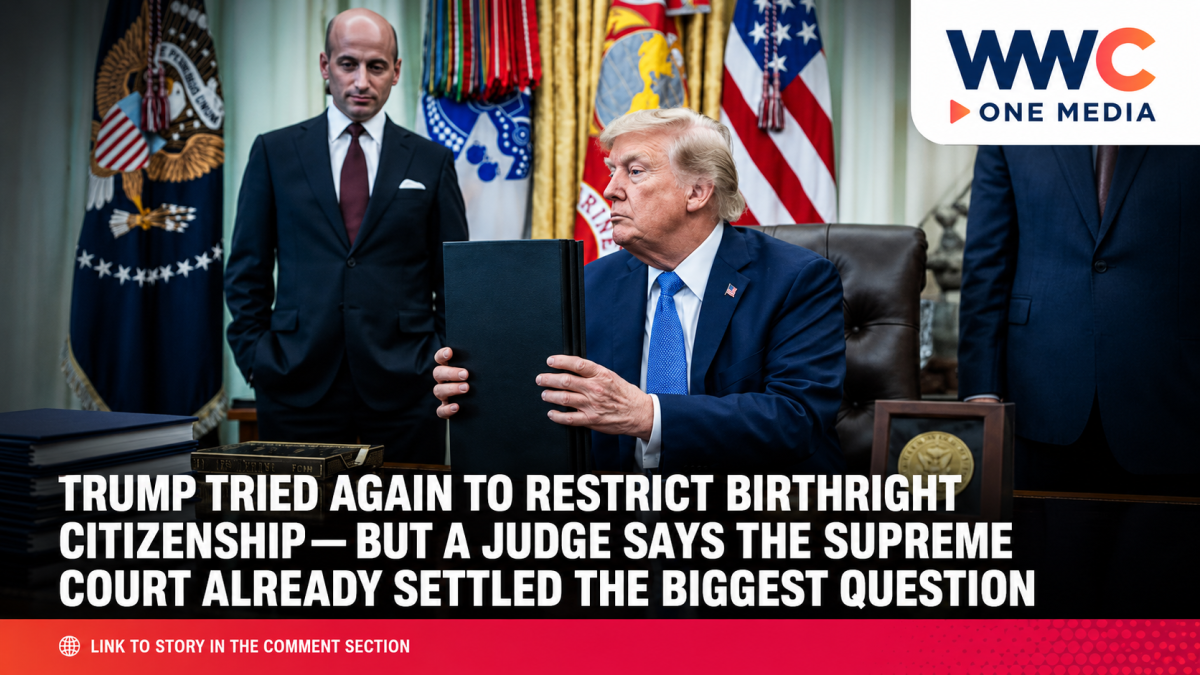
WASHINGTON — President Donald Trump’s renewed attempt to narrow birthright citizenship has suffered another courtroom setback, just weeks after his administration redesigned its policy following a major defeat at the U.S. Supreme Court.
U.S. District Judge Deborah Boardman in Maryland issued a preliminary injunction Wednesday preventing federal agencies from denying or refusing to recognize the citizenship of people covered by an existing class-action lawsuit challenging the administration’s policy.
For Trump, the ruling marks the latest obstacle in a legal battle that has become one of the most consequential tests of presidential authority over immigration and the meaning of the U.S. Constitution’s 14th Amendment.
Boardman said Trump’s latest executive order was “almost certainly unconstitutional” as applied to the certified class, pointing directly to the Supreme Court’s June 30 decision affirming citizenship rights for children born in the United States to parents who are unlawfully or temporarily present in the country.
The injunction prevents agencies including the State Department, Department of Homeland Security and Social Security Administration from interfering with or refusing to recognize the citizenship of individuals protected by the lawsuit while the case proceeds.
Trump Tried a Narrower Approach After Losing at the Supreme Court
The latest confrontation began after the Supreme Court ruled 6-3 on June 30 in Trump v. Barbara.
The case centered on Trump’s January 2025 executive order seeking to deny automatic citizenship to certain children born in the United States when their parents were neither American citizens nor lawful permanent residents.
The Supreme Court held that children born in the United States to parents who are unlawfully or temporarily present are generally “subject to the jurisdiction” of the United States and therefore citizens at birth under the Citizenship Clause of the 14th Amendment.
Rather than abandoning the issue, Trump returned on August 6 with a more targeted executive order.
Executive Order 14418 instructed federal agencies not to recognize citizenship in several specified circumstances when neither parent is a U.S. citizen.
The categories included certain children whose parents are classified as “alien enemies,” some foreign government employees, cases involving alleged fraud or commercial arrangements designed to obtain citizenship, and births in U.S. territories where citizenship is not conferred by federal statute.
A separate order, Executive Order 14419, focused specifically on what the administration calls “birth tourism” — entering the United States on a nonimmigrant visa for the purpose of giving birth on American soil.
The order authorized the State and Homeland Security departments to consider measures including visa denial, visa revocation and entry restrictions against people found to be participating in or facilitating such arrangements.
The Administration Says the New Policy Is Different
The Trump administration argues that its August policy is substantially narrower than the sweeping citizenship restrictions struck down earlier.
Justice Department lawyers also argued that the latest challenge came too soon because federal agencies had not yet completed the public guidance explaining exactly how the new executive order would be implemented.
Reuters reported that draft State Department guidance could require parents applying for U.S. passports for their children to provide documentation showing the parents’ citizenship or immigration status.
That implementation question matters because the administration could argue in future litigation that some applications of the order fall within historically recognized exceptions to birthright citizenship.
The White House itself said when announcing the August measures that the orders were designed to operate within exceptions it believes were recognized by the Supreme Court while combating alleged abuse of the visa system.
The Judge Was Not Persuaded
Boardman rejected the argument that the court should simply wait for agencies to finish writing their rules.
Her reasoning was straightforward: regardless of how the administration ultimately drafts its guidance, the executive order already commands agencies to deny citizenship recognition in circumstances that could cover children whom the Supreme Court has already declared citizens at birth.
That was enough, in her view, to justify court intervention.
The plaintiffs include immigrant-rights organizations CASA and the Asylum Seeker Advocacy Project, groups that were also involved in earlier litigation over Trump’s original citizenship order.
Why Birthright Citizenship Is So Difficult to Change
At the center of the fight is one sentence written into the Constitution more than 150 years ago.
The 14th Amendment states that people born or naturalized in the United States and “subject to the jurisdiction thereof” are U.S. citizens.
Congress has also codified birthright citizenship in federal law.
The Supreme Court noted in its June decision that Congress has repeatedly considered legislation that would change the rules governing birthright citizenship but has not enacted such a change. Justice Brett Kavanaugh, writing separately, said the previous Trump order also conflicted with existing federal citizenship law unless Congress changes it.
There are historically recognized exceptions, including some children of foreign diplomats and children born during hostile military occupation.
But the central dispute has been whether presidents can dramatically expand those exceptions through executive action.
So far, courts have repeatedly resisted that approach.
This Ruling Does Not End the Battle
The latest decision is a preliminary injunction, not a final judgment on every possible application of Trump’s August executive orders.
It also specifically addresses protections for the certified class in the ongoing lawsuit.
That distinction could become important if the administration appeals or attempts to enforce parts of the order against individuals who fall outside that class.
The White House had not immediately responded to Reuters’ request for comment following Boardman’s ruling.
And the administration still possesses several legal options, including appealing the injunction and arguing that particular categories identified in the August order fall within constitutional exceptions recognized by prior court decisions.
But the political and constitutional problem facing Trump is becoming increasingly clear.
His administration is no longer simply fighting immigrant-rights groups or lower-court judges.
It is trying to determine how much room remains for executive action after the Supreme Court itself issued a major ruling establishing that a broad group of U.S.-born children are citizens from the moment they are born.
That means the next chapter may not simply be about whether Trump can restrict birthright citizenship — but whether any president can significantly redefine who is an American without Congress changing the law or the Constitution itself.
WWC ONE MEDIA MJE



Leave a Reply