
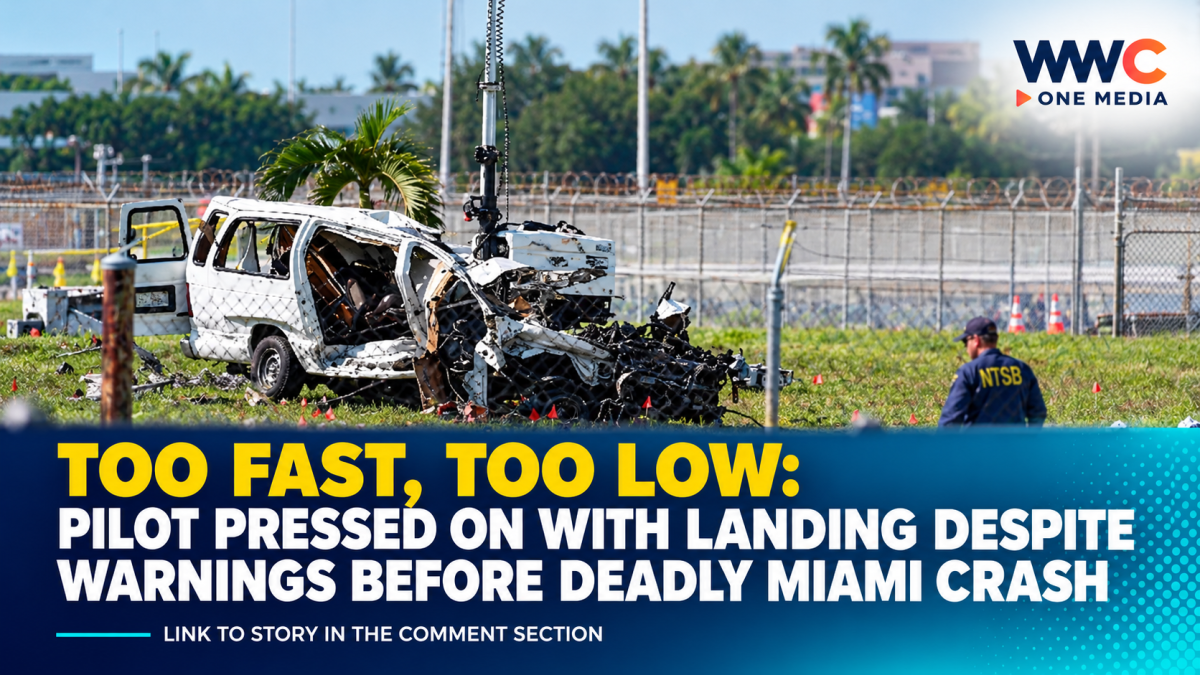
MIAMI — The pilots of an Amazon-contracted cargo jet pressed ahead with their landing at Miami International Airport despite repeated warnings that the aircraft was coming in too fast and descending dangerously low, according to preliminary information released by US investigators.
The Boeing 767 cargo aircraft overran the runway and crashed into vehicles after landing, killing five people and injuring five others. The National Transportation Safety Board is now examining why the crew continued with an unstable approach instead of aborting the landing and attempting another approach.
Warnings Sounded in the Cockpit
Cockpit recordings and flight data reviewed by investigators showed that one of the pilots raised concerns about the aircraft’s speed as it approached the runway.
Automated warnings also sounded in the cockpit, including alerts about the aircraft’s descent rate and its proximity to the ground.
Despite the warnings, the approach continued.
Investigators are now focusing on why the crew did not execute a go-around, a standard procedure in which a pilot abandons a landing attempt and climbs away to prepare for another approach.
A Landing That Went Wrong
The aircraft eventually touched down too far along the runway, leaving insufficient distance to safely stop.
Investigators said there was a brief attempt to increase power after touchdown, suggesting the crew may have tried to abort the landing at the last moment. However, the aircraft continued forward, overran the runway and crashed into vehicles beyond the airport.
The crash killed five people and left five others injured.
Key Braking Systems Under Scrutiny
The investigation has also turned attention to the aircraft’s braking and deceleration systems.
Preliminary data indicated that the aircraft’s speed brakes and thrust reversers did not deploy during the landing sequence, although the wheel brakes were applied.
Investigators have not determined whether the systems failed mechanically or whether they were not activated by the crew. That remains part of the ongoing investigation.
Crew Coordination a Major Focus
The NTSB is also examining communication and coordination between the two pilots.
One pilot reportedly expressed concern about the excessive speed, while investigators are looking at how the warnings were handled and whether the crew followed established procedures for an unstable approach.
Both pilots had received their Boeing 767 type ratings relatively recently, and investigators are expected to interview them as part of the inquiry.
Investigation Continues
The cargo jet was operated by 21 Air for Amazon’s Prime Air network and had arrived in Miami from San Juan, Puerto Rico.
Investigators are examining a range of factors, including pilot actions, aircraft systems, weather conditions, operational procedures and the aircraft’s performance during the approach and landing.
The NTSB has stressed that its investigation is ongoing and that no final cause has yet been determined.
The Bottom Line
The deadly Miami cargo jet crash is increasingly raising questions about why the pilots continued their landing despite warnings that the aircraft was too fast and too low.
Investigators are now examining the crew’s decision-making, cockpit coordination and the failure of key deceleration systems to deploy.
Five people were killed when the aircraft ran off the runway — and the central question now facing investigators is why the crew pressed on with a landing that showed multiple signs of danger.
WWC ONE MEDIA J.M.D




Leave a Reply